

A. desmarestii, checking the acute effect of increasing concentrations of the mixture.
For both species, an RQ was calculated according to Eq. (5). In the case of
T. battagliai, the risk associated with DF and IB individually and to their mixture
was 0.0205, 0.0152, and 0.0357, respectively. Similarly, RQs obtained for
A. desmarestii were 0.127, 0.752, and 0.879, respectively, for DF, IB, and their
mixture. We can observe that in both cases, the values obtained for the mixture were
higher than that obtained for the individual compounds, and this result can be
interpreted as a higher risk associated with the exposure to the mixture. However,
due the fact that the difference between the RQ values is not very large, the risk
associated with the mixture, according to the classification system used above, is the
same as the risk observed for individual compounds: low risk for T. battagliai and
medium risk for A. desmarestii. Similar results were found by Sathishkumar et al.
[77] who in their review work on the occurrence, effects, and ecological risk of DF in
various environmental matrices indicate that this drug represents a low to medium
risk for organisms in surface waters, having RQ values between 0 and 1.0. Additionally, the authors indicated a potential greater impact of DF in seawater organisms
(RQ values higher than one). The RQ values found in the literature for IB vary
between <0.01 and >1 depending on environmental concentrations (MEC or PEC)
used in the RQ calculation, model organism, and endpoint selected [31, 78–
81]. Therefore, data found for both anti-inflammatories indicates that the RQ values
and the associated potential risk depend on the site-specific concentration and the
specific species considered.
Laboratory assays can help evaluate the toxic effects of drugs in the more
complex case of the real aquatic environment where many compounds are present
simultaneously. However, the study of the mixture effects implies a significant
investment in economic and time terms, in addition to the ethical implications, due
to the number of organisms that would be necessary to sacrifice. In this context, it is
therefore useful to use models to predict mixture toxicity, extrapolating toxicological
parameters such as LC 50 and consequently the potential risk (by RQ calculation)
associated with different mixtures. Trombini et al. [21] and Nieto et al. [19] used the
models CA and IA to predict toxic effects of the mixture of DF and IB on
T. battagliai and A. desmarestii and compared experimental and predicted results
to check the effectiveness of both models. According to the theoretical basis of
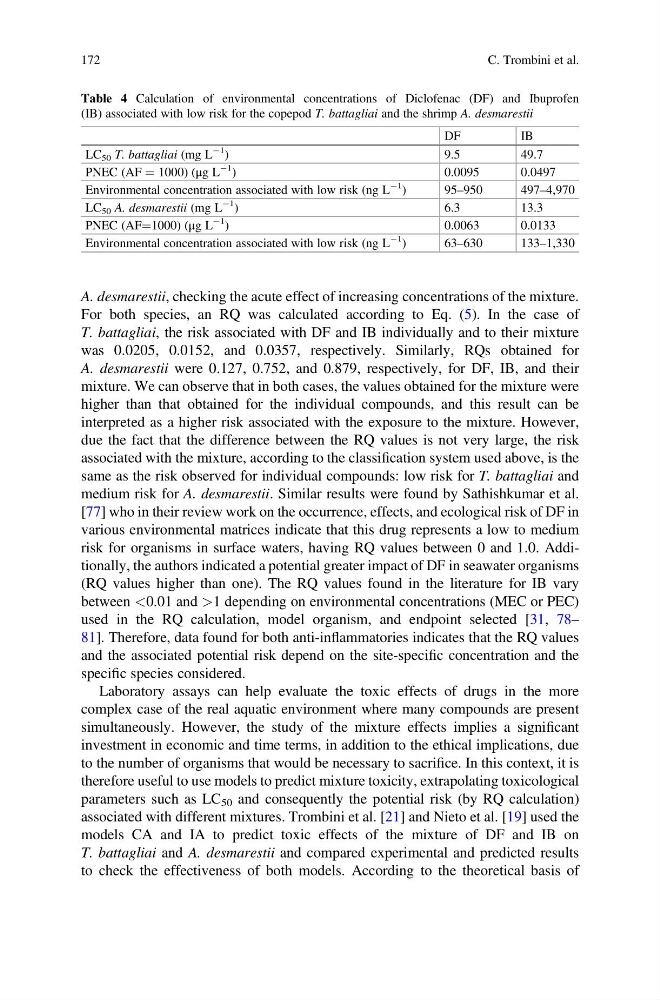
Table 4 Calculation of environmental concentrations of Diclofenac (DF) and Ibuprofen
(IB) associated with low risk for the copepod T. battagliai and the shrimp A. desmarestii
DF
IB
LC 50 T. battagliai (mg L
À1
)
9.5
49.7
PNEC (AF ¼ 1000) (μg L
À1 )
0.0095
0.0497
Environmental concentration associated with low risk (ng L
À1
)
9 5 –950
497–4,970
LC 50 A. desmarestii (mg L
À1
)
6.3
13.3
PNEC (AF¼1000) (μg L
À1
)
0.0063
0.0133
Environmental concentration associated with low risk (ng L
À1
)
6 3 –630
133–1,330
172
C. Trombini et al.
For both species, an RQ was calculated according to Eq. (5). In the case of
T. battagliai, the risk associated with DF and IB individually and to their mixture
was 0.0205, 0.0152, and 0.0357, respectively. Similarly, RQs obtained for
A. desmarestii were 0.127, 0.752, and 0.879, respectively, for DF, IB, and their
mixture. We can observe that in both cases, the values obtained for the mixture were
higher than that obtained for the individual compounds, and this result can be
interpreted as a higher risk associated with the exposure to the mixture. However,
due the fact that the difference between the RQ values is not very large, the risk
associated with the mixture, according to the classification system used above, is the
same as the risk observed for individual compounds: low risk for T. battagliai and
medium risk for A. desmarestii. Similar results were found by Sathishkumar et al.
[77] who in their review work on the occurrence, effects, and ecological risk of DF in
various environmental matrices indicate that this drug represents a low to medium
risk for organisms in surface waters, having RQ values between 0 and 1.0. Additionally, the authors indicated a potential greater impact of DF in seawater organisms
(RQ values higher than one). The RQ values found in the literature for IB vary
between <0.01 and >1 depending on environmental concentrations (MEC or PEC)
used in the RQ calculation, model organism, and endpoint selected [31, 78–
81]. Therefore, data found for both anti-inflammatories indicates that the RQ values
and the associated potential risk depend on the site-specific concentration and the
specific species considered.
Laboratory assays can help evaluate the toxic effects of drugs in the more
complex case of the real aquatic environment where many compounds are present
simultaneously. However, the study of the mixture effects implies a significant
investment in economic and time terms, in addition to the ethical implications, due
to the number of organisms that would be necessary to sacrifice. In this context, it is
therefore useful to use models to predict mixture toxicity, extrapolating toxicological
parameters such as LC 50 and consequently the potential risk (by RQ calculation)
associated with different mixtures. Trombini et al. [21] and Nieto et al. [19] used the
models CA and IA to predict toxic effects of the mixture of DF and IB on
T. battagliai and A. desmarestii and compared experimental and predicted results
to check the effectiveness of both models. According to the theoretical basis of
Table 4 Calculation of environmental concentrations of Diclofenac (DF) and Ibuprofen
(IB) associated with low risk for the copepod T. battagliai and the shrimp A. desmarestii
DF
IB
LC 50 T. battagliai (mg L
À1
)
9.5
49.7
PNEC (AF ¼ 1000) (μg L
À1 )
0.0095
0.0497
Environmental concentration associated with low risk (ng L
À1
)
9 5 –950
497–4,970
LC 50 A. desmarestii (mg L
À1
)
6.3
13.3
PNEC (AF¼1000) (μg L
À1
)
0.0063
0.0133
Environmental concentration associated with low risk (ng L
À1
)
6 3 –630
133–1,330
172
C. Trombini et al.