

tested concentration (637 ng/L). DCF toxicity of gastropods was assessed by
exposing Lymnaea stagnalis specimens for 3 days to environmental realistic
(1–10 μg/L) and therapeutic concentrations (100–1,000 μg/L) of DCF [37]. Effects
on immune parameters of individual snails were measured, namely, hemocyte
density and viability, hemocyte phagocytosis capacity, and hemocyte-related oxidative activities (basal and NADPH-oxidase). Diclofenac induced immune responses,
while no immunosuppression was observed. DCF significantly affected the
immunocapacity and the immunoefficiency of the snails’ hemocytes. This effect is
typical of an inflammatory response, confirmed by the increase of the NADPHoxidase activity, mainly at 1,000 μg/L. The effects of exposure to DCF towards the
Chironomus riparius was assessed through an experiment using spiked sediment
[38]. A 10-day chronic toxicity test with C. riparius was performed to assess effects
on survival, growth, and developmental stage, in terms of biomass, as well as
emergence rates and sex ratio after 21 days of exposure. No effects on survival
and no change in the sex ratio was induced by DCF exposure. In contrast, DCF
decreased the emergence ratio in organisms exposed at concentrations of 34.0 μg/g
of DCF.
2.3 Effects Induced by Ibuprofen Exposure
Acute and chronic toxicity of ibuprofen (IBU) towards non-target, freshwater
invertebrates has been investigated on crustaceans (Daphnia magna), cnidarian
(Hydra vulgaris), bivalves (Dreissena polymorpha and Corbicula fluminea), and
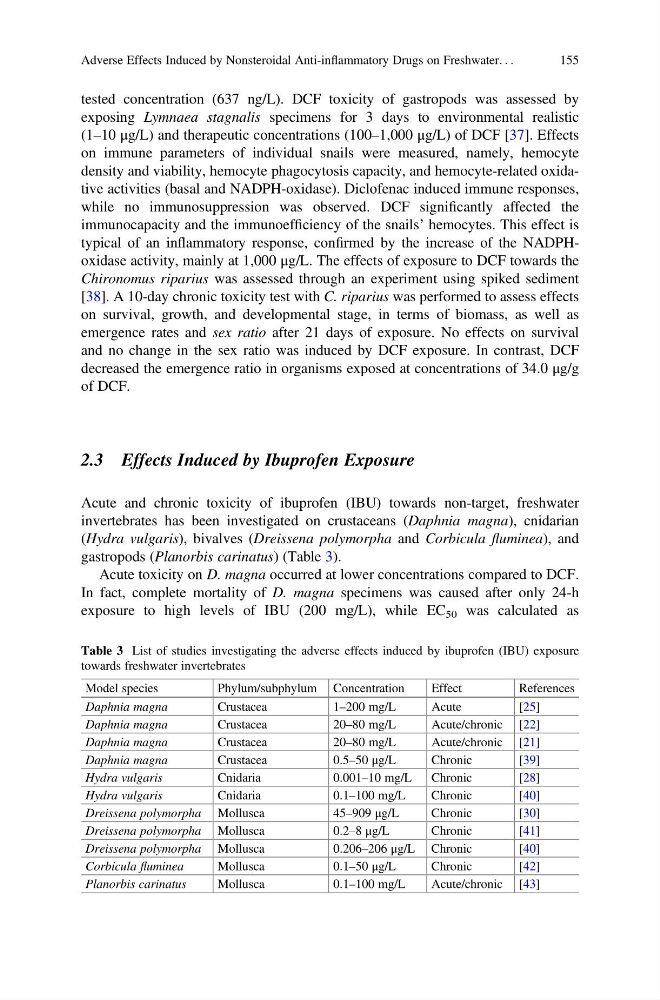
gastropods (Planorbis carinatus) (Table 3).
Acute toxicity on D. magna occurred at lower concentrations compared to DCF.
In fact, complete mortality of D. magna specimens was caused after only 24-h
exposure to high levels of IBU (200 mg/L), while EC 50 was calculated as
Table 3 List of studies investigating the adverse effects induced by ibuprofen (IBU) exposure
towards freshwater invertebrates
Model species
Phylum/subphylum Concentration
Effect
References
Daphnia magna
Crustacea
1–200 mg/L
Acute
[25]
Daphnia magna
Crustacea
20–80 mg/L
Acute/chronic [22]
Daphnia magna
Crustacea
20–80 mg/L
Acute/chronic [21]
Daphnia magna
Crustacea
0.5–50 μg/L
Chronic
[39]
Hydra vulgaris
Cnidaria
0.001–10 mg/L
Chronic
[28]
Hydra vulgaris
Cnidaria
0.1–100 mg/L
Chronic
[40]
Dreissena polymorpha Mollusca
45–909 μg/L
Chronic
[30]
Dreissena polymorpha Mollusca
0.2–8 μg/L
Chronic
[41]
Dreissena polymorpha Mollusca
0.206–206 μg/L Chronic
[40]
Corbicula fluminea
Mollusca
0.1–50 μg/L
Chronic
[42]
Planorbis carinatus
Mollusca
0.1–100 mg/L
Acute/chronic [43]
Adverse Effects Induced by Nonsteroidal Anti-inflammatory Drugs on Freshwater. . .
155
exposing Lymnaea stagnalis specimens for 3 days to environmental realistic
(1–10 μg/L) and therapeutic concentrations (100–1,000 μg/L) of DCF [37]. Effects
on immune parameters of individual snails were measured, namely, hemocyte
density and viability, hemocyte phagocytosis capacity, and hemocyte-related oxidative activities (basal and NADPH-oxidase). Diclofenac induced immune responses,
while no immunosuppression was observed. DCF significantly affected the
immunocapacity and the immunoefficiency of the snails’ hemocytes. This effect is
typical of an inflammatory response, confirmed by the increase of the NADPHoxidase activity, mainly at 1,000 μg/L. The effects of exposure to DCF towards the
Chironomus riparius was assessed through an experiment using spiked sediment
[38]. A 10-day chronic toxicity test with C. riparius was performed to assess effects
on survival, growth, and developmental stage, in terms of biomass, as well as
emergence rates and sex ratio after 21 days of exposure. No effects on survival
and no change in the sex ratio was induced by DCF exposure. In contrast, DCF
decreased the emergence ratio in organisms exposed at concentrations of 34.0 μg/g
of DCF.
2.3 Effects Induced by Ibuprofen Exposure
Acute and chronic toxicity of ibuprofen (IBU) towards non-target, freshwater
invertebrates has been investigated on crustaceans (Daphnia magna), cnidarian
(Hydra vulgaris), bivalves (Dreissena polymorpha and Corbicula fluminea), and
gastropods (Planorbis carinatus) (Table 3).
Acute toxicity on D. magna occurred at lower concentrations compared to DCF.
In fact, complete mortality of D. magna specimens was caused after only 24-h
exposure to high levels of IBU (200 mg/L), while EC 50 was calculated as
Table 3 List of studies investigating the adverse effects induced by ibuprofen (IBU) exposure
towards freshwater invertebrates
Model species
Phylum/subphylum Concentration
Effect
References
Daphnia magna
Crustacea
1–200 mg/L
Acute
[25]
Daphnia magna
Crustacea
20–80 mg/L
Acute/chronic [22]
Daphnia magna
Crustacea
20–80 mg/L
Acute/chronic [21]
Daphnia magna
Crustacea
0.5–50 μg/L
Chronic
[39]
Hydra vulgaris
Cnidaria
0.001–10 mg/L
Chronic
[28]
Hydra vulgaris
Cnidaria
0.1–100 mg/L
Chronic
[40]
Dreissena polymorpha Mollusca
45–909 μg/L
Chronic
[30]
Dreissena polymorpha Mollusca
0.2–8 μg/L
Chronic
[41]
Dreissena polymorpha Mollusca
0.206–206 μg/L Chronic
[40]
Corbicula fluminea
Mollusca
0.1–50 μg/L
Chronic
[42]
Planorbis carinatus
Mollusca
0.1–100 mg/L
Acute/chronic [43]
Adverse Effects Induced by Nonsteroidal Anti-inflammatory Drugs on Freshwater. . .
155