

3.4 Pressure Drop Surveys
69
In the leapfrogging method, both instruments are located underground and readings are performed simultaneously, so correction for atmospheric pressure changes
does not need to be performed. First, a number of measuring stations are fixed, and
then, the two barometers are moved along the stations such that the downstream
barometer used for one pair of measurements becomes the upstream barometer of
the next pair.
Barometer surveys can be approximated employing Bernoulli equation between
the two measuring points as if air were incompressible and velocity pressure changes
negligible. The frictionless pressure drop (P 2 calc ) can be approximated according
to Hall (1981) and Prosser and Loomis (2004) as:
P 2 calc = P 2
2P 1 + Dgρ 1
2P 2 − Dgρ 2
(3.2)
• P 1 : Barometric pressure at station 1 (Pa),
• P 2 : Barometric pressure at station 2 (Pa),
• ρ 1 : Air density at station 1 (kg m
−3 ),
• ρ 2 : Air density at station 2 (kg m
−3 ), and
• D: Depth below datum (m).
Then, the frictional pressure drop (P 12 ) is given by:
P 12 = P 2 calc − P 2
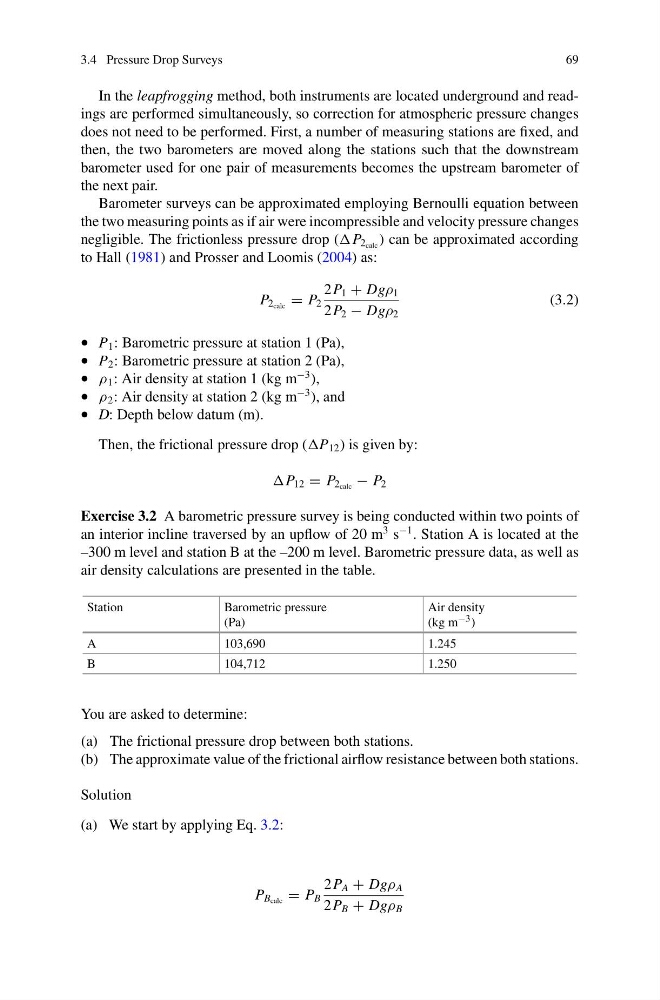
Exercise 3.2 A barometric pressure survey is being conducted within two points of
an interior incline traversed by an upflow of 20 m
3 s
−1 . Station A is located at the
–300 m level and station B at the –200 m level. Barometric pressure data, as well as
air density calculations are presented in the table.
Station
Barometric pressure
(Pa)
Air density
(kg m −3 )
A
103,690
1.245
B
104,712
1.250
You are asked to determine:
(a) The frictional pressure drop between both stations.
(b) The approximate value of the frictional airflow resistance between both stations.
Solution
(a) We start by applying Eq. 3.2:
P B calc = P B
2P A + Dgρ A
2P B + Dgρ B
69
In the leapfrogging method, both instruments are located underground and readings are performed simultaneously, so correction for atmospheric pressure changes
does not need to be performed. First, a number of measuring stations are fixed, and
then, the two barometers are moved along the stations such that the downstream
barometer used for one pair of measurements becomes the upstream barometer of
the next pair.
Barometer surveys can be approximated employing Bernoulli equation between
the two measuring points as if air were incompressible and velocity pressure changes
negligible. The frictionless pressure drop (P 2 calc ) can be approximated according
to Hall (1981) and Prosser and Loomis (2004) as:
P 2 calc = P 2
2P 1 + Dgρ 1
2P 2 − Dgρ 2
(3.2)
• P 1 : Barometric pressure at station 1 (Pa),
• P 2 : Barometric pressure at station 2 (Pa),
• ρ 1 : Air density at station 1 (kg m
−3 ),
• ρ 2 : Air density at station 2 (kg m
−3 ), and
• D: Depth below datum (m).
Then, the frictional pressure drop (P 12 ) is given by:
P 12 = P 2 calc − P 2
Exercise 3.2 A barometric pressure survey is being conducted within two points of
an interior incline traversed by an upflow of 20 m
3 s
−1 . Station A is located at the
–300 m level and station B at the –200 m level. Barometric pressure data, as well as
air density calculations are presented in the table.
Station
Barometric pressure
(Pa)
Air density
(kg m −3 )
A
103,690
1.245
B
104,712
1.250
You are asked to determine:
(a) The frictional pressure drop between both stations.
(b) The approximate value of the frictional airflow resistance between both stations.
Solution
(a) We start by applying Eq. 3.2:
P B calc = P B
2P A + Dgρ A
2P B + Dgρ B