

3.3 Measurement of Dynamic Pressure
67
3.3 Measurement of Dynamic Pressure
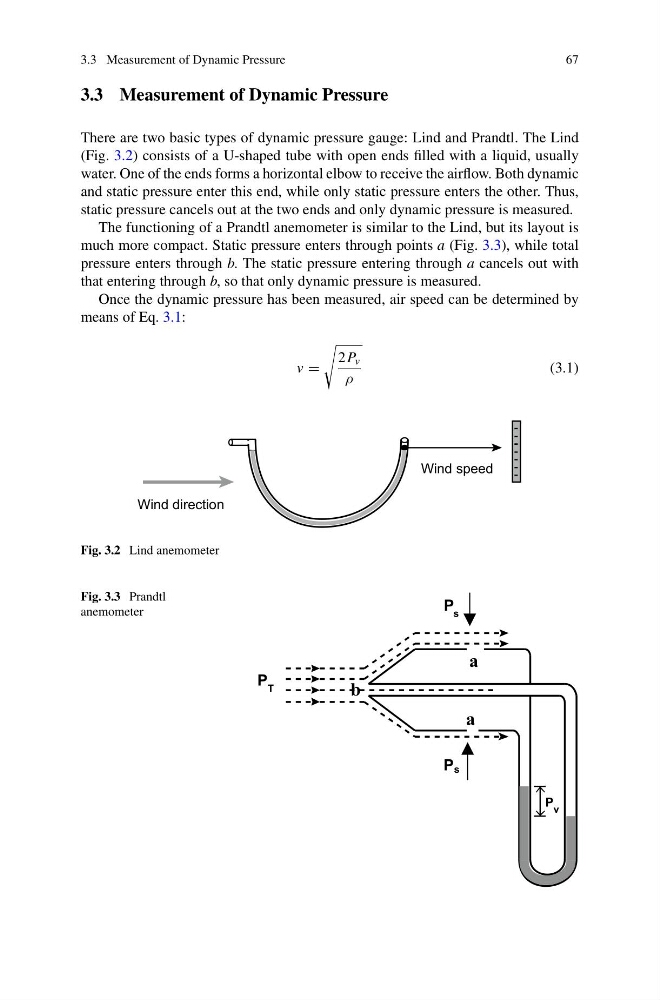
There are two basic types of dynamic pressure gauge: Lind and Prandtl. The Lind
(Fig. 3.2) consists of a U-shaped tube with open ends filled with a liquid, usually
water. One of the ends forms a horizontal elbow to receive the airflow. Both dynamic
and static pressure enter this end, while only static pressure enters the other. Thus,
static pressure cancels out at the two ends and only dynamic pressure is measured.
The functioning of a Prandtl anemometer is similar to the Lind, but its layout is
much more compact. Static pressure enters through points a (Fig. 3.3), while total
pressure enters through b. The static pressure entering through a cancels out with
that entering through b, so that only dynamic pressure is measured.
Once the dynamic pressure has been measured, air speed can be determined by
means of Eq. 3.1:
v =
2P v
ρ
(3.1)
Wind direction
Wind speed
Fig. 3.2 Lind anemometer
Fig. 3.3 Prandtl
anemometer
a
b
a
P s
P s
P
v
P T
67
3.3 Measurement of Dynamic Pressure
There are two basic types of dynamic pressure gauge: Lind and Prandtl. The Lind
(Fig. 3.2) consists of a U-shaped tube with open ends filled with a liquid, usually
water. One of the ends forms a horizontal elbow to receive the airflow. Both dynamic
and static pressure enter this end, while only static pressure enters the other. Thus,
static pressure cancels out at the two ends and only dynamic pressure is measured.
The functioning of a Prandtl anemometer is similar to the Lind, but its layout is
much more compact. Static pressure enters through points a (Fig. 3.3), while total
pressure enters through b. The static pressure entering through a cancels out with
that entering through b, so that only dynamic pressure is measured.
Once the dynamic pressure has been measured, air speed can be determined by
means of Eq. 3.1:
v =
2P v
ρ
(3.1)
Wind direction
Wind speed
Fig. 3.2 Lind anemometer
Fig. 3.3 Prandtl
anemometer
a
b
a
P s
P s
P
v
P T