

2.4 Basic Psychrometry
47
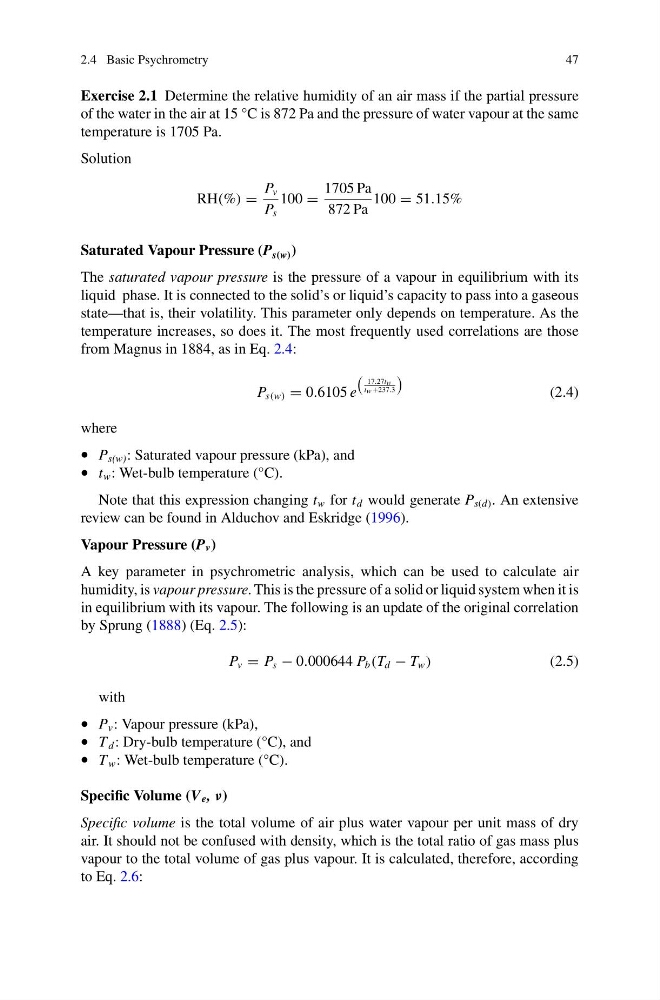
Exercise 2.1 Determine the relative humidity of an air mass if the partial pressure
of the water in the air at 15 °C is 872 Pa and the pressure of water vapour at the same
temperature is 1705 Pa.
Solution
RH(%) =
P v
P s
100 =
1705 Pa
872 Pa
100 = 51.15%
Saturated Vapour Pressure (P s(w) )
The saturated vapour pressure is the pressure of a vapour in equilibrium with its
liquid phase. It is connected to the solid’s or liquid’s capacity to pass into a gaseous
state—that is, their volatility. This parameter only depends on temperature. As the
temperature increases, so does it. The most frequently used correlations are those
from Magnus in 1884, as in Eq. 2.4:
P s(w) = 0.6105 e
17.27tw
tw +237.3
(2.4)
where
• P s(w) : Saturated vapour pressure (kPa), and
• t w : Wet-bulb temperature (°C).
Note that this expression changing t w for t d would generate P s(d) . An extensive
review can be found in Alduchov and Eskridge (1996).
Vapour Pressure (P v )
A key parameter in psychrometric analysis, which can be used to calculate air
humidity, is vapour pressure. This is the pressure of a solid or liquid system when it is
in equilibrium with its vapour. The following is an update of the original correlation
by Sprung (1888) (Eq. 2.5):
P v = P s − 0.000644 P b (T d − T w )
(2.5)
with
• P v : Vapour pressure (kPa),
• T d : Dry-bulb temperature (°C), and
• T w : Wet-bulb temperature (°C).
Specific Volume (V e , ν)
Specific volume is the total volume of air plus water vapour per unit mass of dry
air. It should not be confused with density, which is the total ratio of gas mass plus
vapour to the total volume of gas plus vapour. It is calculated, therefore, according
to Eq. 2.6:
47
Exercise 2.1 Determine the relative humidity of an air mass if the partial pressure
of the water in the air at 15 °C is 872 Pa and the pressure of water vapour at the same
temperature is 1705 Pa.
Solution
RH(%) =
P v
P s
100 =
1705 Pa
872 Pa
100 = 51.15%
Saturated Vapour Pressure (P s(w) )
The saturated vapour pressure is the pressure of a vapour in equilibrium with its
liquid phase. It is connected to the solid’s or liquid’s capacity to pass into a gaseous
state—that is, their volatility. This parameter only depends on temperature. As the
temperature increases, so does it. The most frequently used correlations are those
from Magnus in 1884, as in Eq. 2.4:
P s(w) = 0.6105 e
17.27tw
tw +237.3
(2.4)
where
• P s(w) : Saturated vapour pressure (kPa), and
• t w : Wet-bulb temperature (°C).
Note that this expression changing t w for t d would generate P s(d) . An extensive
review can be found in Alduchov and Eskridge (1996).
Vapour Pressure (P v )
A key parameter in psychrometric analysis, which can be used to calculate air
humidity, is vapour pressure. This is the pressure of a solid or liquid system when it is
in equilibrium with its vapour. The following is an update of the original correlation
by Sprung (1888) (Eq. 2.5):
P v = P s − 0.000644 P b (T d − T w )
(2.5)
with
• P v : Vapour pressure (kPa),
• T d : Dry-bulb temperature (°C), and
• T w : Wet-bulb temperature (°C).
Specific Volume (V e , ν)
Specific volume is the total volume of air plus water vapour per unit mass of dry
air. It should not be confused with density, which is the total ratio of gas mass plus
vapour to the total volume of gas plus vapour. It is calculated, therefore, according
to Eq. 2.6: