

2.2 Gases and Hygiene
41
of the gallery, unless it is occupied by another gas, in which case there will be top-tobottom stratification in order of increasing density. CO is lighter than air, so it will
direct to the roof of the airway. However, because it is not much lighter, assuming that
it can be found at any height represents a conservative approach. Regarding nitrogen
oxides, it should be taken into account that NO will rapidly oxidize to become NO 2 .
2.3 Gas Detection
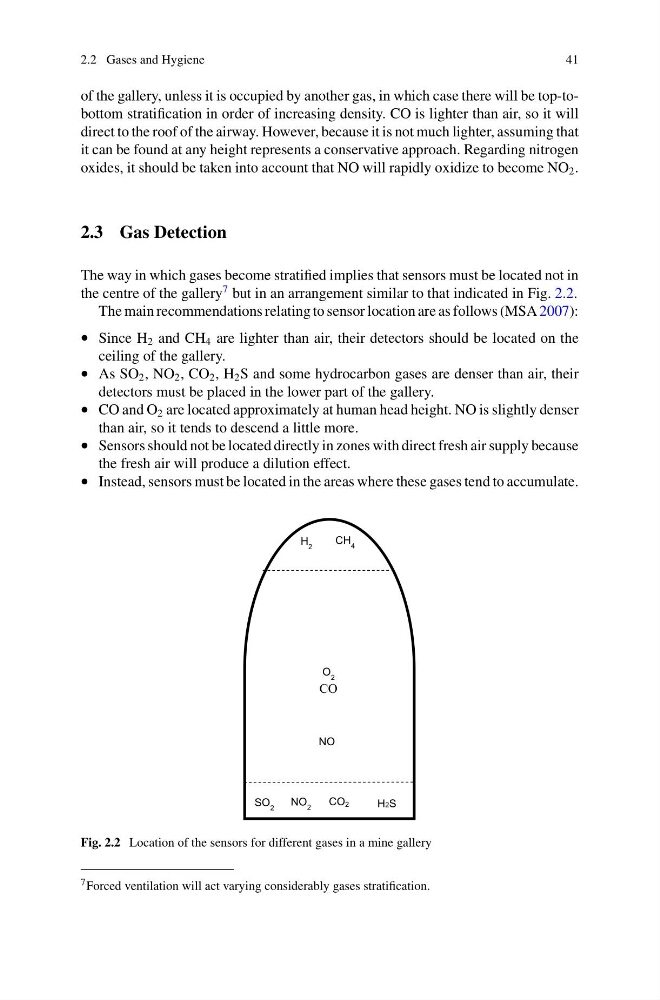
The way in which gases become stratified implies that sensors must be located not in
the centre of the gallery
7 but in an arrangement similar to that indicated in Fig. 2.2.
The main recommendations relating to sensor location are as follows (MSA 2007):
• Since H 2 and CH 4 are lighter than air, their detectors should be located on the
ceiling of the gallery.
• As SO 2 , NO 2 , CO 2 , H 2 S and some hydrocarbon gases are denser than air, their
detectors must be placed in the lower part of the gallery.
• CO and O 2 are located approximately at human head height. NO is slightly denser
than air, so it tends to descend a little more.
• Sensors should not be located directly in zones with direct fresh air supply because
the fresh air will produce a dilution effect.
• Instead, sensors must be located in the areas where these gases tend to accumulate.
H2S
CO 2
NO 2
SO 2
H 2
CH 4
O 2
CO
NO
Fig. 2.2 Location of the sensors for different gases in a mine gallery
7 Forced ventilation will act varying considerably gases stratification.
41
of the gallery, unless it is occupied by another gas, in which case there will be top-tobottom stratification in order of increasing density. CO is lighter than air, so it will
direct to the roof of the airway. However, because it is not much lighter, assuming that
it can be found at any height represents a conservative approach. Regarding nitrogen
oxides, it should be taken into account that NO will rapidly oxidize to become NO 2 .
2.3 Gas Detection
The way in which gases become stratified implies that sensors must be located not in
the centre of the gallery
7 but in an arrangement similar to that indicated in Fig. 2.2.
The main recommendations relating to sensor location are as follows (MSA 2007):
• Since H 2 and CH 4 are lighter than air, their detectors should be located on the
ceiling of the gallery.
• As SO 2 , NO 2 , CO 2 , H 2 S and some hydrocarbon gases are denser than air, their
detectors must be placed in the lower part of the gallery.
• CO and O 2 are located approximately at human head height. NO is slightly denser
than air, so it tends to descend a little more.
• Sensors should not be located directly in zones with direct fresh air supply because
the fresh air will produce a dilution effect.
• Instead, sensors must be located in the areas where these gases tend to accumulate.
H2S
CO 2
NO 2
SO 2
H 2
CH 4
O 2
CO
NO
Fig. 2.2 Location of the sensors for different gases in a mine gallery
7 Forced ventilation will act varying considerably gases stratification.