

32
2 Environmental Conditions in the Mine
2.2 Gases and Hygiene
2.2.1 Air and Oxygen
Air is the homogeneous mixture of gases that covers the Earth’s surface. It consists
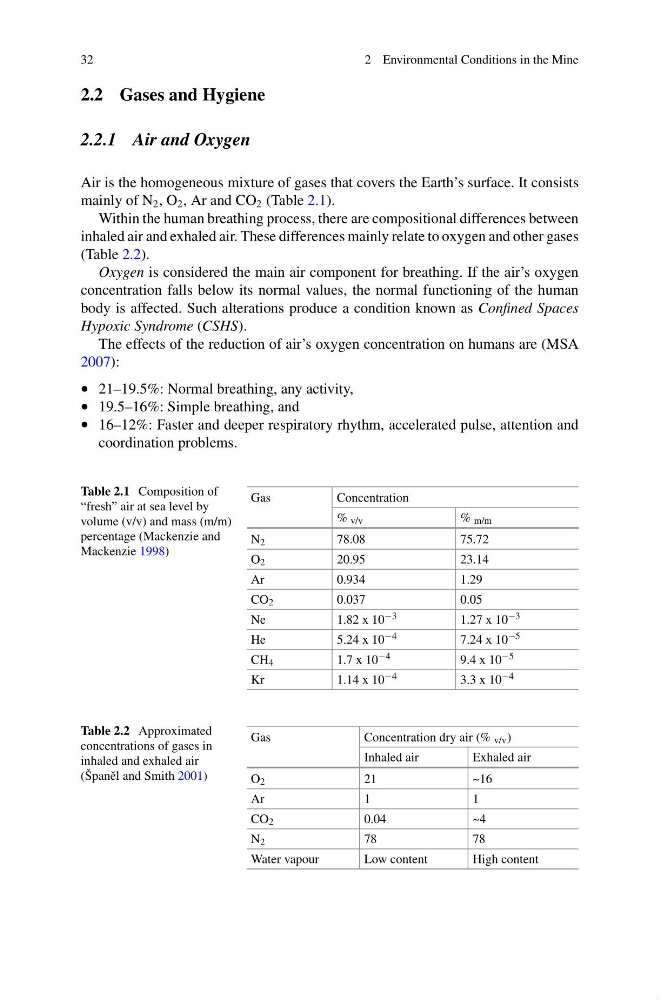
mainly of N 2 , O 2 , Ar and CO 2 (Table 2.1).
Within the human breathing process, there are compositional differences between
inhaled air and exhaled air. These differences mainly relate to oxygen and other gases
(Table 2.2).
Oxygen is considered the main air component for breathing. If the air’s oxygen
concentration falls below its normal values, the normal functioning of the human
body is affected. Such alterations produce a condition known as Confined Spaces
Hypoxic Syndrome (CSHS).
The effects of the reduction of air’s oxygen concentration on humans are (MSA
2007):
• 21–19.5%: Normal breathing, any activity,
• 19.5–16%: Simple breathing, and
• 16–12%: Faster and deeper respiratory rhythm, accelerated pulse, attention and
coordination problems.
Table 2.1 Composition of
“fresh” air at sea level by
volume (v/v) and mass (m/m)
percentage (Mackenzie and
Mackenzie 1998)
Gas
Concentration
% v/v
% m/m
N 2
78.08
75.72
O 2
20.95
23.14
Ar
0.934
1.29
CO 2
0.037
0.05
Ne
1.82 x 10 −3
1.27 x 10 −3
He
5.24 x 10 −4
7.24 x 10 −5
CH 4
1.7 x 10 −4
9.4 x 10 −5
Kr
1.14 x 10 −4
3.3 x 10 −4
Table 2.2 Approximated
concentrations of gases in
inhaled and exhaled air
(Španˇ el and Smith 2001)
Gas
Concentration dry air (% v/v )
Inhaled air
Exhaled air
O 2
21
~16
Ar
1
1
CO 2
0.04
~4
N 2
78
78
Water vapour
Low content
High content
2 Environmental Conditions in the Mine
2.2 Gases and Hygiene
2.2.1 Air and Oxygen
Air is the homogeneous mixture of gases that covers the Earth’s surface. It consists
mainly of N 2 , O 2 , Ar and CO 2 (Table 2.1).
Within the human breathing process, there are compositional differences between
inhaled air and exhaled air. These differences mainly relate to oxygen and other gases
(Table 2.2).
Oxygen is considered the main air component for breathing. If the air’s oxygen
concentration falls below its normal values, the normal functioning of the human
body is affected. Such alterations produce a condition known as Confined Spaces
Hypoxic Syndrome (CSHS).
The effects of the reduction of air’s oxygen concentration on humans are (MSA
2007):
• 21–19.5%: Normal breathing, any activity,
• 19.5–16%: Simple breathing, and
• 16–12%: Faster and deeper respiratory rhythm, accelerated pulse, attention and
coordination problems.
Table 2.1 Composition of
“fresh” air at sea level by
volume (v/v) and mass (m/m)
percentage (Mackenzie and
Mackenzie 1998)
Gas
Concentration
% v/v
% m/m
N 2
78.08
75.72
O 2
20.95
23.14
Ar
0.934
1.29
CO 2
0.037
0.05
Ne
1.82 x 10 −3
1.27 x 10 −3
He
5.24 x 10 −4
7.24 x 10 −5
CH 4
1.7 x 10 −4
9.4 x 10 −5
Kr
1.14 x 10 −4
3.3 x 10 −4
Table 2.2 Approximated
concentrations of gases in
inhaled and exhaled air
(Španˇ el and Smith 2001)
Gas
Concentration dry air (% v/v )
Inhaled air
Exhaled air
O 2
21
~16
Ar
1
1
CO 2
0.04
~4
N 2
78
78
Water vapour
Low content
High content