

342
8 Secondary Ventilation
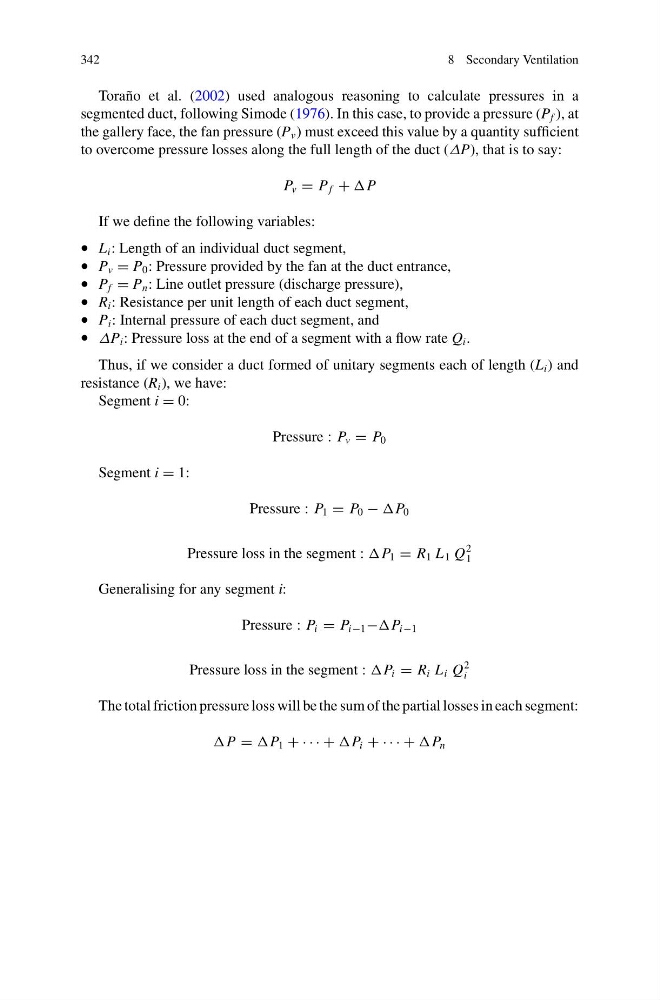
Toraño et al. (2002) used analogous reasoning to calculate pressures in a
segmented duct, following Simode (1976). In this case, to provide a pressure (P f ), at
the gallery face, the fan pressure (P v ) must exceed this value by a quantity sufficient
to overcome pressure losses along the full length of the duct (ΔP), that is to say:
P v = P f + P
If we define the following variables:
• L i : Length of an individual duct segment,
• P v = P 0 : Pressure provided by the fan at the duct entrance,
• P f = P n : Line outlet pressure (discharge pressure),
• R i : Resistance per unit length of each duct segment,
• P i : Internal pressure of each duct segment, and
• ΔP i : Pressure loss at the end of a segment with a flow rate Q i .
Thus, if we consider a duct formed of unitary segments each of length (L i ) and
resistance (R i ), we have:
Segment i = 0:
Pressure : P v = P 0
Segment i = 1:
Pressure : P 1 = P 0 − P 0
Pressure loss in the segment : P 1 = R 1 L 1 Q
2
1
Generalising for any segment i:
Pressure : P i = P i−1 −P i−1
Pressure loss in the segment : P i = R i L i Q
2
i
The total friction pressure loss will be the sum of the partial losses in each segment:
P = P 1 + · · · + P i + · · · + P n
8 Secondary Ventilation
Toraño et al. (2002) used analogous reasoning to calculate pressures in a
segmented duct, following Simode (1976). In this case, to provide a pressure (P f ), at
the gallery face, the fan pressure (P v ) must exceed this value by a quantity sufficient
to overcome pressure losses along the full length of the duct (ΔP), that is to say:
P v = P f + P
If we define the following variables:
• L i : Length of an individual duct segment,
• P v = P 0 : Pressure provided by the fan at the duct entrance,
• P f = P n : Line outlet pressure (discharge pressure),
• R i : Resistance per unit length of each duct segment,
• P i : Internal pressure of each duct segment, and
• ΔP i : Pressure loss at the end of a segment with a flow rate Q i .
Thus, if we consider a duct formed of unitary segments each of length (L i ) and
resistance (R i ), we have:
Segment i = 0:
Pressure : P v = P 0
Segment i = 1:
Pressure : P 1 = P 0 − P 0
Pressure loss in the segment : P 1 = R 1 L 1 Q
2
1
Generalising for any segment i:
Pressure : P i = P i−1 −P i−1
Pressure loss in the segment : P i = R i L i Q
2
i
The total friction pressure loss will be the sum of the partial losses in each segment:
P = P 1 + · · · + P i + · · · + P n