

318
8 Secondary Ventilation
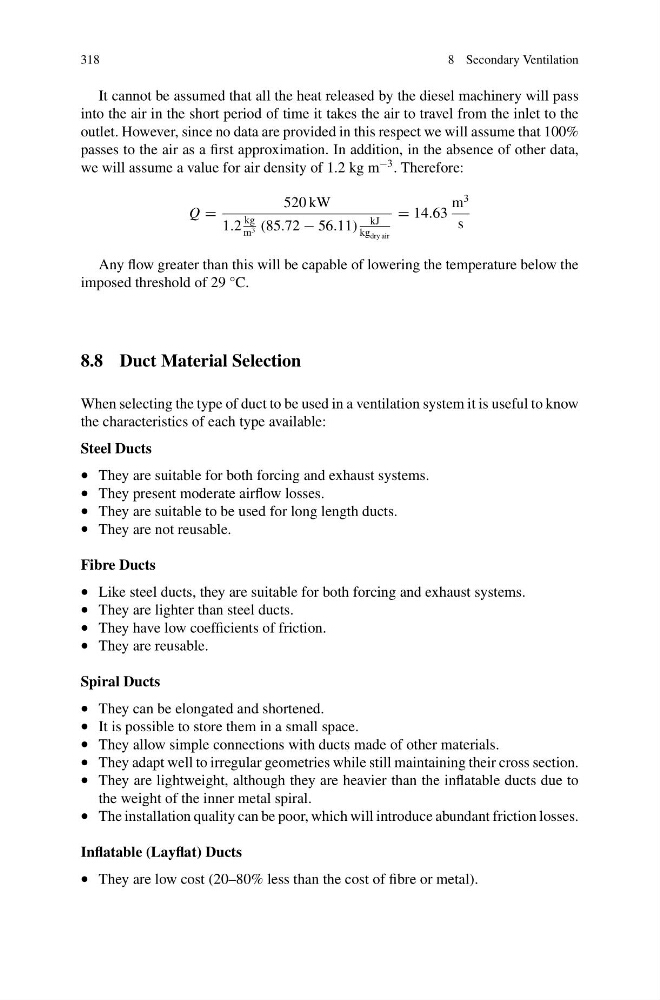
It cannot be assumed that all the heat released by the diesel machinery will pass
into the air in the short period of time it takes the air to travel from the inlet to the
outlet. However, since no data are provided in this respect we will assume that 100%
passes to the air as a first approximation. In addition, in the absence of other data,
we will assume a value for air density of 1.2 kg m
−3 . Therefore:
Q =
520 kW
1.2
kg
m 3 (85.72 − 56.11)
kJ
kg dry air
= 14.63
m
3
s
Any flow greater than this will be capable of lowering the temperature below the
imposed threshold of 29 °C.
8.8 Duct Material Selection
When selecting the type of duct to be used in a ventilation system it is useful to know
the characteristics of each type available:
Steel Ducts
• They are suitable for both forcing and exhaust systems.
• They present moderate airflow losses.
• They are suitable to be used for long length ducts.
• They are not reusable.
Fibre Ducts
• Like steel ducts, they are suitable for both forcing and exhaust systems.
• They are lighter than steel ducts.
• They have low coefficients of friction.
• They are reusable.
Spiral Ducts
• They can be elongated and shortened.
• It is possible to store them in a small space.
• They allow simple connections with ducts made of other materials.
• They adapt well to irregular geometries while still maintaining their cross section.
• They are lightweight, although they are heavier than the inflatable ducts due to
the weight of the inner metal spiral.
• The installation quality can be poor, which will introduce abundant friction losses.
Inflatable (Layflat) Ducts
• They are low cost (20–80% less than the cost of fibre or metal).
8 Secondary Ventilation
It cannot be assumed that all the heat released by the diesel machinery will pass
into the air in the short period of time it takes the air to travel from the inlet to the
outlet. However, since no data are provided in this respect we will assume that 100%
passes to the air as a first approximation. In addition, in the absence of other data,
we will assume a value for air density of 1.2 kg m
−3 . Therefore:
Q =
520 kW
1.2
kg
m 3 (85.72 − 56.11)
kJ
kg dry air
= 14.63
m
3
s
Any flow greater than this will be capable of lowering the temperature below the
imposed threshold of 29 °C.
8.8 Duct Material Selection
When selecting the type of duct to be used in a ventilation system it is useful to know
the characteristics of each type available:
Steel Ducts
• They are suitable for both forcing and exhaust systems.
• They present moderate airflow losses.
• They are suitable to be used for long length ducts.
• They are not reusable.
Fibre Ducts
• Like steel ducts, they are suitable for both forcing and exhaust systems.
• They are lighter than steel ducts.
• They have low coefficients of friction.
• They are reusable.
Spiral Ducts
• They can be elongated and shortened.
• It is possible to store them in a small space.
• They allow simple connections with ducts made of other materials.
• They adapt well to irregular geometries while still maintaining their cross section.
• They are lightweight, although they are heavier than the inflatable ducts due to
the weight of the inner metal spiral.
• The installation quality can be poor, which will introduce abundant friction losses.
Inflatable (Layflat) Ducts
• They are low cost (20–80% less than the cost of fibre or metal).