

316
8 Secondary Ventilation
(continued)
x (m)
C(x, t = 180) (ppm)
300.0
10.8
330.0
3.9
330.0
3.9
8.7 Heat Dissipation with Ventilation
To determine the ventilation flow required to reduce the temperature to a certain value
one can follow the procedure outlined by McPherson (1993, p. 292). The basis of
this procedure relies on a calculation of the energy required to heat the air and water
vapour (a function of the saturated vapour pressure) from a temperature t wi at the
inlet up to a temperature t wo at the outlet, thus t wo > t wi . It consists of the following
steps:
1. Calculate the saturated vapour pressure (P swi ) for the fresh air inlet temperature
(t wi ).
2. Determine the sigma heat (S i ), for condition (1).
3. Specify an exhaust air temperature (t wo ). This temperature will be the maximum
acceptable wet-bulb temperature.
4. Calculate the saturated vapour pressure (P swo ) for air at this maximum acceptable
wet-bulb temperature (t wo ).
5. Calculate the sigma heat for condition 4 (S o ).
6. Calculate the required flow rate based on the total heat flow to the air (q eo ).
Necessary Equations
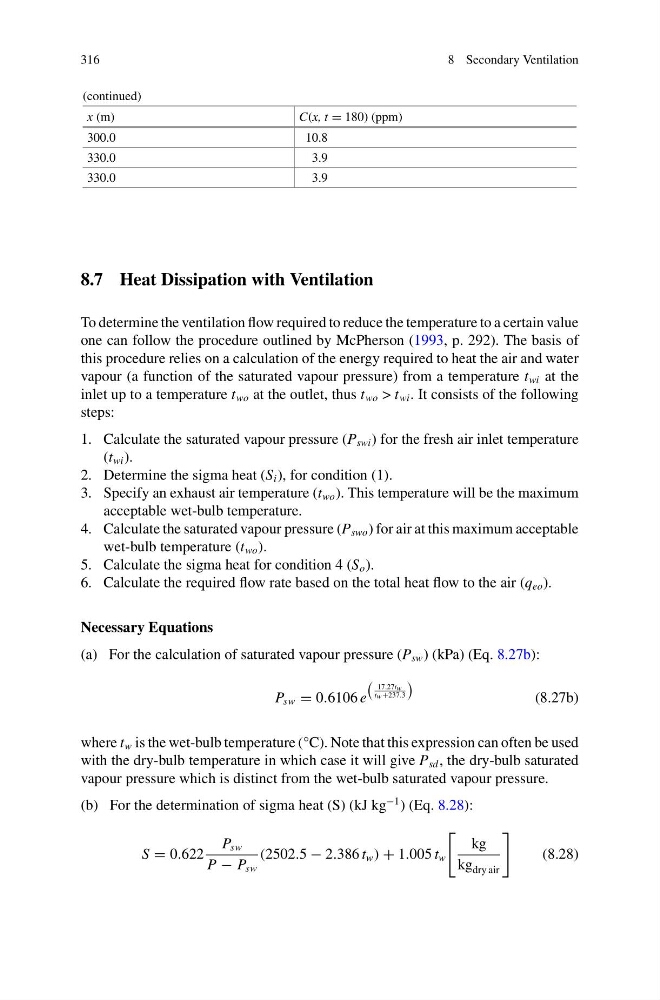
(a) For the calculation of saturated vapour pressure (P sw ) (kPa) (Eq. 8.27b):
P sw = 0.6106 e
17.27tw
tw +237.3
(8.27b)
where t w is the wet-bulb temperature (°C). Note that this expression can often be used
with the dry-bulb temperature in which case it will give P sd , the dry-bulb saturated
vapour pressure which is distinct from the wet-bulb saturated vapour pressure.
(b) For the determination of sigma heat (S) (kJ kg
−1 ) (Eq. 8.28):
S = 0.622
P sw
P − P sw
(2502.5 − 2.386 t w ) + 1.005 t w
kg
kg dry air
(8.28)
8 Secondary Ventilation
(continued)
x (m)
C(x, t = 180) (ppm)
300.0
10.8
330.0
3.9
330.0
3.9
8.7 Heat Dissipation with Ventilation
To determine the ventilation flow required to reduce the temperature to a certain value
one can follow the procedure outlined by McPherson (1993, p. 292). The basis of
this procedure relies on a calculation of the energy required to heat the air and water
vapour (a function of the saturated vapour pressure) from a temperature t wi at the
inlet up to a temperature t wo at the outlet, thus t wo > t wi . It consists of the following
steps:
1. Calculate the saturated vapour pressure (P swi ) for the fresh air inlet temperature
(t wi ).
2. Determine the sigma heat (S i ), for condition (1).
3. Specify an exhaust air temperature (t wo ). This temperature will be the maximum
acceptable wet-bulb temperature.
4. Calculate the saturated vapour pressure (P swo ) for air at this maximum acceptable
wet-bulb temperature (t wo ).
5. Calculate the sigma heat for condition 4 (S o ).
6. Calculate the required flow rate based on the total heat flow to the air (q eo ).
Necessary Equations
(a) For the calculation of saturated vapour pressure (P sw ) (kPa) (Eq. 8.27b):
P sw = 0.6106 e
17.27tw
tw +237.3
(8.27b)
where t w is the wet-bulb temperature (°C). Note that this expression can often be used
with the dry-bulb temperature in which case it will give P sd , the dry-bulb saturated
vapour pressure which is distinct from the wet-bulb saturated vapour pressure.
(b) For the determination of sigma heat (S) (kJ kg
−1 ) (Eq. 8.28):
S = 0.622
P sw
P − P sw
(2502.5 − 2.386 t w ) + 1.005 t w
kg
kg dry air
(8.28)