

8.4 Gas Dilution Models
309
• a: Volume of CO generated per unit of explosive mass (m
3 kg
−1 ). The value
normally used for this parameter is 0.04 m
3 kg
−1 .
9
• d: Dilution factor (%). Maximum amount of CO allowed in the return air.
Normally, a value of 0.008% is used.
• Q: Required airflow rate (m
3 min
−1 ).
A variant of this expression can be found in Russian literature (e.g. Borisov et al.
1976, p. 362) in the form (Eq. 8.19):
t =
12.5 M exp B
Q
(8.19)
where
B: Volume in litres of CO generated in the explosion of 1 kg of explosive
(approximately 40 l in general).
From the above expressions, the following rule of thumb can be deduced for a
dilution time of 30 min:
Q =
100 M exp 0.04 m
3
0.008 · 30 min
Therefore:
Q[m
3 min
−1
] = 16.67 M exp
And in SI units (Eq. 8.20):
Q
m
3
s
= 0.28 M exp
(8.20)
8.5 Throwback Method
This method consists of the implementation of the following 5 steps (Howes 1994;
WMC 2001; Stewart 2014):
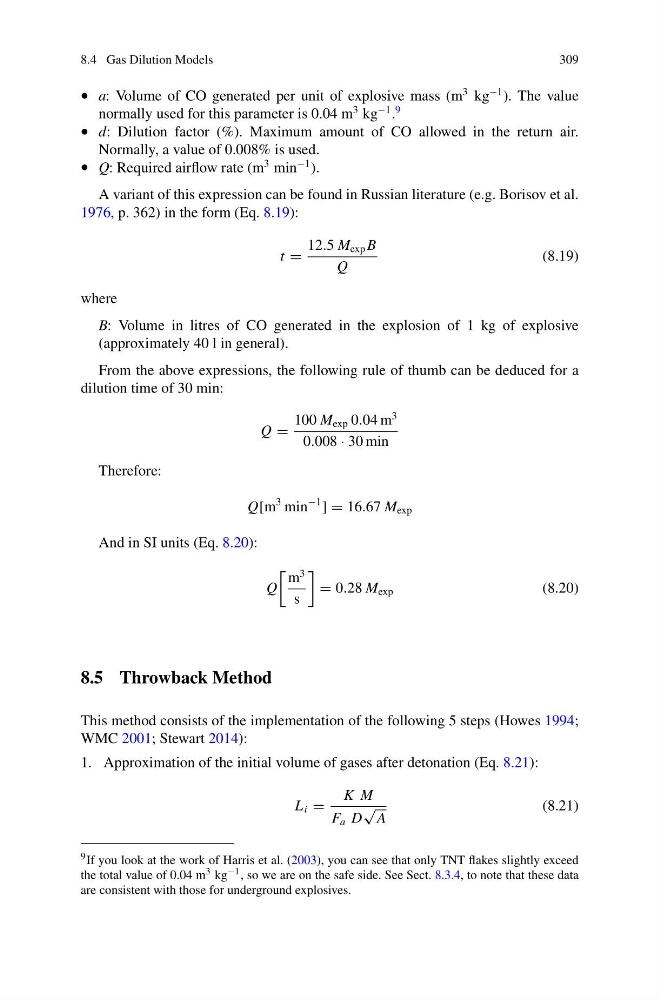
1. Approximation of the initial volume of gases after detonation (Eq. 8.21):
L i =
K M
F a D
√
A
(8.21)
9 If you look at the work of Harris et al. (2003), you can see that only TNT flakes slightly exceed
the total value of 0.04 m 3 kg −1 , so we are on the safe side. See Sect. 8.3.4, to note that these data
are consistent with those for underground explosives.
309
• a: Volume of CO generated per unit of explosive mass (m
3 kg
−1 ). The value
normally used for this parameter is 0.04 m
3 kg
−1 .
9
• d: Dilution factor (%). Maximum amount of CO allowed in the return air.
Normally, a value of 0.008% is used.
• Q: Required airflow rate (m
3 min
−1 ).
A variant of this expression can be found in Russian literature (e.g. Borisov et al.
1976, p. 362) in the form (Eq. 8.19):
t =
12.5 M exp B
Q
(8.19)
where
B: Volume in litres of CO generated in the explosion of 1 kg of explosive
(approximately 40 l in general).
From the above expressions, the following rule of thumb can be deduced for a
dilution time of 30 min:
Q =
100 M exp 0.04 m
3
0.008 · 30 min
Therefore:
Q[m
3 min
−1
] = 16.67 M exp
And in SI units (Eq. 8.20):
Q
m
3
s
= 0.28 M exp
(8.20)
8.5 Throwback Method
This method consists of the implementation of the following 5 steps (Howes 1994;
WMC 2001; Stewart 2014):
1. Approximation of the initial volume of gases after detonation (Eq. 8.21):
L i =
K M
F a D
√
A
(8.21)
9 If you look at the work of Harris et al. (2003), you can see that only TNT flakes slightly exceed
the total value of 0.04 m 3 kg −1 , so we are on the safe side. See Sect. 8.3.4, to note that these data
are consistent with those for underground explosives.