

8.4 Gas Dilution Models
307
8.4.4 Classical Approaches of the Russian School
Novitzky (1962), pp. 247–249, provides a survey of the available Russian literature
and compiles a set of equations for calculating ventilation airflow rates and re-entry
times. These formulae are reproduced here only for historical interest as they are no
longer of practical use.
Forcing Ventilation
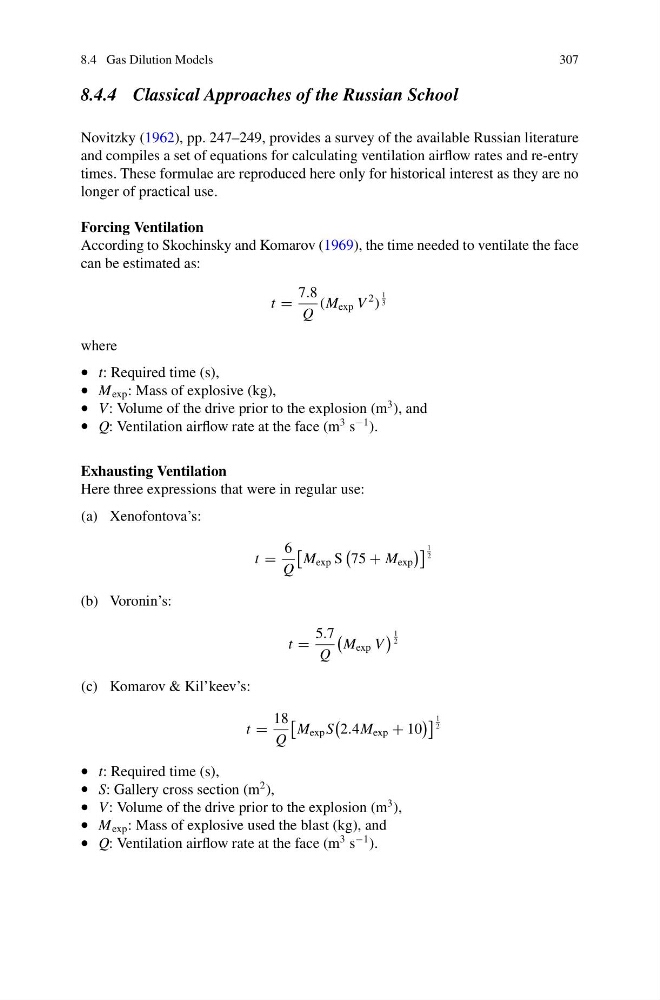
According to Skochinsky and Komarov (1969), the time needed to ventilate the face
can be estimated as:
t =
7.8
Q
(M exp V
2
)
1
3
where
• t: Required time (s),
• M exp : Mass of explosive (kg),
• V: Volume of the drive prior to the explosion (m
3 ), and
• Q: Ventilation airflow rate at the face (m
3 s
−1 ).
Exhausting Ventilation
Here three expressions that were in regular use:
(a) Xenofontova’s:
t =
6
Q
M exp S
75 + M exp
1
2
(b) Voronin’s:
t =
5.7
Q
M exp V
1
2
(c) Komarov & Kil’keev’s:
t =
18
Q
M exp S
2.4M exp + 10
1
2
• t: Required time (s),
• S: Gallery cross section (m
2 ),
• V: Volume of the drive prior to the explosion (m
3 ),
• M exp : Mass of explosive used the blast (kg), and
• Q: Ventilation airflow rate at the face (m
3 s
−1 ).
307
8.4.4 Classical Approaches of the Russian School
Novitzky (1962), pp. 247–249, provides a survey of the available Russian literature
and compiles a set of equations for calculating ventilation airflow rates and re-entry
times. These formulae are reproduced here only for historical interest as they are no
longer of practical use.
Forcing Ventilation
According to Skochinsky and Komarov (1969), the time needed to ventilate the face
can be estimated as:
t =
7.8
Q
(M exp V
2
)
1
3
where
• t: Required time (s),
• M exp : Mass of explosive (kg),
• V: Volume of the drive prior to the explosion (m
3 ), and
• Q: Ventilation airflow rate at the face (m
3 s
−1 ).
Exhausting Ventilation
Here three expressions that were in regular use:
(a) Xenofontova’s:
t =
6
Q
M exp S
75 + M exp
1
2
(b) Voronin’s:
t =
5.7
Q
M exp V
1
2
(c) Komarov & Kil’keev’s:
t =
18
Q
M exp S
2.4M exp + 10
1
2
• t: Required time (s),
• S: Gallery cross section (m
2 ),
• V: Volume of the drive prior to the explosion (m
3 ),
• M exp : Mass of explosive used the blast (kg), and
• Q: Ventilation airflow rate at the face (m
3 s
−1 ).