

260
7 The Role of Ventilation in Fires and Explosions
(a) Two Airways Forking into One
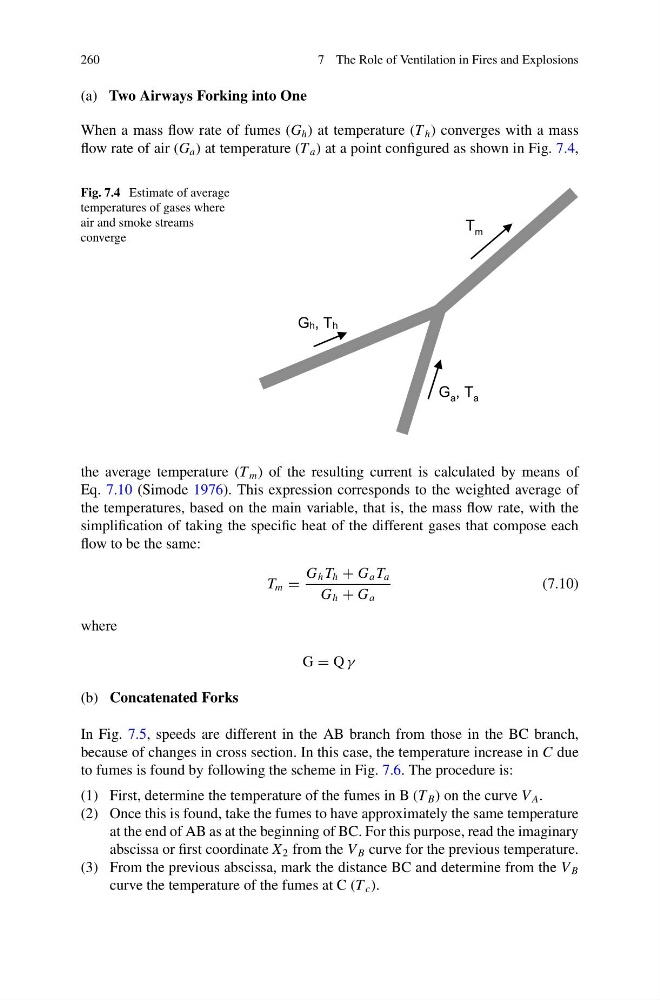
When a mass flow rate of fumes (G h ) at temperature (T h ) converges with a mass
flow rate of air (G a ) at temperature (T a ) at a point configured as shown in Fig. 7.4,
Fig. 7.4 Estimate of average
temperatures of gases where
air and smoke streams
converge
Gh, Th
G a , T a
T m
the average temperature (T m ) of the resulting current is calculated by means of
Eq. 7.10 (Simode 1976). This expression corresponds to the weighted average of
the temperatures, based on the main variable, that is, the mass flow rate, with the
simplification of taking the specific heat of the different gases that compose each
flow to be the same:
T m =
G h T h + G a T a
G h + G a
(7.10)
where
G = Q γ
(b) Concatenated Forks
In Fig. 7.5, speeds are different in the AB branch from those in the BC branch,
because of changes in cross section. In this case, the temperature increase in C due
to fumes is found by following the scheme in Fig. 7.6. The procedure is:
(1) First, determine the temperature of the fumes in B (T B ) on the curve V A .
(2) Once this is found, take the fumes to have approximately the same temperature
at the end of AB as at the beginning of BC. For this purpose, read the imaginary
abscissa or first coordinate X 2 from the V B curve for the previous temperature.
(3) From the previous abscissa, mark the distance BC and determine from the V B
curve the temperature of the fumes at C (T c ).
7 The Role of Ventilation in Fires and Explosions
(a) Two Airways Forking into One
When a mass flow rate of fumes (G h ) at temperature (T h ) converges with a mass
flow rate of air (G a ) at temperature (T a ) at a point configured as shown in Fig. 7.4,
Fig. 7.4 Estimate of average
temperatures of gases where
air and smoke streams
converge
Gh, Th
G a , T a
T m
the average temperature (T m ) of the resulting current is calculated by means of
Eq. 7.10 (Simode 1976). This expression corresponds to the weighted average of
the temperatures, based on the main variable, that is, the mass flow rate, with the
simplification of taking the specific heat of the different gases that compose each
flow to be the same:
T m =
G h T h + G a T a
G h + G a
(7.10)
where
G = Q γ
(b) Concatenated Forks
In Fig. 7.5, speeds are different in the AB branch from those in the BC branch,
because of changes in cross section. In this case, the temperature increase in C due
to fumes is found by following the scheme in Fig. 7.6. The procedure is:
(1) First, determine the temperature of the fumes in B (T B ) on the curve V A .
(2) Once this is found, take the fumes to have approximately the same temperature
at the end of AB as at the beginning of BC. For this purpose, read the imaginary
abscissa or first coordinate X 2 from the V B curve for the previous temperature.
(3) From the previous abscissa, mark the distance BC and determine from the V B
curve the temperature of the fumes at C (T c ).