

1.3 Fluid Dynamics
15
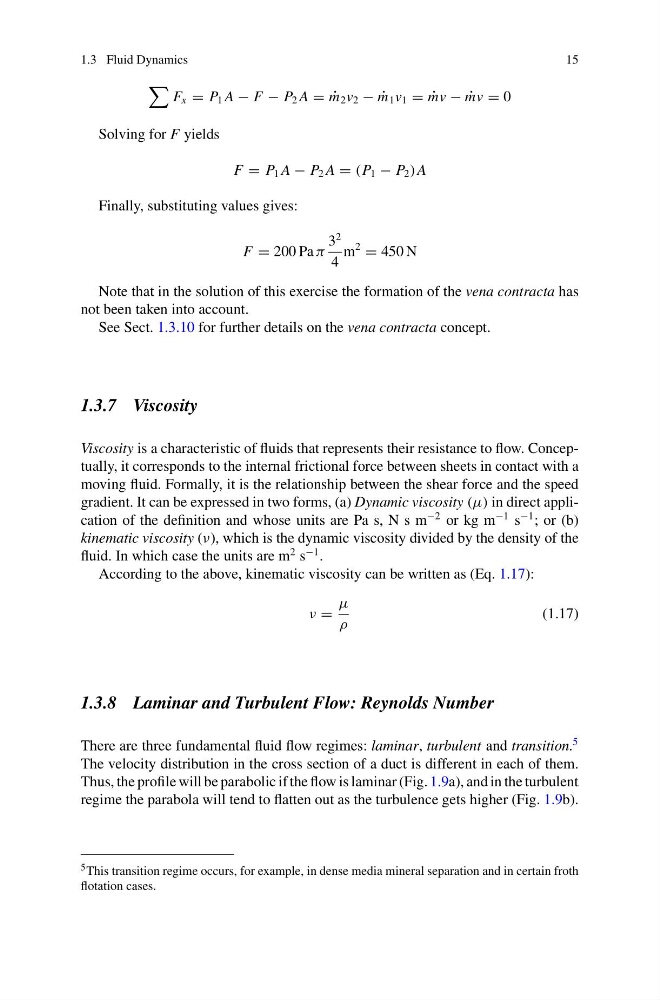
F x = P 1 A − F − P 2 A = ˙
m 2 v 2 − ˙
m 1 v 1 = ˙
mv − ˙
mv = 0
Solving for F yields
F = P 1 A − P 2 A = (P 1 − P 2 )A
Finally, substituting values gives:
F = 200 Pa π
3
2
4
m
2
= 450 N
Note that in the solution of this exercise the formation of the vena contracta has
not been taken into account.
See Sect. 1.3.10 for further details on the vena contracta concept.
1.3.7 Viscosity
Viscosity is a characteristic of fluids that represents their resistance to flow. Conceptually, it corresponds to the internal frictional force between sheets in contact with a
moving fluid. Formally, it is the relationship between the shear force and the speed
gradient. It can be expressed in two forms, (a) Dynamic viscosity (μ) in direct application of the definition and whose units are Pa s, N s m
−2 or kg m
−1 s
−1 ; or (b)
kinematic viscosity (ν), which is the dynamic viscosity divided by the density of the
fluid. In which case the units are m
2 s
−1 .
According to the above, kinematic viscosity can be written as (Eq. 1.17):
ν =
μ
ρ
(1.17)
1.3.8 Laminar and Turbulent Flow: Reynolds Number
There are three fundamental fluid flow regimes: laminar, turbulent and transition.
5
The velocity distribution in the cross section of a duct is different in each of them.
Thus, the profile will be parabolic if the flow is laminar (Fig. 1.9a), and in the turbulent
regime the parabola will tend to flatten out as the turbulence gets higher (Fig. 1.9b).
5 This transition regime occurs, for example, in dense media mineral separation and in certain froth
flotation cases.
15
F x = P 1 A − F − P 2 A = ˙
m 2 v 2 − ˙
m 1 v 1 = ˙
mv − ˙
mv = 0
Solving for F yields
F = P 1 A − P 2 A = (P 1 − P 2 )A
Finally, substituting values gives:
F = 200 Pa π
3
2
4
m
2
= 450 N
Note that in the solution of this exercise the formation of the vena contracta has
not been taken into account.
See Sect. 1.3.10 for further details on the vena contracta concept.
1.3.7 Viscosity
Viscosity is a characteristic of fluids that represents their resistance to flow. Conceptually, it corresponds to the internal frictional force between sheets in contact with a
moving fluid. Formally, it is the relationship between the shear force and the speed
gradient. It can be expressed in two forms, (a) Dynamic viscosity (μ) in direct application of the definition and whose units are Pa s, N s m
−2 or kg m
−1 s
−1 ; or (b)
kinematic viscosity (ν), which is the dynamic viscosity divided by the density of the
fluid. In which case the units are m
2 s
−1 .
According to the above, kinematic viscosity can be written as (Eq. 1.17):
ν =
μ
ρ
(1.17)
1.3.8 Laminar and Turbulent Flow: Reynolds Number
There are three fundamental fluid flow regimes: laminar, turbulent and transition.
5
The velocity distribution in the cross section of a duct is different in each of them.
Thus, the profile will be parabolic if the flow is laminar (Fig. 1.9a), and in the turbulent
regime the parabola will tend to flatten out as the turbulence gets higher (Fig. 1.9b).
5 This transition regime occurs, for example, in dense media mineral separation and in certain froth
flotation cases.