

228
6 Fans and Flow Control Devices
6.2.11 Power–Flow and Pressure–Flow Curves for Axial
and Centrifugal Fans
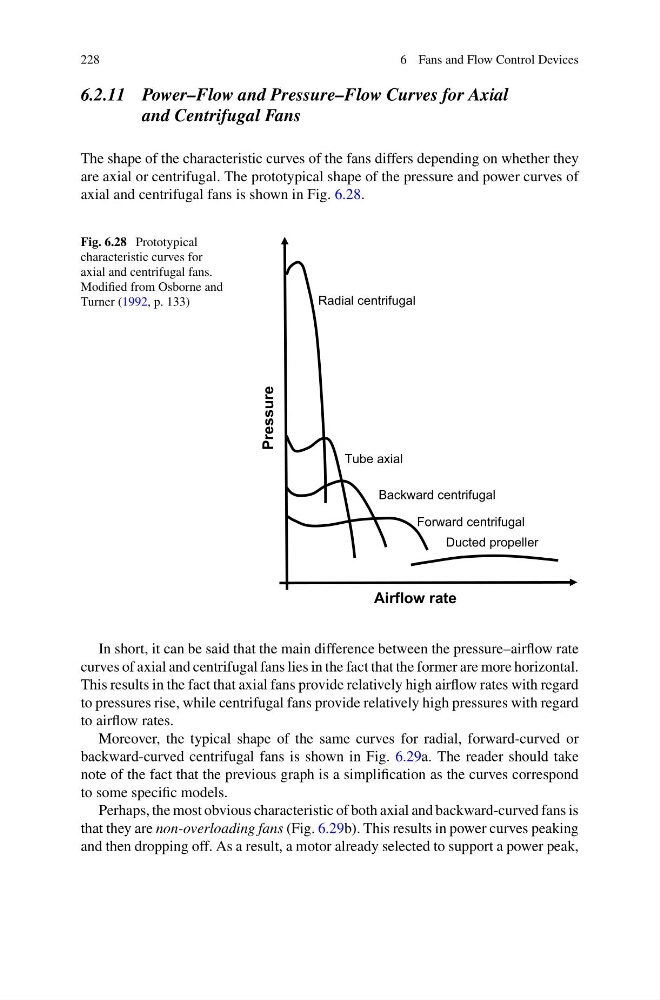
The shape of the characteristic curves of the fans differs depending on whether they
are axial or centrifugal. The prototypical shape of the pressure and power curves of
axial and centrifugal fans is shown in Fig. 6.28.
Fig. 6.28 Prototypical
characteristic curves for
axial and centrifugal fans.
Modified from Osborne and
Turner (1992, p. 133)
Radial centrifugal
Tube axial
Backward centrifugal
Forward centrifugal
Ducted propeller
Pressure
Airflow rate
In short, it can be said that the main difference between the pressure–airflow rate
curves of axial and centrifugal fans lies in the fact that the former are more horizontal.
This results in the fact that axial fans provide relatively high airflow rates with regard
to pressures rise, while centrifugal fans provide relatively high pressures with regard
to airflow rates.
Moreover, the typical shape of the same curves for radial, forward-curved or
backward-curved centrifugal fans is shown in Fig. 6.29a. The reader should take
note of the fact that the previous graph is a simplification as the curves correspond
to some specific models.
Perhaps, the most obvious characteristic of both axial and backward-curved fans is
that they are non-overloading fans (Fig. 6.29b). This results in power curves peaking
and then dropping off. As a result, a motor already selected to support a power peak,
6 Fans and Flow Control Devices
6.2.11 Power–Flow and Pressure–Flow Curves for Axial
and Centrifugal Fans
The shape of the characteristic curves of the fans differs depending on whether they
are axial or centrifugal. The prototypical shape of the pressure and power curves of
axial and centrifugal fans is shown in Fig. 6.28.
Fig. 6.28 Prototypical
characteristic curves for
axial and centrifugal fans.
Modified from Osborne and
Turner (1992, p. 133)
Radial centrifugal
Tube axial
Backward centrifugal
Forward centrifugal
Ducted propeller
Pressure
Airflow rate
In short, it can be said that the main difference between the pressure–airflow rate
curves of axial and centrifugal fans lies in the fact that the former are more horizontal.
This results in the fact that axial fans provide relatively high airflow rates with regard
to pressures rise, while centrifugal fans provide relatively high pressures with regard
to airflow rates.
Moreover, the typical shape of the same curves for radial, forward-curved or
backward-curved centrifugal fans is shown in Fig. 6.29a. The reader should take
note of the fact that the previous graph is a simplification as the curves correspond
to some specific models.
Perhaps, the most obvious characteristic of both axial and backward-curved fans is
that they are non-overloading fans (Fig. 6.29b). This results in power curves peaking
and then dropping off. As a result, a motor already selected to support a power peak,