

226
6 Fans and Flow Control Devices
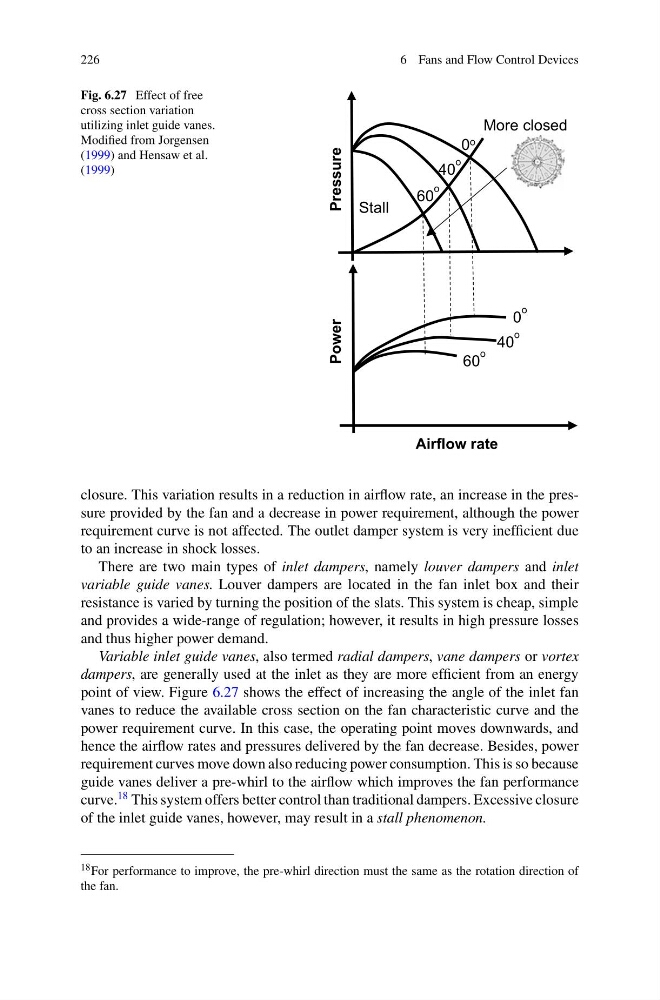
Fig. 6.27 Effect of free
cross section variation
utilizing inlet guide vanes.
Modified from Jorgensen
(1999) and Hensaw et al.
(1999)
Airflow rate
Power
Pressure
0 o
40
o
60
o
0
o
40
o
60
o
More closed
Stall
closure. This variation results in a reduction in airflow rate, an increase in the pressure provided by the fan and a decrease in power requirement, although the power
requirement curve is not affected. The outlet damper system is very inefficient due
to an increase in shock losses.
There are two main types of inlet dampers, namely louver dampers and inlet
variable guide vanes. Louver dampers are located in the fan inlet box and their
resistance is varied by turning the position of the slats. This system is cheap, simple
and provides a wide-range of regulation; however, it results in high pressure losses
and thus higher power demand.
Variable inlet guide vanes, also termed radial dampers, vane dampers or vortex
dampers, are generally used at the inlet as they are more efficient from an energy
point of view. Figure 6.27 shows the effect of increasing the angle of the inlet fan
vanes to reduce the available cross section on the fan characteristic curve and the
power requirement curve. In this case, the operating point moves downwards, and
hence the airflow rates and pressures delivered by the fan decrease. Besides, power
requirement curves move down also reducing power consumption. This is so because
guide vanes deliver a pre-whirl to the airflow which improves the fan performance
curve.
18 This system offers better control than traditional dampers. Excessive closure
of the inlet guide vanes, however, may result in a stall phenomenon.
18 For performance to improve, the pre-whirl direction must the same as the rotation direction of
the fan.
6 Fans and Flow Control Devices
Fig. 6.27 Effect of free
cross section variation
utilizing inlet guide vanes.
Modified from Jorgensen
(1999) and Hensaw et al.
(1999)
Airflow rate
Power
Pressure
0 o
40
o
60
o
0
o
40
o
60
o
More closed
Stall
closure. This variation results in a reduction in airflow rate, an increase in the pressure provided by the fan and a decrease in power requirement, although the power
requirement curve is not affected. The outlet damper system is very inefficient due
to an increase in shock losses.
There are two main types of inlet dampers, namely louver dampers and inlet
variable guide vanes. Louver dampers are located in the fan inlet box and their
resistance is varied by turning the position of the slats. This system is cheap, simple
and provides a wide-range of regulation; however, it results in high pressure losses
and thus higher power demand.
Variable inlet guide vanes, also termed radial dampers, vane dampers or vortex
dampers, are generally used at the inlet as they are more efficient from an energy
point of view. Figure 6.27 shows the effect of increasing the angle of the inlet fan
vanes to reduce the available cross section on the fan characteristic curve and the
power requirement curve. In this case, the operating point moves downwards, and
hence the airflow rates and pressures delivered by the fan decrease. Besides, power
requirement curves move down also reducing power consumption. This is so because
guide vanes deliver a pre-whirl to the airflow which improves the fan performance
curve.
18 This system offers better control than traditional dampers. Excessive closure
of the inlet guide vanes, however, may result in a stall phenomenon.
18 For performance to improve, the pre-whirl direction must the same as the rotation direction of
the fan.