

6.2 Fans
219
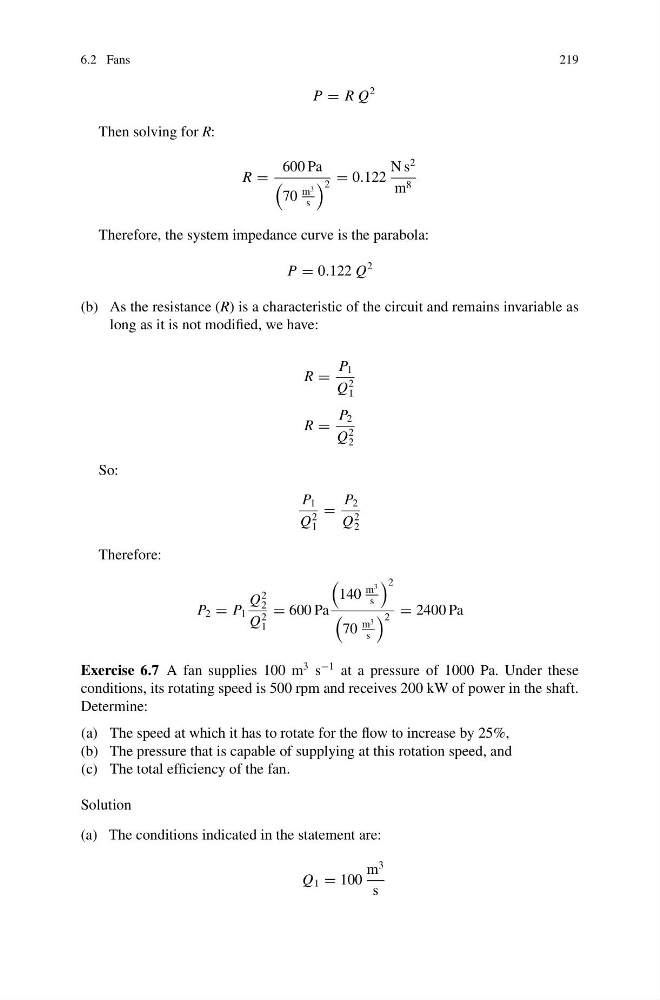
P = R Q
2
Then solving for R:
R =
600 Pa
70
m 3
s
2 = 0.122
N s
2
m 8
Therefore, the system impedance curve is the parabola:
P = 0.122 Q
2
(b) As the resistance (R) is a characteristic of the circuit and remains invariable as
long as it is not modified, we have:
R =
P 1
Q
2
1
R =
P 2
Q
2
2
So:
P 1
Q
2
1
=
P 2
Q
2
2
Therefore:
P 2 = P 1
Q
2
2
Q
2
1
= 600 Pa
140
m
3
s
2
70
m 3
s
2 = 2400 Pa
Exercise 6.7 A fan supplies 100 m
3 s
−1 at a pressure of 1000 Pa. Under these
conditions, its rotating speed is 500 rpm and receives 200 kW of power in the shaft.
Determine:
(a) The speed at which it has to rotate for the flow to increase by 25%,
(b) The pressure that is capable of supplying at this rotation speed, and
(c) The total efficiency of the fan.
Solution
(a) The conditions indicated in the statement are:
Q 1 = 100
m
3
s
219
P = R Q
2
Then solving for R:
R =
600 Pa
70
m 3
s
2 = 0.122
N s
2
m 8
Therefore, the system impedance curve is the parabola:
P = 0.122 Q
2
(b) As the resistance (R) is a characteristic of the circuit and remains invariable as
long as it is not modified, we have:
R =
P 1
Q
2
1
R =
P 2
Q
2
2
So:
P 1
Q
2
1
=
P 2
Q
2
2
Therefore:
P 2 = P 1
Q
2
2
Q
2
1
= 600 Pa
140
m
3
s
2
70
m 3
s
2 = 2400 Pa
Exercise 6.7 A fan supplies 100 m
3 s
−1 at a pressure of 1000 Pa. Under these
conditions, its rotating speed is 500 rpm and receives 200 kW of power in the shaft.
Determine:
(a) The speed at which it has to rotate for the flow to increase by 25%,
(b) The pressure that is capable of supplying at this rotation speed, and
(c) The total efficiency of the fan.
Solution
(a) The conditions indicated in the statement are:
Q 1 = 100
m
3
s