

214
6 Fans and Flow Control Devices
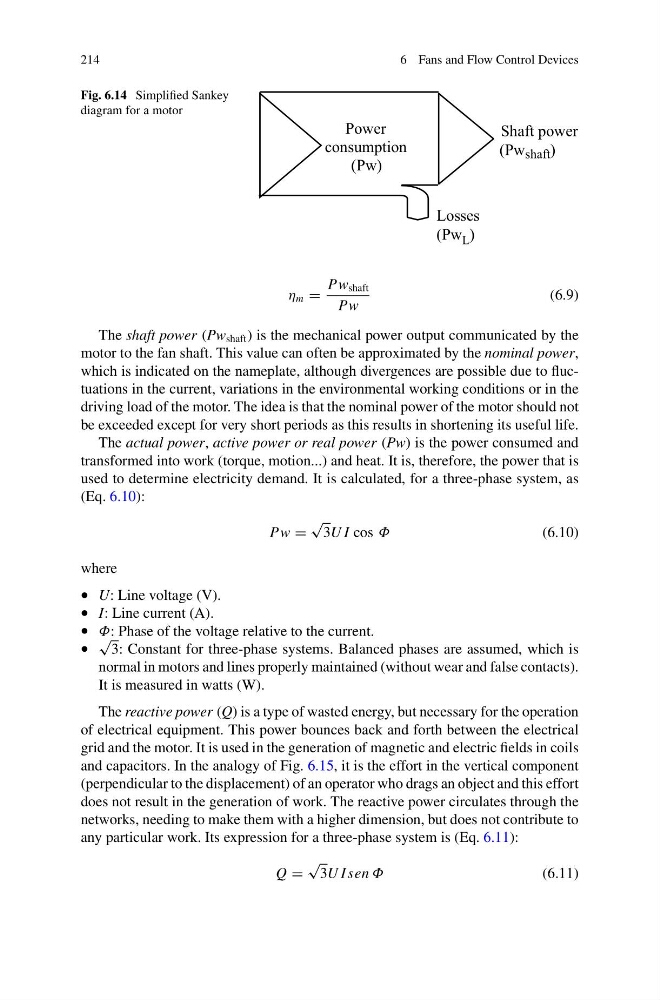
Fig. 6.14 Simplified Sankey
diagram for a motor
Power
consumption
(Pw)
(Pw shaft )
Shaft power
Losses
(Pw L )
η m =
Pw shaft
Pw
(6.9)
The shaft power (Pw shaft ) is the mechanical power output communicated by the
motor to the fan shaft. This value can often be approximated by the nominal power,
which is indicated on the nameplate, although divergences are possible due to fluctuations in the current, variations in the environmental working conditions or in the
driving load of the motor. The idea is that the nominal power of the motor should not
be exceeded except for very short periods as this results in shortening its useful life.
The actual power, active power or real power (Pw) is the power consumed and
transformed into work (torque, motion...) and heat. It is, therefore, the power that is
used to determine electricity demand. It is calculated, for a three-phase system, as
(Eq. 6.10):
Pw =
√
3U I cos Φ
(6.10)
where
• U: Line voltage (V).
• I: Line current (A).
• Φ: Phase of the voltage relative to the current.
•
√
3: Constant for three-phase systems. Balanced phases are assumed, which is
normal in motors and lines properly maintained (without wear and false contacts).
It is measured in watts (W).
The reactive power (Q) is a type of wasted energy, but necessary for the operation
of electrical equipment. This power bounces back and forth between the electrical
grid and the motor. It is used in the generation of magnetic and electric fields in coils
and capacitors. In the analogy of Fig. 6.15, it is the effort in the vertical component
(perpendicular to the displacement) of an operator who drags an object and this effort
does not result in the generation of work. The reactive power circulates through the
networks, needing to make them with a higher dimension, but does not contribute to
any particular work. Its expression for a three-phase system is (Eq. 6.11):
Q =
√
3U I sen Φ
(6.11)
6 Fans and Flow Control Devices
Fig. 6.14 Simplified Sankey
diagram for a motor
Power
consumption
(Pw)
(Pw shaft )
Shaft power
Losses
(Pw L )
η m =
Pw shaft
Pw
(6.9)
The shaft power (Pw shaft ) is the mechanical power output communicated by the
motor to the fan shaft. This value can often be approximated by the nominal power,
which is indicated on the nameplate, although divergences are possible due to fluctuations in the current, variations in the environmental working conditions or in the
driving load of the motor. The idea is that the nominal power of the motor should not
be exceeded except for very short periods as this results in shortening its useful life.
The actual power, active power or real power (Pw) is the power consumed and
transformed into work (torque, motion...) and heat. It is, therefore, the power that is
used to determine electricity demand. It is calculated, for a three-phase system, as
(Eq. 6.10):
Pw =
√
3U I cos Φ
(6.10)
where
• U: Line voltage (V).
• I: Line current (A).
• Φ: Phase of the voltage relative to the current.
•
√
3: Constant for three-phase systems. Balanced phases are assumed, which is
normal in motors and lines properly maintained (without wear and false contacts).
It is measured in watts (W).
The reactive power (Q) is a type of wasted energy, but necessary for the operation
of electrical equipment. This power bounces back and forth between the electrical
grid and the motor. It is used in the generation of magnetic and electric fields in coils
and capacitors. In the analogy of Fig. 6.15, it is the effort in the vertical component
(perpendicular to the displacement) of an operator who drags an object and this effort
does not result in the generation of work. The reactive power circulates through the
networks, needing to make them with a higher dimension, but does not contribute to
any particular work. Its expression for a three-phase system is (Eq. 6.11):
Q =
√
3U I sen Φ
(6.11)