

1.3 Fluid Dynamics
11
1.3.4 Continuity Equation and Bernoulli Effect
The continuity equation is nothing more than the law of conservation of mass applied
to the flow of a fluid through a duct. Therefore, you have that (Eq. 1.14):
ρ A 1 v 1 = ρ A 2 v 2
(1.14)
where ρ is the density of the fluid, A is the cross-sectional area of the duct and V is
the velocity in the section considered.
The above expression finds its most characteristic example in the Venturi effect.
This is the reduction in static pressure when the fluid velocity increases in the
constricted section of a duct.
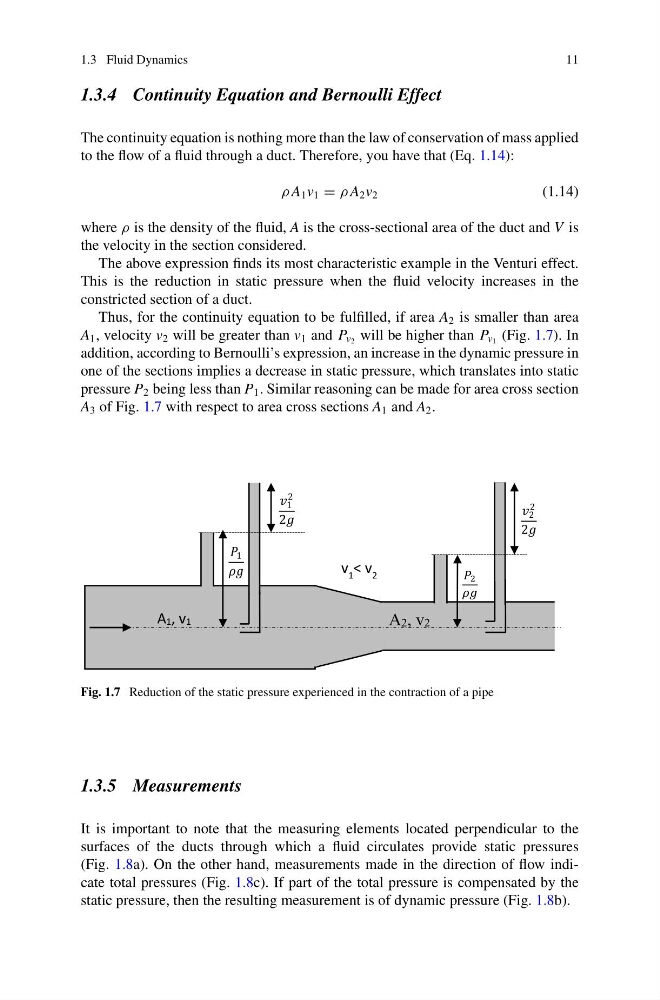
Thus, for the continuity equation to be fulfilled, if area A 2 is smaller than area
A 1 , velocity v 2 will be greater than v 1 and P v 2 will be higher than P v 1 (Fig. 1.7). In
addition, according to Bernoulli’s expression, an increase in the dynamic pressure in
one of the sections implies a decrease in static pressure, which translates into static
pressure P 2 being less than P 1 . Similar reasoning can be made for area cross section
A 3 of Fig. 1.7 with respect to area cross sections A 1 and A 2 .
Fig. 1.7 Reduction of the static pressure experienced in the contraction of a pipe
1.3.5 Measurements
It is important to note that the measuring elements located perpendicular to the
surfaces of the ducts through which a fluid circulates provide static pressures
(Fig. 1.8a). On the other hand, measurements made in the direction of flow indicate total pressures (Fig. 1.8c). If part of the total pressure is compensated by the
static pressure, then the resulting measurement is of dynamic pressure (Fig. 1.8b).
11
1.3.4 Continuity Equation and Bernoulli Effect
The continuity equation is nothing more than the law of conservation of mass applied
to the flow of a fluid through a duct. Therefore, you have that (Eq. 1.14):
ρ A 1 v 1 = ρ A 2 v 2
(1.14)
where ρ is the density of the fluid, A is the cross-sectional area of the duct and V is
the velocity in the section considered.
The above expression finds its most characteristic example in the Venturi effect.
This is the reduction in static pressure when the fluid velocity increases in the
constricted section of a duct.
Thus, for the continuity equation to be fulfilled, if area A 2 is smaller than area
A 1 , velocity v 2 will be greater than v 1 and P v 2 will be higher than P v 1 (Fig. 1.7). In
addition, according to Bernoulli’s expression, an increase in the dynamic pressure in
one of the sections implies a decrease in static pressure, which translates into static
pressure P 2 being less than P 1 . Similar reasoning can be made for area cross section
A 3 of Fig. 1.7 with respect to area cross sections A 1 and A 2 .
Fig. 1.7 Reduction of the static pressure experienced in the contraction of a pipe
1.3.5 Measurements
It is important to note that the measuring elements located perpendicular to the
surfaces of the ducts through which a fluid circulates provide static pressures
(Fig. 1.8a). On the other hand, measurements made in the direction of flow indicate total pressures (Fig. 1.8c). If part of the total pressure is compensated by the
static pressure, then the resulting measurement is of dynamic pressure (Fig. 1.8b).