

188
5 Main Ventilation
5.8 Ventilation and Exploitation Method
The fundamental factors to consider in the selection of an exploitation method are
morphological, geotechnical and economic. In addition, as each method must be
ventilated differently, ventilation may, in some cases, influence the selection of the
method. Any mining engineering textbook in which mining methods are studied will
provide a detailed account of the particulars of the ventilation system to be used
for each of them. The ventilation of the most common mining methods is explained
afterwards for illustrative purposes.
For example, in the case of pillar-supported methods, the most characteristic
is that of room and pillars. This method generates large horizontal extensions, of
complex ventilation in which diesel equipment is the most common. The method
implies the installation of auxiliary fans in the faces, although it is still frequent to
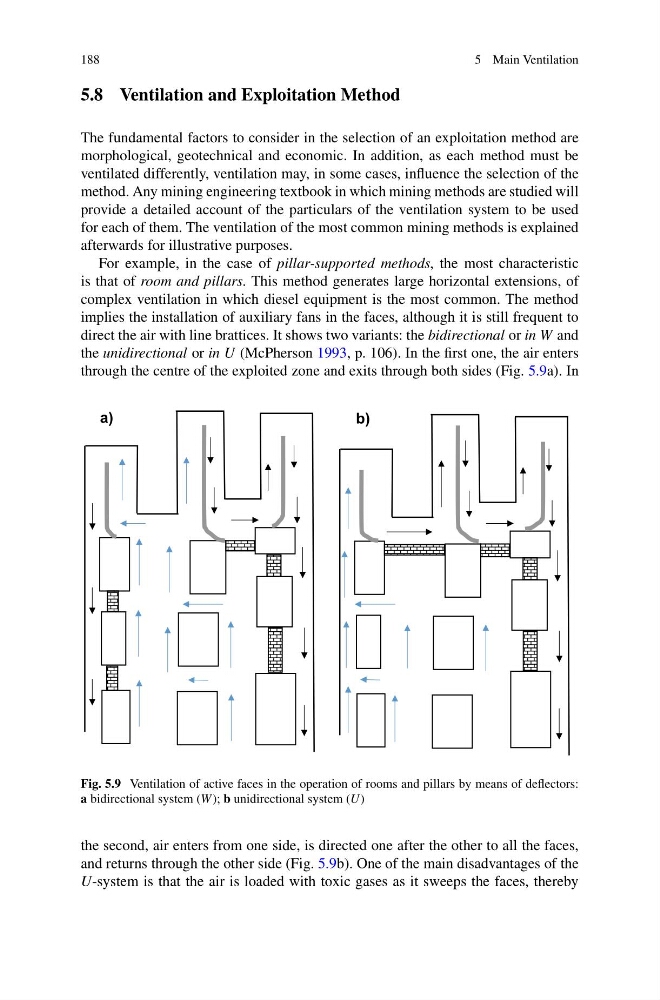
direct the air with line brattices. It shows two variants: the bidirectional or in W and
the unidirectional or in U (McPherson 1993, p. 106). In the first one, the air enters
through the centre of the exploited zone and exits through both sides (Fig. 5.9a). In
a)
b)
Fig. 5.9 Ventilation of active faces in the operation of rooms and pillars by means of deflectors:
a bidirectional system (W ); b unidirectional system (U)
the second, air enters from one side, is directed one after the other to all the faces,
and returns through the other side (Fig. 5.9b). One of the main disadvantages of the
U-system is that the air is loaded with toxic gases as it sweeps the faces, thereby
5 Main Ventilation
5.8 Ventilation and Exploitation Method
The fundamental factors to consider in the selection of an exploitation method are
morphological, geotechnical and economic. In addition, as each method must be
ventilated differently, ventilation may, in some cases, influence the selection of the
method. Any mining engineering textbook in which mining methods are studied will
provide a detailed account of the particulars of the ventilation system to be used
for each of them. The ventilation of the most common mining methods is explained
afterwards for illustrative purposes.
For example, in the case of pillar-supported methods, the most characteristic
is that of room and pillars. This method generates large horizontal extensions, of
complex ventilation in which diesel equipment is the most common. The method
implies the installation of auxiliary fans in the faces, although it is still frequent to
direct the air with line brattices. It shows two variants: the bidirectional or in W and
the unidirectional or in U (McPherson 1993, p. 106). In the first one, the air enters
through the centre of the exploited zone and exits through both sides (Fig. 5.9a). In
a)
b)
Fig. 5.9 Ventilation of active faces in the operation of rooms and pillars by means of deflectors:
a bidirectional system (W ); b unidirectional system (U)
the second, air enters from one side, is directed one after the other to all the faces,
and returns through the other side (Fig. 5.9b). One of the main disadvantages of the
U-system is that the air is loaded with toxic gases as it sweeps the faces, thereby