

5.5 Airflow Generation Systems
185
• Shock pressure losses are higher in blowing than in depression systems.
Taking all this into account, the preferred system for the main ventilation is
depression, assisted by several booster fans distributed inside the mine.
5.6 Direction of Transportation
The direction of air circulation is also strongly conditioned by the direction of transport inside the mine. According to this, two systems are distinguished: anti-tropic
and homotropic. In the former, the movement of air and materials transported from
the mine to the outside takes place in the opposite direction. Whereas, in the latter,
the direction of the airflow and the materials transported outside the mine coincide.
In general, the homotropic is the preferred one, as it raises less dust and heat, and
gases generated inside the mine are expelled more easily. Moreover, this system also
allows for a better management of eventual fires that take place in the mine slope.
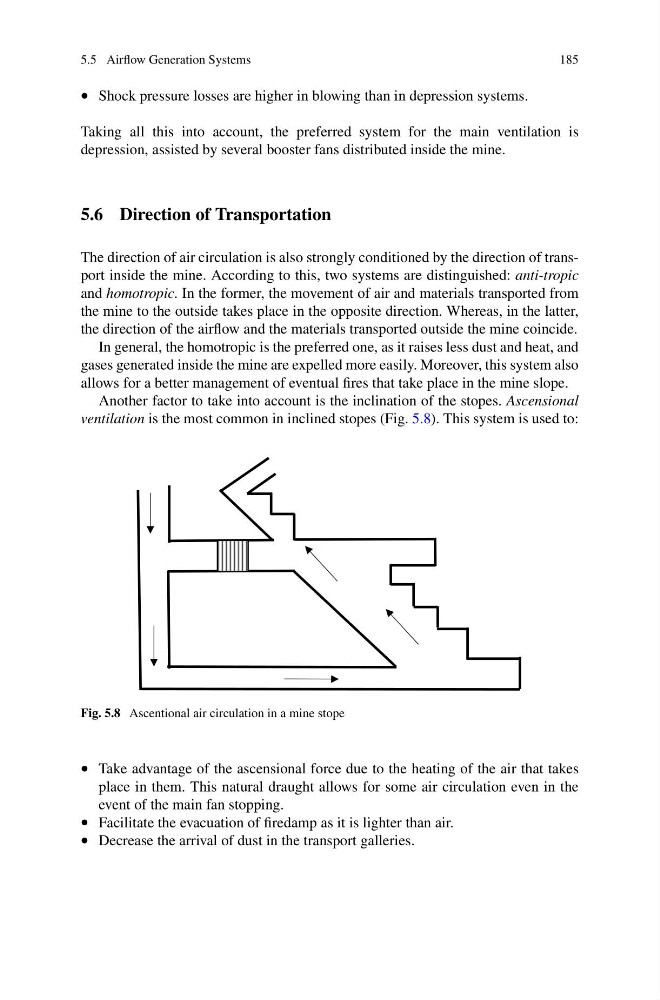
Another factor to take into account is the inclination of the stopes. Ascensional
ventilation is the most common in inclined stopes (Fig. 5.8). This system is used to:
Fig. 5.8 Ascentional air circulation in a mine stope
• Take advantage of the ascensional force due to the heating of the air that takes
place in them. This natural draught allows for some air circulation even in the
event of the main fan stopping.
• Facilitate the evacuation of firedamp as it is lighter than air.
• Decrease the arrival of dust in the transport galleries.
185
• Shock pressure losses are higher in blowing than in depression systems.
Taking all this into account, the preferred system for the main ventilation is
depression, assisted by several booster fans distributed inside the mine.
5.6 Direction of Transportation
The direction of air circulation is also strongly conditioned by the direction of transport inside the mine. According to this, two systems are distinguished: anti-tropic
and homotropic. In the former, the movement of air and materials transported from
the mine to the outside takes place in the opposite direction. Whereas, in the latter,
the direction of the airflow and the materials transported outside the mine coincide.
In general, the homotropic is the preferred one, as it raises less dust and heat, and
gases generated inside the mine are expelled more easily. Moreover, this system also
allows for a better management of eventual fires that take place in the mine slope.
Another factor to take into account is the inclination of the stopes. Ascensional
ventilation is the most common in inclined stopes (Fig. 5.8). This system is used to:
Fig. 5.8 Ascentional air circulation in a mine stope
• Take advantage of the ascensional force due to the heating of the air that takes
place in them. This natural draught allows for some air circulation even in the
event of the main fan stopping.
• Facilitate the evacuation of firedamp as it is lighter than air.
• Decrease the arrival of dust in the transport galleries.