

5.3 Natural Ventilation
167
• To use the dry air values for R. Therefore, as R mass for dry air is approximately
3
287
J
K kg
. Referred in weight R w = 29.29
J
N K
.
• If both shafts have the same depth (h), the P md is approximately equal to the P mu ,
and equal to the average pressure on the shafts (P m ).
• Finally, P m is about 101 kPa and it is difficult to measure, so in some texts, it is
simplified by the value of atmospheric pressure.
So P n can be calculated as (e.g. Hartman et al. 1997, p. 298):
P n =
h P m
R
1
T md
−
1
T mu
where substituting, we have (Eq. 5.4):
P n = 0.03415
N K
J
h P m
1
T md
−
1
T mu
(5.4)
The temperature close to the mouth of the downcast shaft could be quite similar
to that of the air outside, thus being instable. Similarly, the temperature of the upcast
shaft may resemble largely that of the interior of the mine. So T md and T mu are
normally obtained as the mean between the temperatures that exist at the bottom of
the shafts and 35 m below their respective mouths (neutral zone).
Equation 5.4 assumes that downcast and upcast shafts have an equal depth. Some
considerations must then be made in the event that the mouths of the two shafts are
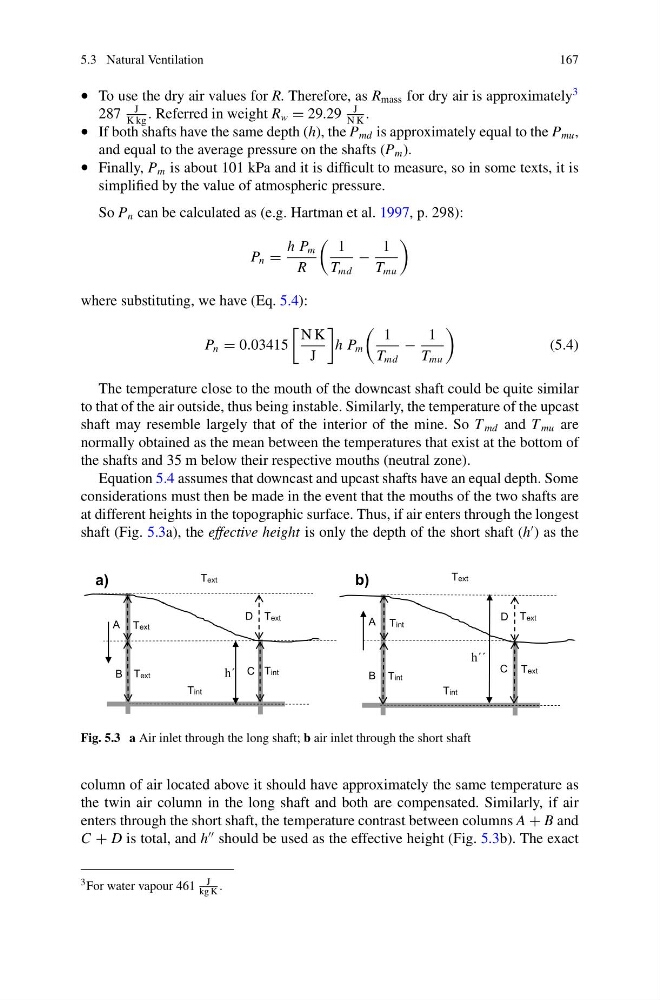
at different heights in the topographic surface. Thus, if air enters through the longest
shaft (Fig. 5.3a), the effective height is only the depth of the short shaft (h
) as the
Text
Text
Text
Tint
Tint
h´
Text
Text
Text
Text
Tint
Tint
Tint
a)
b)
h´´
C
D
A
B
B
A
D
C
Fig. 5.3 a Air inlet through the long shaft; b air inlet through the short shaft
column of air located above it should have approximately the same temperature as
the twin air column in the long shaft and both are compensated. Similarly, if air
enters through the short shaft, the temperature contrast between columns A + B and
C + D is total, and h
should be used as the effective height (Fig. 5.3b). The exact
3 For water vapour 461
J
kg K .
167
• To use the dry air values for R. Therefore, as R mass for dry air is approximately
3
287
J
K kg
. Referred in weight R w = 29.29
J
N K
.
• If both shafts have the same depth (h), the P md is approximately equal to the P mu ,
and equal to the average pressure on the shafts (P m ).
• Finally, P m is about 101 kPa and it is difficult to measure, so in some texts, it is
simplified by the value of atmospheric pressure.
So P n can be calculated as (e.g. Hartman et al. 1997, p. 298):
P n =
h P m
R
1
T md
−
1
T mu
where substituting, we have (Eq. 5.4):
P n = 0.03415
N K
J
h P m
1
T md
−
1
T mu
(5.4)
The temperature close to the mouth of the downcast shaft could be quite similar
to that of the air outside, thus being instable. Similarly, the temperature of the upcast
shaft may resemble largely that of the interior of the mine. So T md and T mu are
normally obtained as the mean between the temperatures that exist at the bottom of
the shafts and 35 m below their respective mouths (neutral zone).
Equation 5.4 assumes that downcast and upcast shafts have an equal depth. Some
considerations must then be made in the event that the mouths of the two shafts are
at different heights in the topographic surface. Thus, if air enters through the longest
shaft (Fig. 5.3a), the effective height is only the depth of the short shaft (h
) as the
Text
Text
Text
Tint
Tint
h´
Text
Text
Text
Text
Tint
Tint
Tint
a)
b)
h´´
C
D
A
B
B
A
D
C
Fig. 5.3 a Air inlet through the long shaft; b air inlet through the short shaft
column of air located above it should have approximately the same temperature as
the twin air column in the long shaft and both are compensated. Similarly, if air
enters through the short shaft, the temperature contrast between columns A + B and
C + D is total, and h
should be used as the effective height (Fig. 5.3b). The exact
3 For water vapour 461
J
kg K .