

158
4 Mine Ventilation Networks
Matrix of functions
|F i |
Jacobian of the system |J|
Q i = −
J −1 F
Function Calculation
Q 12
Q 23
Inverse matrix |J| =
|J| −1
Q ij Value
F x =
0.0
dF x /dQ i 114.09626 −10.23624 0.0089196 0.0017287 Q 12 0.000
F y =
6.945 ×
10 −5
dF y /dQ i −10.23624 52.816727 0.0017287 0.0
Q 23 0.000
R 14
R 12
R 24
R 34
R 23
Q 12
Q 23
Q a
0.4
0.3
0.8
0.2
0.1
80.700
87.098
150
Solutions for iteration 5
Q 14
Q 12
Q 24
Q 34
Q 23
−69.300
80.700
−6.398
−62.902
87.098
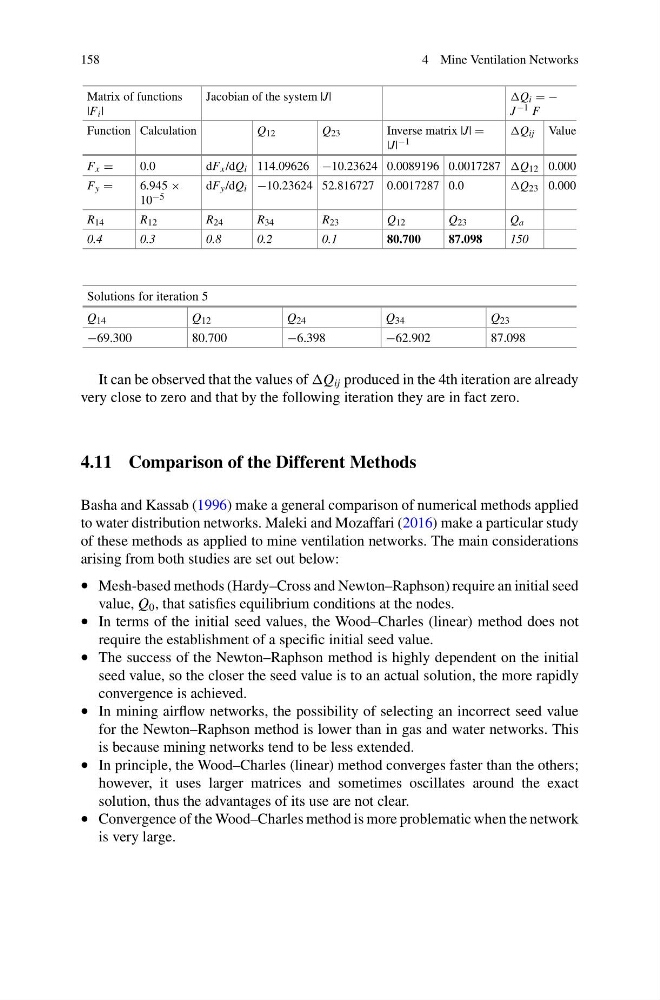
It can be observed that the values of Q ij produced in the 4th iteration are already
very close to zero and that by the following iteration they are in fact zero.
4.11 Comparison of the Different Methods
Basha and Kassab (1996) make a general comparison of numerical methods applied
to water distribution networks. Maleki and Mozaffari (2016) make a particular study
of these methods as applied to mine ventilation networks. The main considerations
arising from both studies are set out below:
• Mesh-based methods (Hardy–Cross and Newton–Raphson) require an initial seed
value, Q 0 , that satisfies equilibrium conditions at the nodes.
• In terms of the initial seed values, the Wood–Charles (linear) method does not
require the establishment of a specific initial seed value.
• The success of the Newton–Raphson method is highly dependent on the initial
seed value, so the closer the seed value is to an actual solution, the more rapidly
convergence is achieved.
• In mining airflow networks, the possibility of selecting an incorrect seed value
for the Newton–Raphson method is lower than in gas and water networks. This
is because mining networks tend to be less extended.
• In principle, the Wood–Charles (linear) method converges faster than the others;
however, it uses larger matrices and sometimes oscillates around the exact
solution, thus the advantages of its use are not clear.
• Convergence of the Wood–Charles method is more problematic when the network
is very large.
4 Mine Ventilation Networks
Matrix of functions
|F i |
Jacobian of the system |J|
Q i = −
J −1 F
Function Calculation
Q 12
Q 23
Inverse matrix |J| =
|J| −1
Q ij Value
F x =
0.0
dF x /dQ i 114.09626 −10.23624 0.0089196 0.0017287 Q 12 0.000
F y =
6.945 ×
10 −5
dF y /dQ i −10.23624 52.816727 0.0017287 0.0
Q 23 0.000
R 14
R 12
R 24
R 34
R 23
Q 12
Q 23
Q a
0.4
0.3
0.8
0.2
0.1
80.700
87.098
150
Solutions for iteration 5
Q 14
Q 12
Q 24
Q 34
Q 23
−69.300
80.700
−6.398
−62.902
87.098
It can be observed that the values of Q ij produced in the 4th iteration are already
very close to zero and that by the following iteration they are in fact zero.
4.11 Comparison of the Different Methods
Basha and Kassab (1996) make a general comparison of numerical methods applied
to water distribution networks. Maleki and Mozaffari (2016) make a particular study
of these methods as applied to mine ventilation networks. The main considerations
arising from both studies are set out below:
• Mesh-based methods (Hardy–Cross and Newton–Raphson) require an initial seed
value, Q 0 , that satisfies equilibrium conditions at the nodes.
• In terms of the initial seed values, the Wood–Charles (linear) method does not
require the establishment of a specific initial seed value.
• The success of the Newton–Raphson method is highly dependent on the initial
seed value, so the closer the seed value is to an actual solution, the more rapidly
convergence is achieved.
• In mining airflow networks, the possibility of selecting an incorrect seed value
for the Newton–Raphson method is lower than in gas and water networks. This
is because mining networks tend to be less extended.
• In principle, the Wood–Charles (linear) method converges faster than the others;
however, it uses larger matrices and sometimes oscillates around the exact
solution, thus the advantages of its use are not clear.
• Convergence of the Wood–Charles method is more problematic when the network
is very large.