

4.10 Complex Networks
147
sign changes, once again we use absolute values, thus: K (n) = R i
Q i(n−1)
, then: R 14
ǀQ 14(1) ǀ = 0.4 ǀ−60.89ǀ = 24.3564.
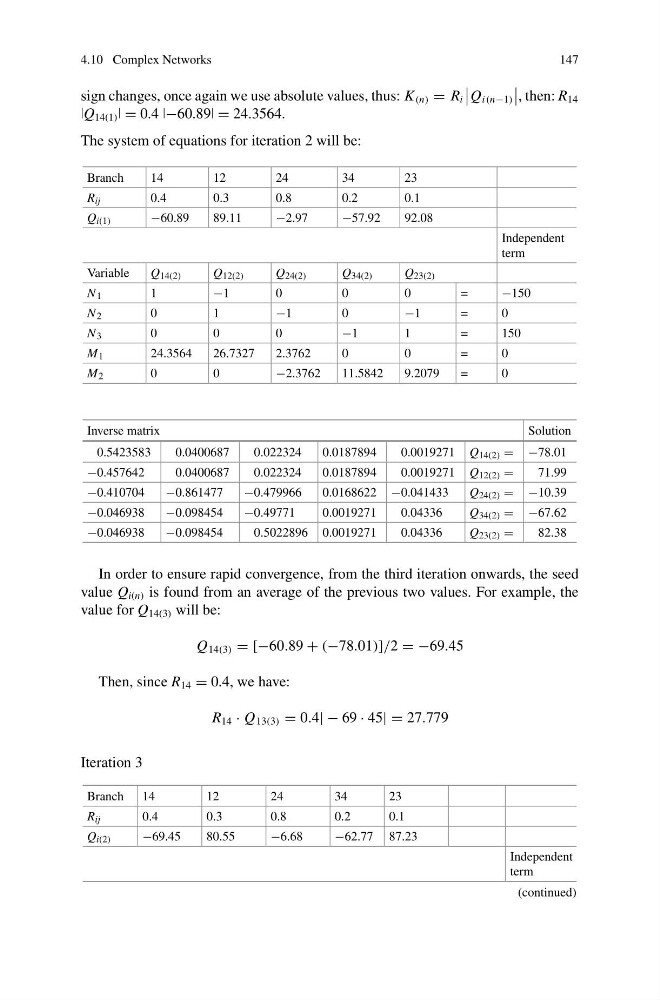
The system of equations for iteration 2 will be:
Branch
14
12
24
34
23
R ij
0.4
0.3
0.8
0.2
0.1
Q i(1)
−60.89
89.11
−2.97
−57.92
92.08
Independent
term
Variable
Q 14(2)
Q 12(2)
Q 24(2)
Q 34(2)
Q 23(2)
N 1
1
−1
0
0
0
=
−150
N 2
0
1
−1
0
−1
=
0
N 3
0
0
0
−1
1
=
150
M 1
24.3564
26.7327
2.3762
0
0
=
0
M 2
0
0
−2.3762
11.5842
9.2079
=
0
Inverse matrix
Solution
0.5423583
0.0400687
0.022324
0.0187894
0.0019271 Q 14(2) = −78.01
−0.457642
0.0400687
0.022324
0.0187894
0.0019271 Q 12(2) =
71.99
−0.410704
−0.861477
−0.479966
0.0168622 −0.041433
Q 24(2) = −10.39
−0.046938
−0.098454
−0.49771
0.0019271
0.04336
Q 34(2) = −67.62
−0.046938
−0.098454
0.5022896 0.0019271
0.04336
Q 23(2) =
82.38
In order to ensure rapid convergence, from the third iteration onwards, the seed
value Q i(n) is found from an average of the previous two values. For example, the
value for Q 14(3) will be:
Q 14(3) = [−60.89 + (−78.01)]/2 = −69.45
Then, since R 14 = 0.4, we have:
R 14 · Q 13(3) = 0.4| − 69 · 45| = 27.779
Iteration 3
Branch 14
12
24
34
23
R ij
0.4
0.3
0.8
0.2
0.1
Q i(2)
−69.45
80.55
−6.68
−62.77 87.23
Independent
term
(continued)
147
sign changes, once again we use absolute values, thus: K (n) = R i
Q i(n−1)
, then: R 14
ǀQ 14(1) ǀ = 0.4 ǀ−60.89ǀ = 24.3564.
The system of equations for iteration 2 will be:
Branch
14
12
24
34
23
R ij
0.4
0.3
0.8
0.2
0.1
Q i(1)
−60.89
89.11
−2.97
−57.92
92.08
Independent
term
Variable
Q 14(2)
Q 12(2)
Q 24(2)
Q 34(2)
Q 23(2)
N 1
1
−1
0
0
0
=
−150
N 2
0
1
−1
0
−1
=
0
N 3
0
0
0
−1
1
=
150
M 1
24.3564
26.7327
2.3762
0
0
=
0
M 2
0
0
−2.3762
11.5842
9.2079
=
0
Inverse matrix
Solution
0.5423583
0.0400687
0.022324
0.0187894
0.0019271 Q 14(2) = −78.01
−0.457642
0.0400687
0.022324
0.0187894
0.0019271 Q 12(2) =
71.99
−0.410704
−0.861477
−0.479966
0.0168622 −0.041433
Q 24(2) = −10.39
−0.046938
−0.098454
−0.49771
0.0019271
0.04336
Q 34(2) = −67.62
−0.046938
−0.098454
0.5022896 0.0019271
0.04336
Q 23(2) =
82.38
In order to ensure rapid convergence, from the third iteration onwards, the seed
value Q i(n) is found from an average of the previous two values. For example, the
value for Q 14(3) will be:
Q 14(3) = [−60.89 + (−78.01)]/2 = −69.45
Then, since R 14 = 0.4, we have:
R 14 · Q 13(3) = 0.4| − 69 · 45| = 27.779
Iteration 3
Branch 14
12
24
34
23
R ij
0.4
0.3
0.8
0.2
0.1
Q i(2)
−69.45
80.55
−6.68
−62.77 87.23
Independent
term
(continued)