

124
4 Mine Ventilation Networks
4.9.1 Splitting Air Currents
Diving the total airflow through several branches of a network is a requirement in
most ventilation regulations as it permits the creation of separated ventilation districts
thus increasing the overall safety of the network. Moreover, it is a common strategy
by which to reduce the pressure that the main fan must supply. This is a natural
consequence of the fact that the pressure drop is equal across multiple airways in
parallel. Parallel branches can be created in multiple locations of the mine but are
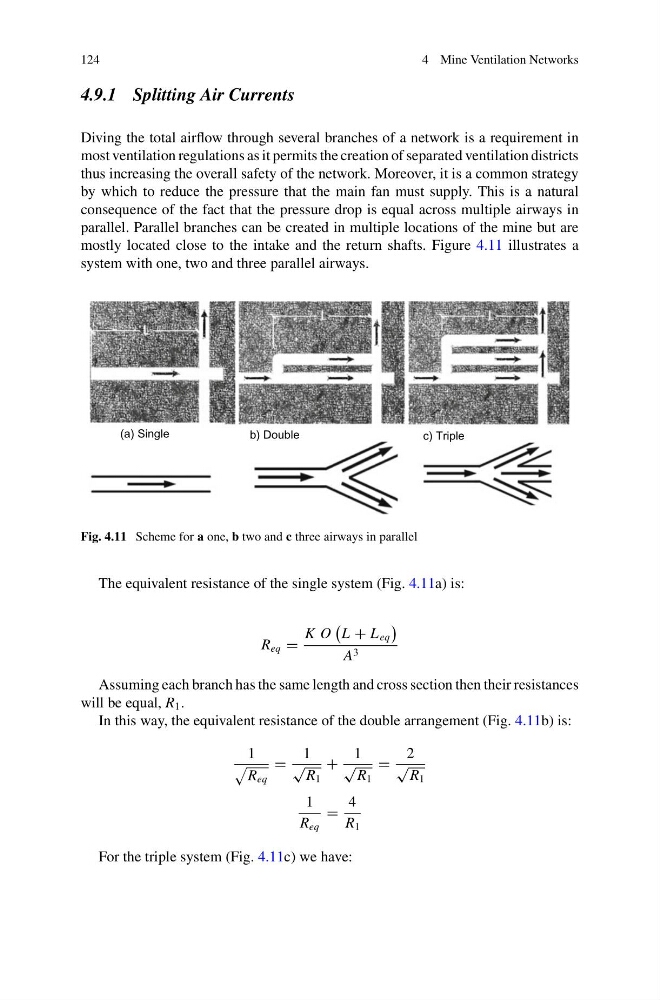
mostly located close to the intake and the return shafts. Figure 4.11 illustrates a
system with one, two and three parallel airways.
(a) Single
b) Double
c) Triple
Fig. 4.11 Scheme for a one, b two and c three airways in parallel
The equivalent resistance of the single system (Fig. 4.11a) is:
R eq =
K O
L + L eq
A 3
Assuming each branch has the same length and cross section then their resistances
will be equal, R 1 .
In this way, the equivalent resistance of the double arrangement (Fig. 4.11b) is:
1
R eq
=
1
√
R 1
+
1
√
R 1
=
2
√
R 1
1
R eq
=
4
R 1
For the triple system (Fig. 4.11c) we have:
4 Mine Ventilation Networks
4.9.1 Splitting Air Currents
Diving the total airflow through several branches of a network is a requirement in
most ventilation regulations as it permits the creation of separated ventilation districts
thus increasing the overall safety of the network. Moreover, it is a common strategy
by which to reduce the pressure that the main fan must supply. This is a natural
consequence of the fact that the pressure drop is equal across multiple airways in
parallel. Parallel branches can be created in multiple locations of the mine but are
mostly located close to the intake and the return shafts. Figure 4.11 illustrates a
system with one, two and three parallel airways.
(a) Single
b) Double
c) Triple
Fig. 4.11 Scheme for a one, b two and c three airways in parallel
The equivalent resistance of the single system (Fig. 4.11a) is:
R eq =
K O
L + L eq
A 3
Assuming each branch has the same length and cross section then their resistances
will be equal, R 1 .
In this way, the equivalent resistance of the double arrangement (Fig. 4.11b) is:
1
R eq
=
1
√
R 1
+
1
√
R 1
=
2
√
R 1
1
R eq
=
4
R 1
For the triple system (Fig. 4.11c) we have: