

4.9 Resistances in Parallel
119
Therefore, we obtain, for the system:
Q A + Q B = 27.022
m
3
s
0.7
N s
2
m 8 Q
2
A = 234.83 Pa
Solving this we get:
Q A = 18.322
m
3
s
Q B = 8.70
m
3
s
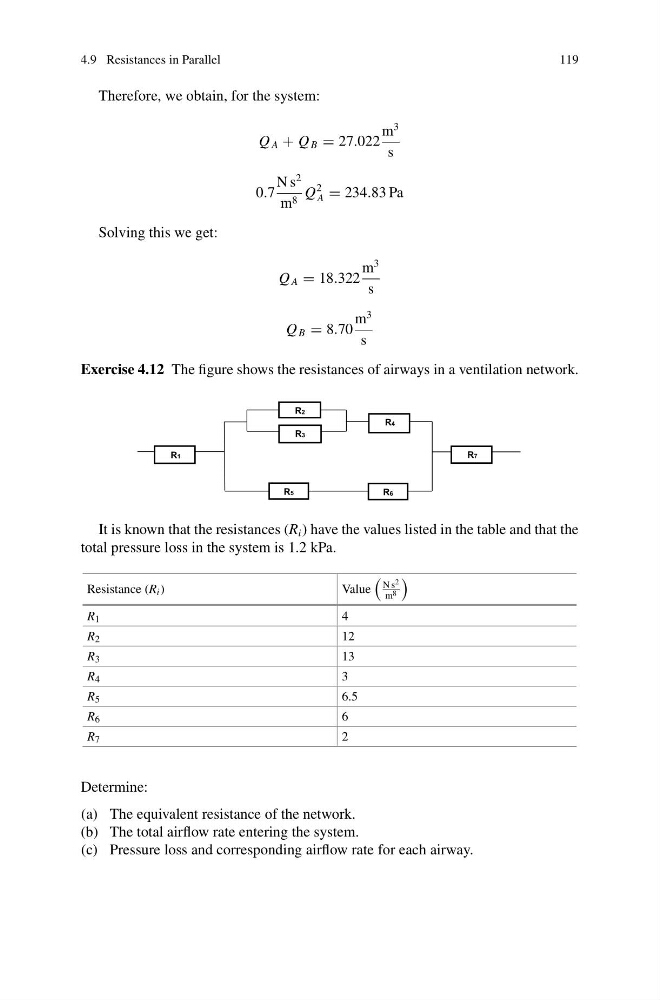
Exercise 4.12 The figure shows the resistances of airways in a ventilation network.
R1
R2
R3
R4
R6
R7
R5
It is known that the resistances (R i ) have the values listed in the table and that the
total pressure loss in the system is 1.2 kPa.
Resistance (R i )
Value
N s 2
m 8
R 1
4
R 2
12
R 3
13
R 4
3
R 5
6.5
R 6
6
R 7
2
Determine:
(a) The equivalent resistance of the network.
(b) The total airflow rate entering the system.
(c) Pressure loss and corresponding airflow rate for each airway.
119
Therefore, we obtain, for the system:
Q A + Q B = 27.022
m
3
s
0.7
N s
2
m 8 Q
2
A = 234.83 Pa
Solving this we get:
Q A = 18.322
m
3
s
Q B = 8.70
m
3
s
Exercise 4.12 The figure shows the resistances of airways in a ventilation network.
R1
R2
R3
R4
R6
R7
R5
It is known that the resistances (R i ) have the values listed in the table and that the
total pressure loss in the system is 1.2 kPa.
Resistance (R i )
Value
N s 2
m 8
R 1
4
R 2
12
R 3
13
R 4
3
R 5
6.5
R 6
6
R 7
2
Determine:
(a) The equivalent resistance of the network.
(b) The total airflow rate entering the system.
(c) Pressure loss and corresponding airflow rate for each airway.