

4.9 Resistances in Parallel
117
Once this is done, we see that R 2453 is in series with both R 1 and R 6 such that, to
calculate the equivalent resistance for the network of airways (R eq ):
R eq = R 1 + R 6 + R 2453 = (20 + 27 + 11.49)
N s
2
m 8 = 58.49
N s
2
m 8
(b) The pressure loss between the inlet and the outlet is defined by Atkinson’s
equation:
= R eq Q
2
= 58.49
N s
2
m 8
150
m
3
s
2
= 1.31 MPa
(c) This exercise is designed to establish the importance of verifying whether results
make physical sense. Here, although calculations are correct, the results make
no technical sense. The calculated pressure of 13 atm required to ventilate the
mine, is absolutely unfeasible. To understand this, consider the following:
1. No fan would supply such pressure; the air inside the network would simply
become compressed.
2. The proposed pressure would put at risk the lives of workers.
3. Atkinson’s equation would, in fact, no longer apply under these operating
conditions.
The inconsistency observed here between calculation and operating reality may
be due to two considerations: the airflow recorded is excessive and/or the resistances
of the mine airways have been incorrectly estimated The first is the one which most
influences the working pressure of the fan. To illustrate this, consider that in order
to double the airflow rate into any mine, the pressure provided by the main fan must
be quadrupled. Moreover, the airflow rate stated in the exercise is not excessive for
a main fan as normal flow rates range between 150 and 350 m
3 s
−1 . However, as far
as the resistances are concerned, this is a very high total resistance for a very simple
scheme. In fact, it is unlikely that it could be overcome even by the use of booster
fans to assist the main fan. It seems, therefore that this last consideration is the likely
source of the inconsistencies highlighted.
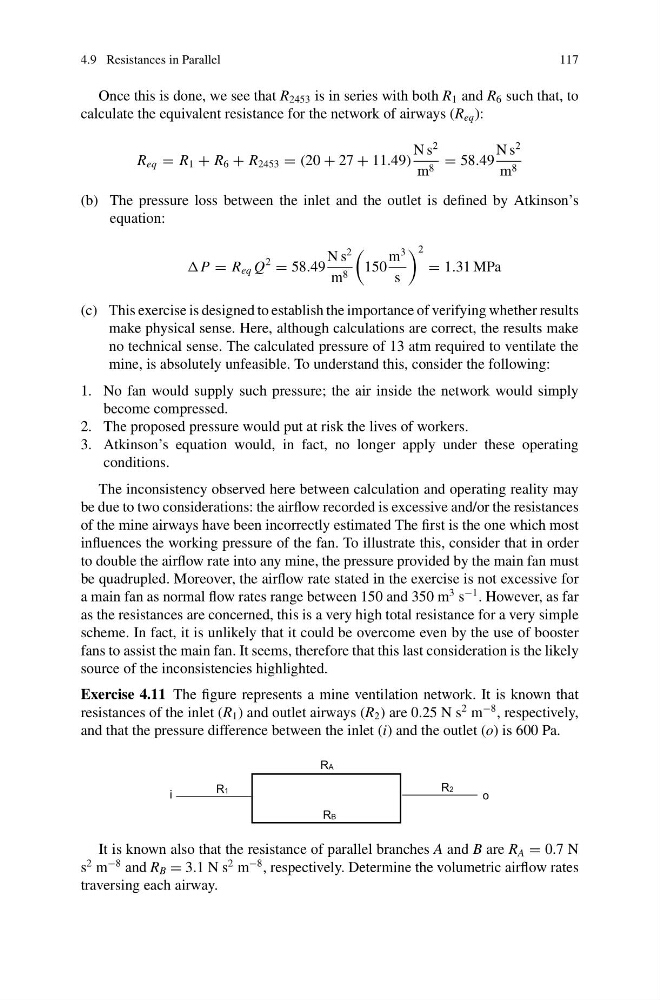
Exercise 4.11 The figure represents a mine ventilation network. It is known that
resistances of the inlet (R 1 ) and outlet airways (R 2 ) are 0.25 N s
2 m
−8 , respectively,
and that the pressure difference between the inlet (i) and the outlet (o) is 600 Pa.
i
o
RB
RA
R2
R1
It is known also that the resistance of parallel branches A and B are R A = 0.7 N
s
2 m
−8 and R B = 3.1 N s
2 m
−8 , respectively. Determine the volumetric airflow rates
traversing each airway.
117
Once this is done, we see that R 2453 is in series with both R 1 and R 6 such that, to
calculate the equivalent resistance for the network of airways (R eq ):
R eq = R 1 + R 6 + R 2453 = (20 + 27 + 11.49)
N s
2
m 8 = 58.49
N s
2
m 8
(b) The pressure loss between the inlet and the outlet is defined by Atkinson’s
equation:
= R eq Q
2
= 58.49
N s
2
m 8
150
m
3
s
2
= 1.31 MPa
(c) This exercise is designed to establish the importance of verifying whether results
make physical sense. Here, although calculations are correct, the results make
no technical sense. The calculated pressure of 13 atm required to ventilate the
mine, is absolutely unfeasible. To understand this, consider the following:
1. No fan would supply such pressure; the air inside the network would simply
become compressed.
2. The proposed pressure would put at risk the lives of workers.
3. Atkinson’s equation would, in fact, no longer apply under these operating
conditions.
The inconsistency observed here between calculation and operating reality may
be due to two considerations: the airflow recorded is excessive and/or the resistances
of the mine airways have been incorrectly estimated The first is the one which most
influences the working pressure of the fan. To illustrate this, consider that in order
to double the airflow rate into any mine, the pressure provided by the main fan must
be quadrupled. Moreover, the airflow rate stated in the exercise is not excessive for
a main fan as normal flow rates range between 150 and 350 m
3 s
−1 . However, as far
as the resistances are concerned, this is a very high total resistance for a very simple
scheme. In fact, it is unlikely that it could be overcome even by the use of booster
fans to assist the main fan. It seems, therefore that this last consideration is the likely
source of the inconsistencies highlighted.
Exercise 4.11 The figure represents a mine ventilation network. It is known that
resistances of the inlet (R 1 ) and outlet airways (R 2 ) are 0.25 N s
2 m
−8 , respectively,
and that the pressure difference between the inlet (i) and the outlet (o) is 600 Pa.
i
o
RB
RA
R2
R1
It is known also that the resistance of parallel branches A and B are R A = 0.7 N
s
2 m
−8 and R B = 3.1 N s
2 m
−8 , respectively. Determine the volumetric airflow rates
traversing each airway.