

114
4 Mine Ventilation Networks
Therefore:
R eq
=
P
R 1
+
P
R 2
+
P
R 3
Finally:
1
R eq
=
1
√
R 1
+
1
√
R 2
+
1
√
R 3
Thus, generalizing for n resistances (Eq. 4.20):
1
R eq
=
n
i=1
1
√
R i
(4.20)
Therefore, in a parallel arrangement, the reciprocal of the square root of the
equivalent resistance (R eq ) is the sum of the reciprocals of the square roots of the n
resistances of each branch (R i ).
Question 4.3 Comment on the expression: “Air always tends to flow through the
shortest path”.
Answer
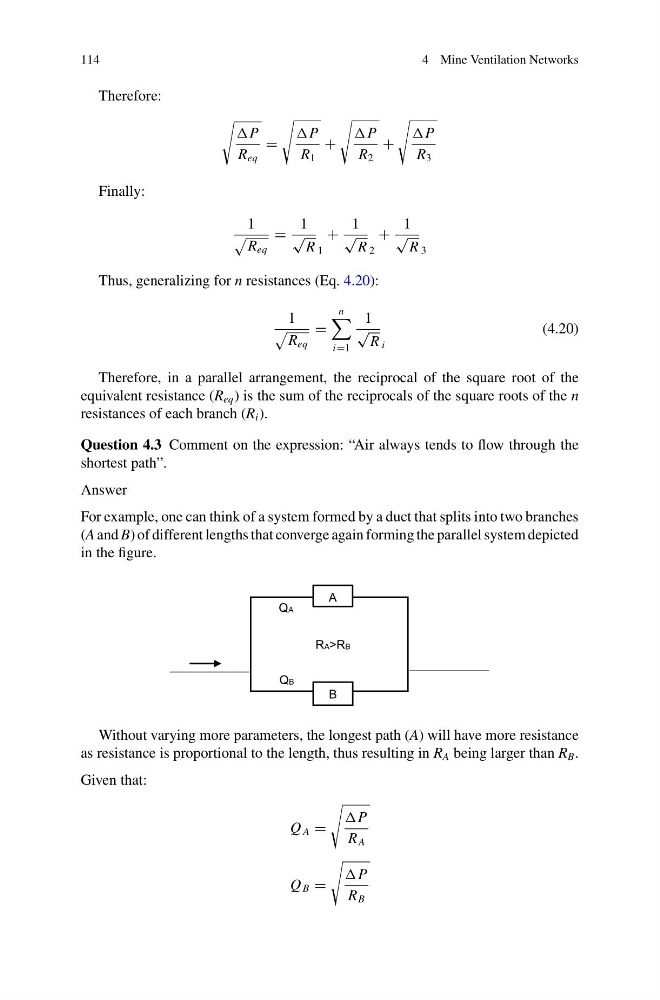
For example, one can think of a system formed by a duct that splits into two branches
(A and B) of different lengths that converge again forming the parallel system depicted
in the figure.
B
A
RA>RB
QB
QA
Without varying more parameters, the longest path (A) will have more resistance
as resistance is proportional to the length, thus resulting in R A being larger than R B .
Given that:
Q A =
R A
Q B =
P
R B
4 Mine Ventilation Networks
Therefore:
R eq
=
P
R 1
+
P
R 2
+
P
R 3
Finally:
1
R eq
=
1
√
R 1
+
1
√
R 2
+
1
√
R 3
Thus, generalizing for n resistances (Eq. 4.20):
1
R eq
=
n
i=1
1
√
R i
(4.20)
Therefore, in a parallel arrangement, the reciprocal of the square root of the
equivalent resistance (R eq ) is the sum of the reciprocals of the square roots of the n
resistances of each branch (R i ).
Question 4.3 Comment on the expression: “Air always tends to flow through the
shortest path”.
Answer
For example, one can think of a system formed by a duct that splits into two branches
(A and B) of different lengths that converge again forming the parallel system depicted
in the figure.
B
A
RA>RB
QB
QA
Without varying more parameters, the longest path (A) will have more resistance
as resistance is proportional to the length, thus resulting in R A being larger than R B .
Given that:
Q A =
R A
Q B =
P
R B