

4.6 Shock Resistance and Equivalent Length
105
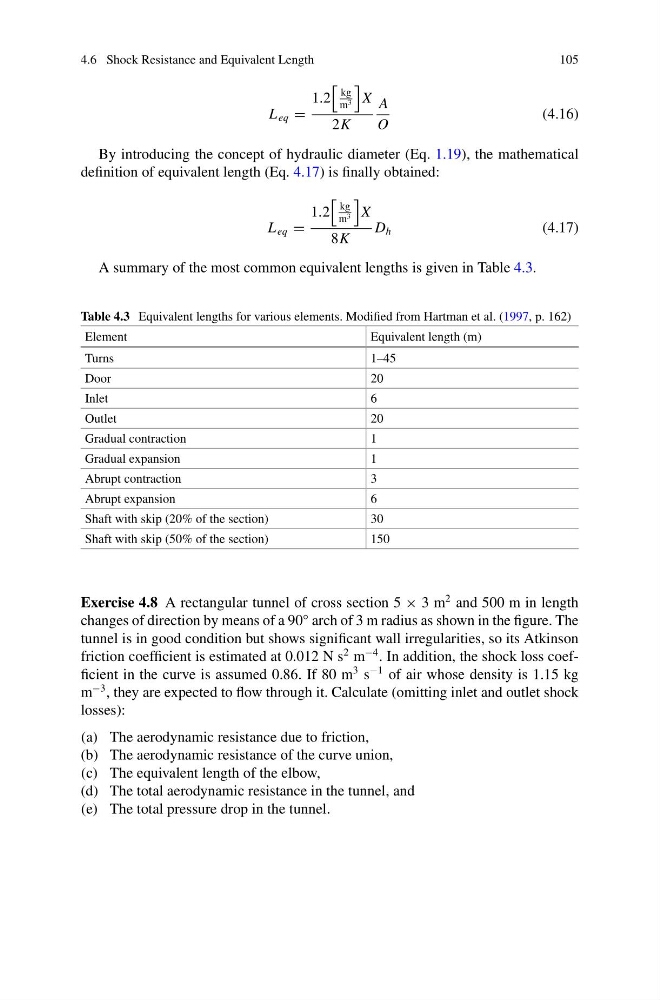
L eq =
1.2
kg
m 3
X
2K
A
O
(4.16)
By introducing the concept of hydraulic diameter (Eq. 1.19), the mathematical
definition of equivalent length (Eq. 4.17) is finally obtained:
L eq =
1.2
kg
m 3
X
8K
D h
(4.17)
A summary of the most common equivalent lengths is given in Table 4.3.
Table 4.3 Equivalent lengths for various elements. Modified from Hartman et al. (1997, p. 162)
Element
Equivalent length (m)
Turns
1–45
Door
20
Inlet
6
Outlet
20
Gradual contraction
1
Gradual expansion
1
Abrupt contraction
3
Abrupt expansion
6
Shaft with skip (20% of the section)
30
Shaft with skip (50% of the section)
150
Exercise 4.8 A rectangular tunnel of cross section 5 × 3 m
2 and 500 m in length
changes of direction by means of a 90° arch of 3 m radius as shown in the figure. The
tunnel is in good condition but shows significant wall irregularities, so its Atkinson
friction coefficient is estimated at 0.012 N s
2 m
−4 . In addition, the shock loss coefficient in the curve is assumed 0.86. If 80 m
3 s
−1 of air whose density is 1.15 kg
m
−3 , they are expected to flow through it. Calculate (omitting inlet and outlet shock
losses):
(a) The aerodynamic resistance due to friction,
(b) The aerodynamic resistance of the curve union,
(c) The equivalent length of the elbow,
(d) The total aerodynamic resistance in the tunnel, and
(e) The total pressure drop in the tunnel.
105
L eq =
1.2
kg
m 3
X
2K
A
O
(4.16)
By introducing the concept of hydraulic diameter (Eq. 1.19), the mathematical
definition of equivalent length (Eq. 4.17) is finally obtained:
L eq =
1.2
kg
m 3
X
8K
D h
(4.17)
A summary of the most common equivalent lengths is given in Table 4.3.
Table 4.3 Equivalent lengths for various elements. Modified from Hartman et al. (1997, p. 162)
Element
Equivalent length (m)
Turns
1–45
Door
20
Inlet
6
Outlet
20
Gradual contraction
1
Gradual expansion
1
Abrupt contraction
3
Abrupt expansion
6
Shaft with skip (20% of the section)
30
Shaft with skip (50% of the section)
150
Exercise 4.8 A rectangular tunnel of cross section 5 × 3 m
2 and 500 m in length
changes of direction by means of a 90° arch of 3 m radius as shown in the figure. The
tunnel is in good condition but shows significant wall irregularities, so its Atkinson
friction coefficient is estimated at 0.012 N s
2 m
−4 . In addition, the shock loss coefficient in the curve is assumed 0.86. If 80 m
3 s
−1 of air whose density is 1.15 kg
m
−3 , they are expected to flow through it. Calculate (omitting inlet and outlet shock
losses):
(a) The aerodynamic resistance due to friction,
(b) The aerodynamic resistance of the curve union,
(c) The equivalent length of the elbow,
(d) The total aerodynamic resistance in the tunnel, and
(e) The total pressure drop in the tunnel.