

67
2.2 Linear Cascades
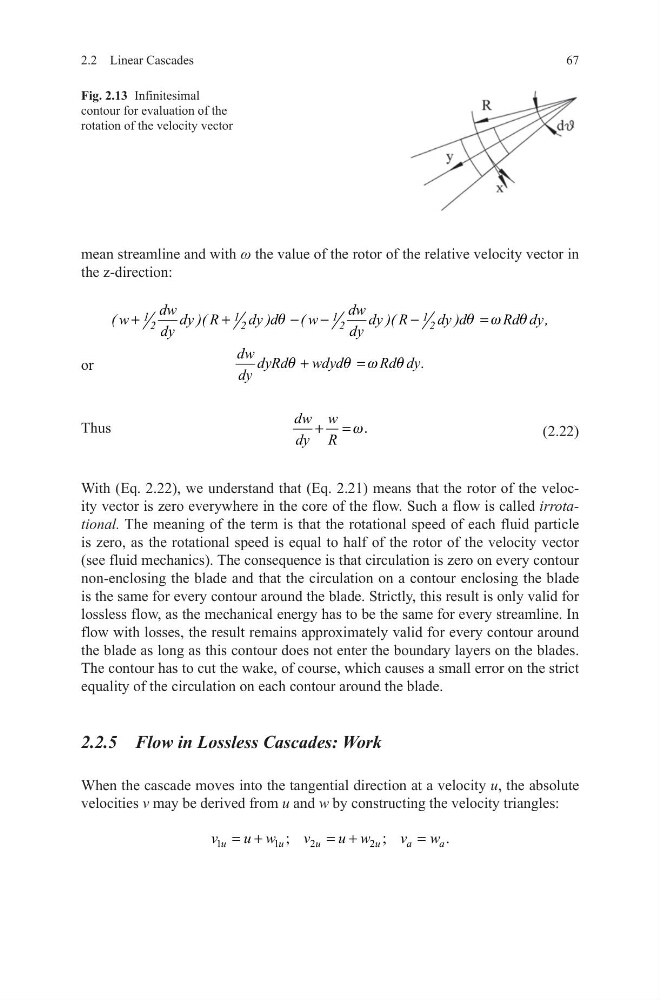
mean streamline and with ω the value of the rotor of the relative velocity vector in
the z-direction:
or
Thus
(2.22)
With (Eq. 2.22), we understand that (Eq. 2.21) means that the rotor of the velocity vector is zero everywhere in the core of the flow. Such a flow is called irrotational. The meaning of the term is that the rotational speed of each fluid particle
is zero, as the rotational speed is equal to half of the rotor of the velocity vector
(see fluid mechanics). The consequence is that circulation is zero on every contour
non-enclosing the blade and that the circulation on a contour enclosing the blade
is the same for every contour around the blade. Strictly, this result is only valid for
lossless flow, as the mechanical energy has to be the same for every streamline. In
flow with losses, the result remains approximately valid for every contour around
the blade as long as this contour does not enter the boundary layers on the blades.
The contour has to cut the wake, of course, which causes a small error on the strict
equality of the circulation on each contour around the blade.
2.2.5 Flow in Lossless Cascades: Work
When the cascade moves into the tangential direction at a velocity u, the absolute
velocities v may be derived from u and w by constructing the velocity triangles:
1
1
1
1
2
2
2
2
dw
dw
( w
dy )( R
dy )d ( w
dy )( R
dy )d
Rd dy,
dy
dy
dw dyRd
wdyd
Rd dy.
dy
q
q w q
q
q w q
+
+
− −
−
=
+
=
.
dw w
dy R
w
+ =
1
1
2
2
;
;
.
u
u
u
u
a
a
v
u w
v
u w
v
w
= +
= +
=
Fig. 2.13 Infinitesimal
contour for evaluation of the
rotation of the velocity vector
2.2 Linear Cascades
mean streamline and with ω the value of the rotor of the relative velocity vector in
the z-direction:
or
Thus
(2.22)
With (Eq. 2.22), we understand that (Eq. 2.21) means that the rotor of the velocity vector is zero everywhere in the core of the flow. Such a flow is called irrotational. The meaning of the term is that the rotational speed of each fluid particle
is zero, as the rotational speed is equal to half of the rotor of the velocity vector
(see fluid mechanics). The consequence is that circulation is zero on every contour
non-enclosing the blade and that the circulation on a contour enclosing the blade
is the same for every contour around the blade. Strictly, this result is only valid for
lossless flow, as the mechanical energy has to be the same for every streamline. In
flow with losses, the result remains approximately valid for every contour around
the blade as long as this contour does not enter the boundary layers on the blades.
The contour has to cut the wake, of course, which causes a small error on the strict
equality of the circulation on each contour around the blade.
2.2.5 Flow in Lossless Cascades: Work
When the cascade moves into the tangential direction at a velocity u, the absolute
velocities v may be derived from u and w by constructing the velocity triangles:
1
1
1
1
2
2
2
2
dw
dw
( w
dy )( R
dy )d ( w
dy )( R
dy )d
Rd dy,
dy
dy
dw dyRd
wdyd
Rd dy.
dy
q
q w q
q
q w q
+
+
− −
−
=
+
=
.
dw w
dy R
w
+ =
1
1
2
2
;
;
.
u
u
u
u
a
a
v
u w
v
u w
v
w
= +
= +
=
Fig. 2.13 Infinitesimal
contour for evaluation of the
rotation of the velocity vector