

65
2.2 Linear Cascades
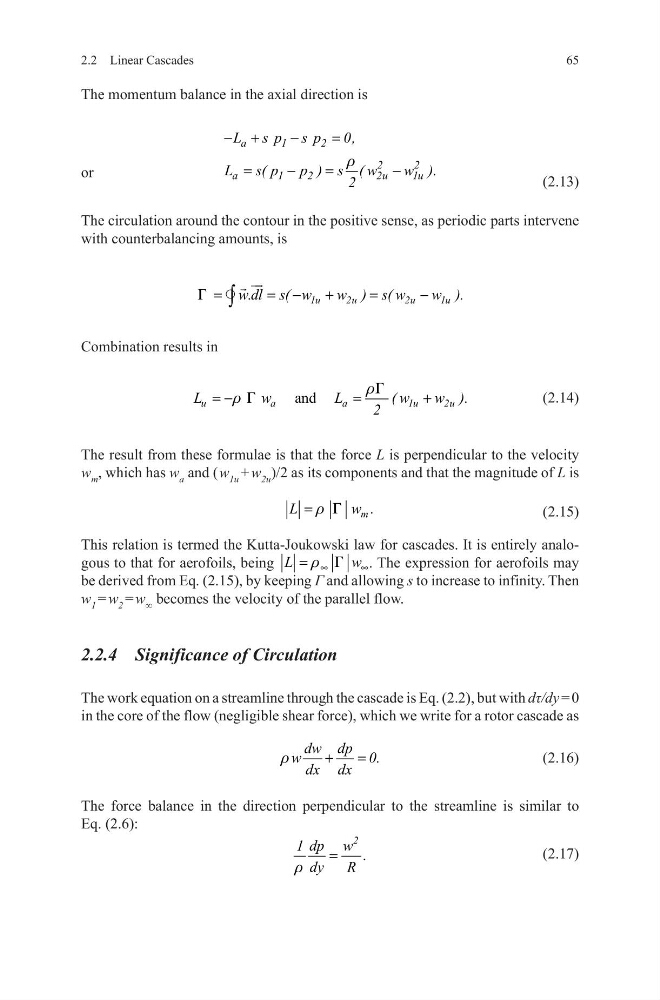
The momentum balance in the axial direction is
or
(2.13)
The circulation around the contour in the positive sense, as periodic parts intervene
with counterbalancing amounts, is
Combination results in
(2.14)
The result from these formulae is that the force L is perpendicular to the velocity
w m , which has w a and ( w 1u + w 2u )/2 as its components and that the magnitude of L is
(2.15)
This relation is termed the Kutta-Joukowski law for cascades. It is entirely analogous to that for aerofoils, being L
w
r G
∞
∞
=
. The expression for aerofoils may
be derived from Eq. (2.15), by keeping Γ and allowing s to increase to infinity. Then
w 1 = w 2 = w ∞ becomes the velocity of the parallel flow.
2.2.4 Significance of Circulation
The work equation on a streamline through the cascade is Eq. (2.2), but with dτ/dy = 0
in the core of the flow (negligible shear force), which we write for a rotor cascade as
(2.16)
The force balance in the direction perpendicular to the streamline is similar to
Eq. (2.6):
(2.17)
a
1
2
2
2
a
1
2
2u
1u
L s p s p 0,
L
s( p p ) s ( w
w ).
2
r
− +
−
=
=
−
=
−
1u
2u
2u
1u
w.dl s( w
w ) s( w
w ).
G =
= −
+
=
−
∫
and
u
a
a
1u
2u
L
w
L
( w
w ).
2
rG
r G
= −
=
+
m
L
w .
r G
=
dw dp
w
0.
dx dx
r
+
=
2
1 dp w .
dy
R
r
=
2.2 Linear Cascades
The momentum balance in the axial direction is
or
(2.13)
The circulation around the contour in the positive sense, as periodic parts intervene
with counterbalancing amounts, is
Combination results in
(2.14)
The result from these formulae is that the force L is perpendicular to the velocity
w m , which has w a and ( w 1u + w 2u )/2 as its components and that the magnitude of L is
(2.15)
This relation is termed the Kutta-Joukowski law for cascades. It is entirely analogous to that for aerofoils, being L
w
r G
∞
∞
=
. The expression for aerofoils may
be derived from Eq. (2.15), by keeping Γ and allowing s to increase to infinity. Then
w 1 = w 2 = w ∞ becomes the velocity of the parallel flow.
2.2.4 Significance of Circulation
The work equation on a streamline through the cascade is Eq. (2.2), but with dτ/dy = 0
in the core of the flow (negligible shear force), which we write for a rotor cascade as
(2.16)
The force balance in the direction perpendicular to the streamline is similar to
Eq. (2.6):
(2.17)
a
1
2
2
2
a
1
2
2u
1u
L s p s p 0,
L
s( p p ) s ( w
w ).
2
r
− +
−
=
=
−
=
−
1u
2u
2u
1u
w.dl s( w
w ) s( w
w ).
G =
= −
+
=
−
∫
and
u
a
a
1u
2u
L
w
L
( w
w ).
2
rG
r G
= −
=
+
m
L
w .
r G
=
dw dp
w
0.
dx dx
r
+
=
2
1 dp w .
dy
R
r
=