

50
2 Basic Components
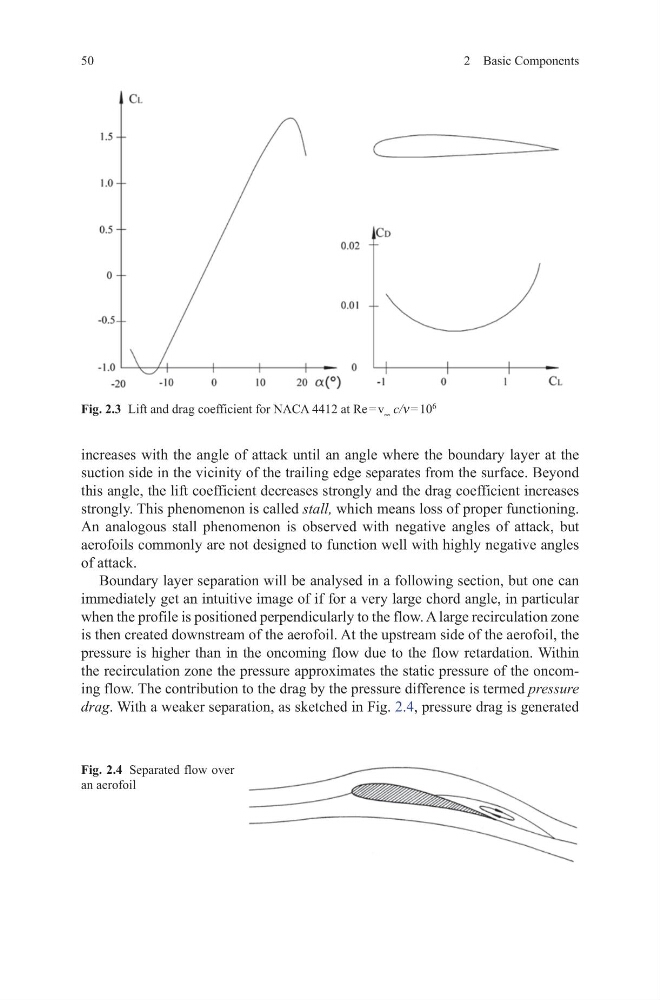
increases with the angle of attack until an angle where the boundary layer at the
suction side in the vicinity of the trailing edge separates from the surface. Beyond
this angle, the lift coefficient decreases strongly and the drag coefficient increases
strongly. This phenomenon is called stall, which means loss of proper functioning.
An analogous stall phenomenon is observed with negative angles of attack, but
aerofoils commonly are not designed to function well with highly negative angles
of attack.
Boundary layer separation will be analysed in a following section, but one can
immediately get an intuitive image of if for a very large chord angle, in particular
when the profile is positioned perpendicularly to the flow. A large recirculation zone
is then created downstream of the aerofoil. At the upstream side of the aerofoil, the
pressure is higher than in the oncoming flow due to the flow retardation. Within
the recirculation zone the pressure approximates the static pressure of the oncoming flow. The contribution to the drag by the pressure difference is termed pressure
drag. With a weaker separation, as sketched in Fig. 2.4, pressure drag is generated
Fig. 2.3 Lift and drag coefficient for NACA 4412 at Re = v ∞ c/ν = 10
6
Fig. 2.4 Separated flow over
an aerofoil
2 Basic Components
increases with the angle of attack until an angle where the boundary layer at the
suction side in the vicinity of the trailing edge separates from the surface. Beyond
this angle, the lift coefficient decreases strongly and the drag coefficient increases
strongly. This phenomenon is called stall, which means loss of proper functioning.
An analogous stall phenomenon is observed with negative angles of attack, but
aerofoils commonly are not designed to function well with highly negative angles
of attack.
Boundary layer separation will be analysed in a following section, but one can
immediately get an intuitive image of if for a very large chord angle, in particular
when the profile is positioned perpendicularly to the flow. A large recirculation zone
is then created downstream of the aerofoil. At the upstream side of the aerofoil, the
pressure is higher than in the oncoming flow due to the flow retardation. Within
the recirculation zone the pressure approximates the static pressure of the oncoming flow. The contribution to the drag by the pressure difference is termed pressure
drag. With a weaker separation, as sketched in Fig. 2.4, pressure drag is generated
Fig. 2.3 Lift and drag coefficient for NACA 4412 at Re = v ∞ c/ν = 10
6
Fig. 2.4 Separated flow over
an aerofoil