

557
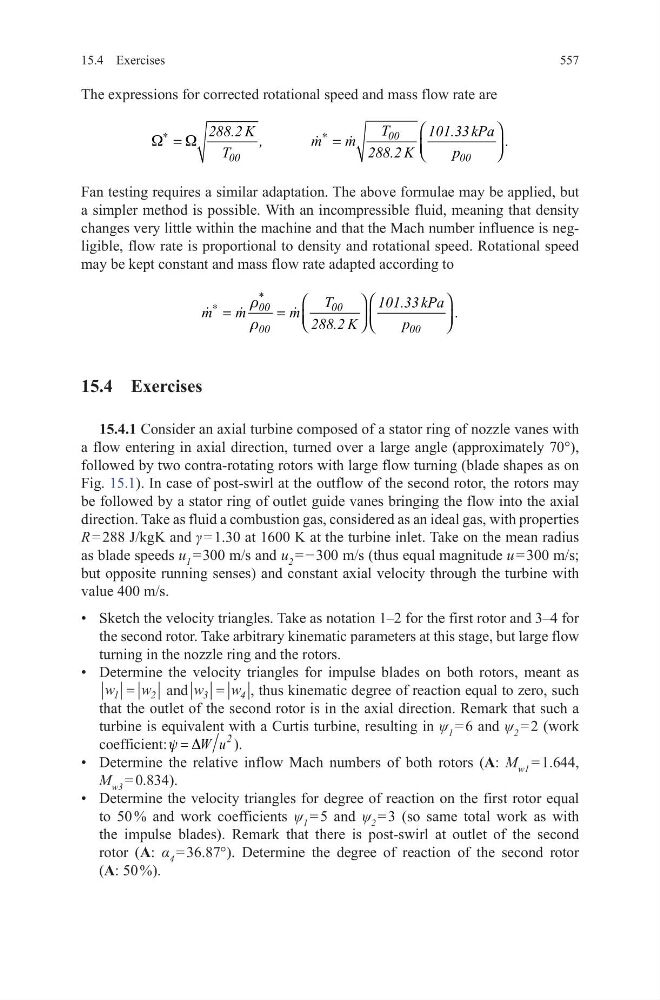
The expressions for corrected rotational speed and mass flow rate are
Fan testing requires a similar adaptation. The above formulae may be applied, but
a simpler method is possible. With an incompressible fluid, meaning that density
changes very little within the machine and that the Mach number influence is negligible, flow rate is proportional to density and rotational speed. Rotational speed
may be kept constant and mass flow rate adapted according to
15.4 Exercises
15.4.1 Consider an axial turbine composed of a stator ring of nozzle vanes with
a flow entering in axial direction, turned over a large angle (approximately 70°),
followed by two contra-rotating rotors with large flow turning (blade shapes as on
Fig. 15.1). In case of post-swirl at the outflow of the second rotor, the rotors may
be followed by a stator ring of outlet guide vanes bringing the flow into the axial
direction. Take as fluid a combustion gas, considered as an ideal gas, with properties
R = 288 J/kgK and γ = 1.30 at 1600 K at the turbine inlet. Take on the mean radius
as blade speeds u 1 = 300 m/s and u 2 = − 300 m/s (thus equal magnitude u = 300 m/s;
but opposite running senses) and constant axial velocity through the turbine with
value 400 m/s.
• Sketch the velocity triangles. Take as notation 1–2 for the first rotor and 3–4 for
the second rotor. Take arbitrary kinematic parameters at this stage, but large flow
turning in the nozzle ring and the rotors.
• Determine the velocity triangles for impulse blades on both rotors, meant as
w
w
1
2
=
and w
w
3
4
=
, thus kinematic degree of reaction equal to zero, such
that the outlet of the second rotor is in the axial direction. Remark that such a
turbine is equivalent with a Curtis turbine, resulting in ψ 1 = 6 and ψ 2 = 2 (work
coefficient:
2
W u
y D
=
).
• Determine the relative inflow Mach numbers of both rotors (A: M w1 = 1.644,
M w3 = 0.834).
• Determine the velocity triangles for degree of reaction on the first rotor equal
to 50 % and work coefficients ψ 1 = 5 and ψ 2 = 3 (so same total work as with
the impulse blades). Remark that there is post-swirl at outlet of the second
rotor (A: α 4 = 36.87°). Determine the degree of reaction of the second rotor
(A: 50 %).
00
00
00
T
288.2 K
101.33 kPa
,
m
m
.
T
288.2 K
p
W W
∗
∗
=
=
*
00
00
00
00
T
101.33 kPa
m
m
m
.
288.2 K
p
r
r
∗
=
=
15.4 Exercises
The expressions for corrected rotational speed and mass flow rate are
Fan testing requires a similar adaptation. The above formulae may be applied, but
a simpler method is possible. With an incompressible fluid, meaning that density
changes very little within the machine and that the Mach number influence is negligible, flow rate is proportional to density and rotational speed. Rotational speed
may be kept constant and mass flow rate adapted according to
15.4 Exercises
15.4.1 Consider an axial turbine composed of a stator ring of nozzle vanes with
a flow entering in axial direction, turned over a large angle (approximately 70°),
followed by two contra-rotating rotors with large flow turning (blade shapes as on
Fig. 15.1). In case of post-swirl at the outflow of the second rotor, the rotors may
be followed by a stator ring of outlet guide vanes bringing the flow into the axial
direction. Take as fluid a combustion gas, considered as an ideal gas, with properties
R = 288 J/kgK and γ = 1.30 at 1600 K at the turbine inlet. Take on the mean radius
as blade speeds u 1 = 300 m/s and u 2 = − 300 m/s (thus equal magnitude u = 300 m/s;
but opposite running senses) and constant axial velocity through the turbine with
value 400 m/s.
• Sketch the velocity triangles. Take as notation 1–2 for the first rotor and 3–4 for
the second rotor. Take arbitrary kinematic parameters at this stage, but large flow
turning in the nozzle ring and the rotors.
• Determine the velocity triangles for impulse blades on both rotors, meant as
w
w
1
2
=
and w
w
3
4
=
, thus kinematic degree of reaction equal to zero, such
that the outlet of the second rotor is in the axial direction. Remark that such a
turbine is equivalent with a Curtis turbine, resulting in ψ 1 = 6 and ψ 2 = 2 (work
coefficient:
2
W u
y D
=
).
• Determine the relative inflow Mach numbers of both rotors (A: M w1 = 1.644,
M w3 = 0.834).
• Determine the velocity triangles for degree of reaction on the first rotor equal
to 50 % and work coefficients ψ 1 = 5 and ψ 2 = 3 (so same total work as with
the impulse blades). Remark that there is post-swirl at outlet of the second
rotor (A: α 4 = 36.87°). Determine the degree of reaction of the second rotor
(A: 50 %).
00
00
00
T
288.2 K
101.33 kPa
,
m
m
.
T
288.2 K
p
W W
∗
∗
=
=
*
00
00
00
00
T
101.33 kPa
m
m
m
.
288.2 K
p
r
r
∗
=
=
15.4 Exercises