

555
15.3 Dimensional Analysis with Compressible Fluids
and T 00 . Mass flow rate
m and rotational speed Ω determine the operating point. D
is a characteristic diameter allowing identification of the machine within a family
of similar machines. Note that the operating point may also be determined by the
pressure ratio and the rotational speed. It is sometimes a matter of point of view to
consider mass flow rate as independent and pressure ratio as dependent (the standard choice with compressors), or vice versa (the standard choice with turbines).
We opt for mass flow rate here, as this option is the most complex one for a dimensional analysis, the pressure ratio spontaneously being a dimensionless group.
The intervening dimensions are length, mass, time and temperature. There are
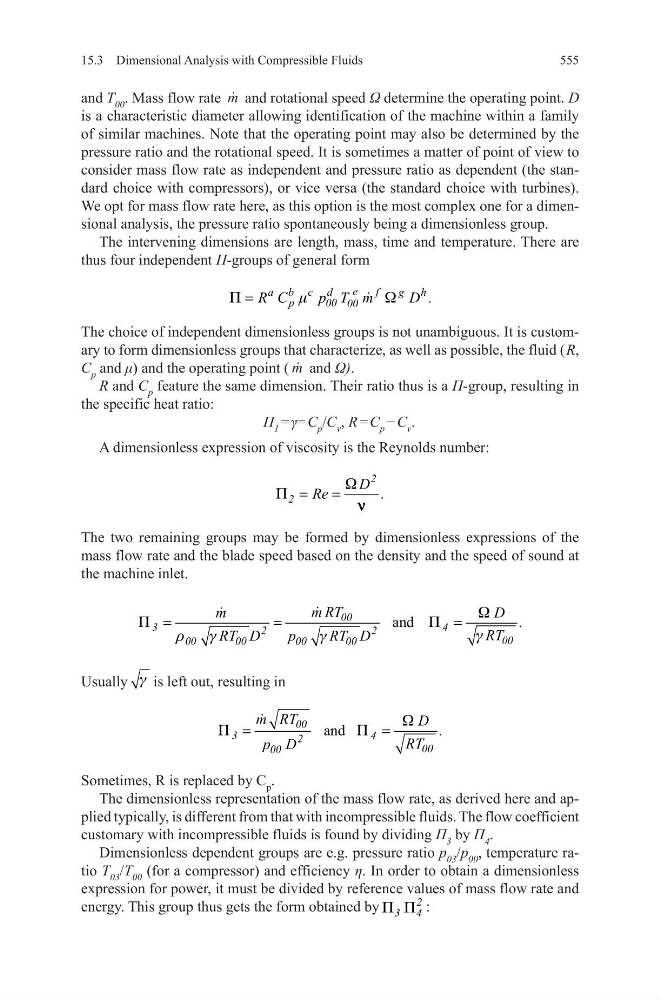
thus four independent Π-groups of general form
The choice of independent dimensionless groups is not unambiguous. It is customary to form dimensionless groups that characterize, as well as possible, the fluid ( R,
C p and μ) and the operating point (
m and Ω).
R and C p feature the same dimension. Their ratio thus is a Π-group, resulting in
the specific heat ratio:
Π 1 = γ= C p /C v , R = C p − C v .
A dimensionless expression of viscosity is the Reynolds number:
The two remaining groups may be formed by dimensionless expressions of the
mass flow rate and the blade speed based on the density and the speed of sound at
the machine inlet.
Usually g is left out, resulting in
Sometimes, R is replaced by C p .
The dimensionless representation of the mass flow rate, as derived here and applied typically, is different from that with incompressible fluids. The flow coefficient
customary with incompressible fluids is found by dividing Π 3 by Π 4 .
Dimensionless dependent groups are e.g. pressure ratio p 03 /p 00 , temperature ratio T 03 /T 00 (for a compressor) and efficiency η. In order to obtain a dimensionless
expression for power, it must be divided by reference values of mass flow rate and
energy. This group thus gets the form obtained by
2
3 4
P P :
e
a b c d
f
g h
p
00 00
R C
p T m
D .
P
m
W
=
2
2
D
Re
.
W
P =
= ν
and
00
3
4
2
2
00
00
00
00
00
m RT
m
D .
RT
RT D
p
RT D
W
P
P
g
r
g
g
=
=
=
and
00
3
4
2
00
00
m RT
D .
RT
p D
W
P
P
=
=
15.3 Dimensional Analysis with Compressible Fluids
and T 00 . Mass flow rate
m and rotational speed Ω determine the operating point. D
is a characteristic diameter allowing identification of the machine within a family
of similar machines. Note that the operating point may also be determined by the
pressure ratio and the rotational speed. It is sometimes a matter of point of view to
consider mass flow rate as independent and pressure ratio as dependent (the standard choice with compressors), or vice versa (the standard choice with turbines).
We opt for mass flow rate here, as this option is the most complex one for a dimensional analysis, the pressure ratio spontaneously being a dimensionless group.
The intervening dimensions are length, mass, time and temperature. There are
thus four independent Π-groups of general form
The choice of independent dimensionless groups is not unambiguous. It is customary to form dimensionless groups that characterize, as well as possible, the fluid ( R,
C p and μ) and the operating point (
m and Ω).
R and C p feature the same dimension. Their ratio thus is a Π-group, resulting in
the specific heat ratio:
Π 1 = γ= C p /C v , R = C p − C v .
A dimensionless expression of viscosity is the Reynolds number:
The two remaining groups may be formed by dimensionless expressions of the
mass flow rate and the blade speed based on the density and the speed of sound at
the machine inlet.
Usually g is left out, resulting in
Sometimes, R is replaced by C p .
The dimensionless representation of the mass flow rate, as derived here and applied typically, is different from that with incompressible fluids. The flow coefficient
customary with incompressible fluids is found by dividing Π 3 by Π 4 .
Dimensionless dependent groups are e.g. pressure ratio p 03 /p 00 , temperature ratio T 03 /T 00 (for a compressor) and efficiency η. In order to obtain a dimensionless
expression for power, it must be divided by reference values of mass flow rate and
energy. This group thus gets the form obtained by
2
3 4
P P :
e
a b c d
f
g h
p
00 00
R C
p T m
D .
P
m
W
=
2
2
D
Re
.
W
P =
= ν
and
00
3
4
2
2
00
00
00
00
00
m RT
m
D .
RT
RT D
p
RT D
W
P
P
g
r
g
g
=
=
=
and
00
3
4
2
00
00
m RT
D .
RT
p D
W
P
P
=
=