

543
15.1 Axial Turbines
Optimisation, in principle, means minimisation of the sum of the momentum
loss thicknesses, relative to the blade distance perpendicular to the outlet flow. This
implies that the spacing should be as great as possible, just avoiding separation
at the suction side. For the basic aspects concerning separation and transition, we
refer to Sect. 13.4.1. The pressure side features a strong acceleration immediately
downstream the stagnation point. This reduces the loading capacity of the profile,
but is unavoidable if the profile should have a certain thickness. After the initial
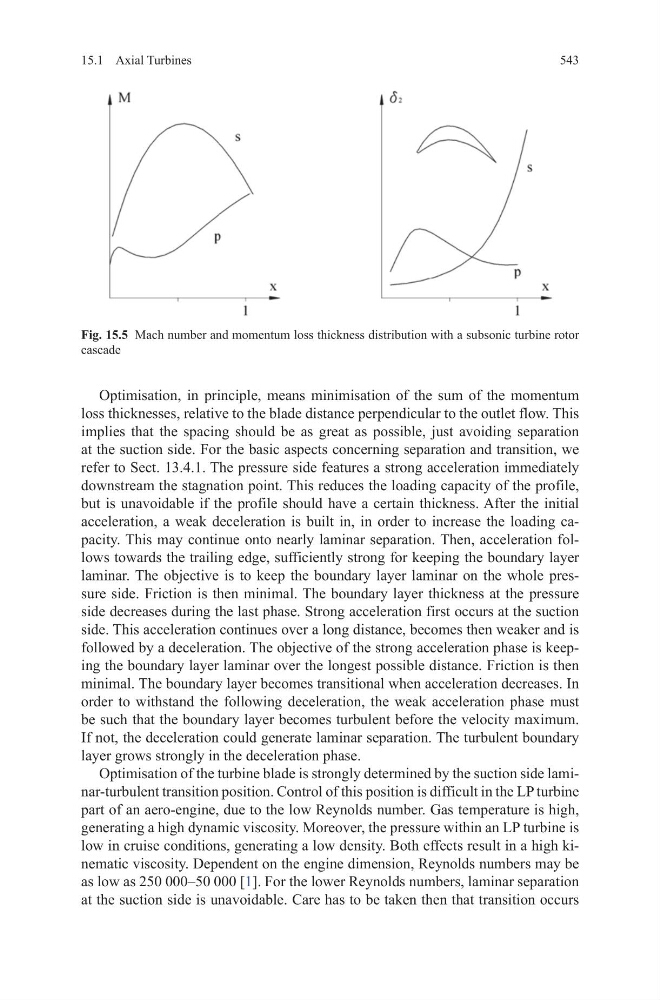
acceleration, a weak deceleration is built in, in order to increase the loading capacity. This may continue onto nearly laminar separation. Then, acceleration follows towards the trailing edge, sufficiently strong for keeping the boundary layer
laminar. The objective is to keep the boundary layer laminar on the whole pressure side. Friction is then minimal. The boundary layer thickness at the pressure
side decreases during the last phase. Strong acceleration first occurs at the suction
side. This acceleration continues over a long distance, becomes then weaker and is
followed by a deceleration. The objective of the strong acceleration phase is keeping the boundary layer laminar over the longest possible distance. Friction is then
minimal. The boundary layer becomes transitional when acceleration decreases. In
order to withstand the following deceleration, the weak acceleration phase must
be such that the boundary layer becomes turbulent before the velocity maximum.
If not, the deceleration could generate laminar separation. The turbulent boundary
layer grows strongly in the deceleration phase.
Optimisation of the turbine blade is strongly determined by the suction side laminar-turbulent transition position. Control of this position is difficult in the LP turbine
part of an aero-engine, due to the low Reynolds number. Gas temperature is high,
generating a high dynamic viscosity. Moreover, the pressure within an LP turbine is
low in cruise conditions, generating a low density. Both effects result in a high kinematic viscosity. Dependent on the engine dimension, Reynolds numbers may be
as low as 250 000–50 000 [1]. For the lower Reynolds numbers, laminar separation
at the suction side is unavoidable. Care has to be taken then that transition occurs
Fig. 15.5 Mach number and momentum loss thickness distribution with a subsonic turbine rotor
cascade
15.1 Axial Turbines
Optimisation, in principle, means minimisation of the sum of the momentum
loss thicknesses, relative to the blade distance perpendicular to the outlet flow. This
implies that the spacing should be as great as possible, just avoiding separation
at the suction side. For the basic aspects concerning separation and transition, we
refer to Sect. 13.4.1. The pressure side features a strong acceleration immediately
downstream the stagnation point. This reduces the loading capacity of the profile,
but is unavoidable if the profile should have a certain thickness. After the initial
acceleration, a weak deceleration is built in, in order to increase the loading capacity. This may continue onto nearly laminar separation. Then, acceleration follows towards the trailing edge, sufficiently strong for keeping the boundary layer
laminar. The objective is to keep the boundary layer laminar on the whole pressure side. Friction is then minimal. The boundary layer thickness at the pressure
side decreases during the last phase. Strong acceleration first occurs at the suction
side. This acceleration continues over a long distance, becomes then weaker and is
followed by a deceleration. The objective of the strong acceleration phase is keeping the boundary layer laminar over the longest possible distance. Friction is then
minimal. The boundary layer becomes transitional when acceleration decreases. In
order to withstand the following deceleration, the weak acceleration phase must
be such that the boundary layer becomes turbulent before the velocity maximum.
If not, the deceleration could generate laminar separation. The turbulent boundary
layer grows strongly in the deceleration phase.
Optimisation of the turbine blade is strongly determined by the suction side laminar-turbulent transition position. Control of this position is difficult in the LP turbine
part of an aero-engine, due to the low Reynolds number. Gas temperature is high,
generating a high dynamic viscosity. Moreover, the pressure within an LP turbine is
low in cruise conditions, generating a low density. Both effects result in a high kinematic viscosity. Dependent on the engine dimension, Reynolds numbers may be
as low as 250 000–50 000 [1]. For the lower Reynolds numbers, laminar separation
at the suction side is unavoidable. Care has to be taken then that transition occurs
Fig. 15.5 Mach number and momentum loss thickness distribution with a subsonic turbine rotor
cascade