

531
14.6 Performance Characteristics
The dried gas gets compressed again. A large operating range is normally not required. The compressor of a diesel engine turbocharger requires a relatively large
operating range. Therefore, up to a pressure ratio around 4, vaneless diffusers are
used. Cascade diffusers are used with larger pressure ratio. The surge margin is
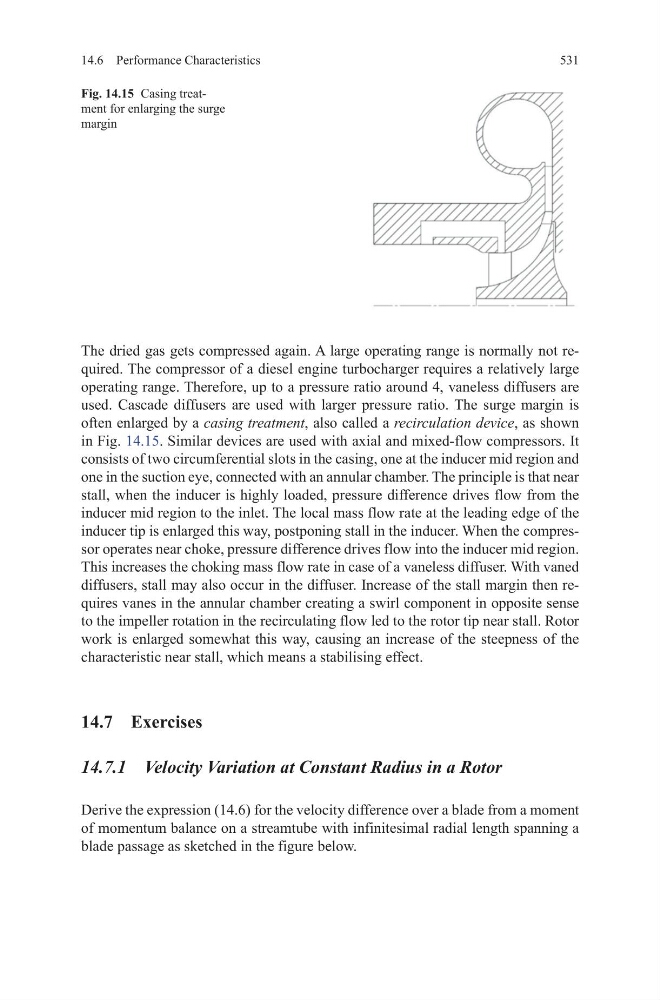
often enlarged by a casing treatment, also called a recirculation device, as shown
in Fig. 14.15. Similar devices are used with axial and mixed-flow compressors. It
consists of two circumferential slots in the casing, one at the inducer mid region and
one in the suction eye, connected with an annular chamber. The principle is that near
stall, when the inducer is highly loaded, pressure difference drives flow from the
inducer mid region to the inlet. The local mass flow rate at the leading edge of the
inducer tip is enlarged this way, postponing stall in the inducer. When the compressor operates near choke, pressure difference drives flow into the inducer mid region.
This increases the choking mass flow rate in case of a vaneless diffuser. With vaned
diffusers, stall may also occur in the diffuser. Increase of the stall margin then requires vanes in the annular chamber creating a swirl component in opposite sense
to the impeller rotation in the recirculating flow led to the rotor tip near stall. Rotor
work is enlarged somewhat this way, causing an increase of the steepness of the
characteristic near stall, which means a stabilising effect.
14.7 Exercises
14.7.1 Velocity Variation at Constant Radius in a Rotor
Derive the expression (14.6) for the velocity difference over a blade from a moment
of momentum balance on a streamtube with infinitesimal radial length spanning a
blade passage as sketched in the figure below.
Fig. 14.15 Casing treatment for enlarging the surge
margin
14.6 Performance Characteristics
The dried gas gets compressed again. A large operating range is normally not required. The compressor of a diesel engine turbocharger requires a relatively large
operating range. Therefore, up to a pressure ratio around 4, vaneless diffusers are
used. Cascade diffusers are used with larger pressure ratio. The surge margin is
often enlarged by a casing treatment, also called a recirculation device, as shown
in Fig. 14.15. Similar devices are used with axial and mixed-flow compressors. It
consists of two circumferential slots in the casing, one at the inducer mid region and
one in the suction eye, connected with an annular chamber. The principle is that near
stall, when the inducer is highly loaded, pressure difference drives flow from the
inducer mid region to the inlet. The local mass flow rate at the leading edge of the
inducer tip is enlarged this way, postponing stall in the inducer. When the compressor operates near choke, pressure difference drives flow into the inducer mid region.
This increases the choking mass flow rate in case of a vaneless diffuser. With vaned
diffusers, stall may also occur in the diffuser. Increase of the stall margin then requires vanes in the annular chamber creating a swirl component in opposite sense
to the impeller rotation in the recirculating flow led to the rotor tip near stall. Rotor
work is enlarged somewhat this way, causing an increase of the steepness of the
characteristic near stall, which means a stabilising effect.
14.7 Exercises
14.7.1 Velocity Variation at Constant Radius in a Rotor
Derive the expression (14.6) for the velocity difference over a blade from a moment
of momentum balance on a streamtube with infinitesimal radial length spanning a
blade passage as sketched in the figure below.
Fig. 14.15 Casing treatment for enlarging the surge
margin