

28
1 Working Principles
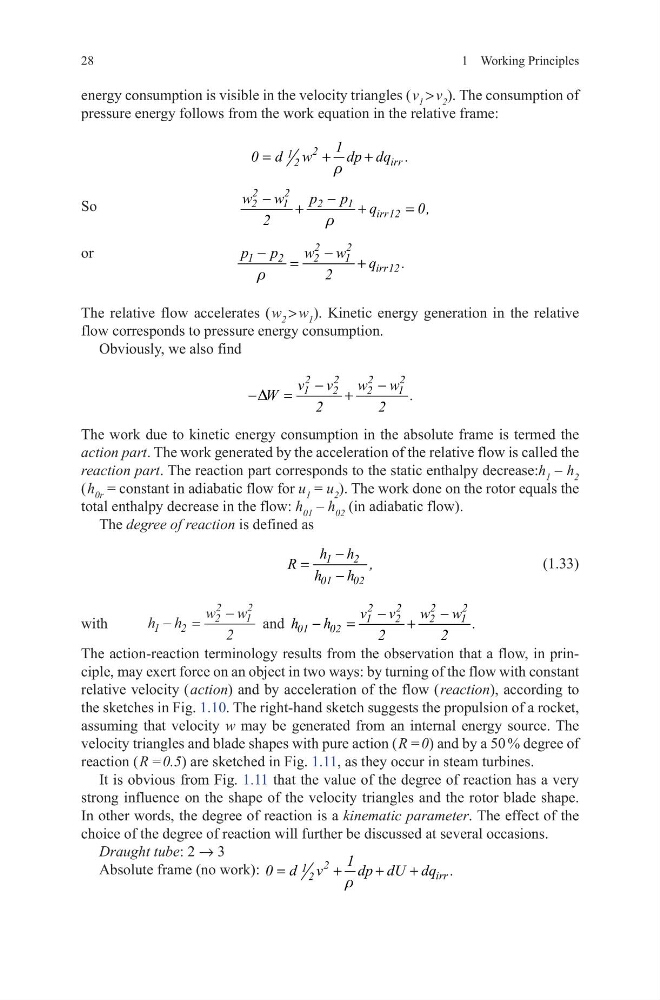
energy consumption is visible in the velocity triangles ( v 1 > v 2 ). The consumption of
pressure energy follows from the work equation in the relative frame:
So
or
The relative flow accelerates ( w 2 > w 1 ). Kinetic energy generation in the relative
flow corresponds to pressure energy consumption.
Obviously, we also find
The work due to kinetic energy consumption in the absolute frame is termed the
action part. The work generated by the acceleration of the relative flow is called the
reaction part. The reaction part corresponds to the static enthalpy decrease:h 1 – h 2
( h 0r = constant in adiabatic flow for u 1 = u 2 ). The work done on the rotor equals the
total enthalpy decrease in the flow: h 01 – h 02 (in adiabatic flow).
The degree of reaction is defined as
(1.33)
with
h h
w w
1
2
2
2
1
2
2
− =
−
and
2
2
2
2
1
2
2
1
01
02
v v
w w
h
h
.
2
2
−
−
−
=
+
The action-reaction terminology results from the observation that a flow, in principle, may exert force on an object in two ways: by turning of the flow with constant
relative velocity ( action) and by acceleration of the flow ( reaction), according to
the sketches in Fig. 1.10. The right-hand sketch suggests the propulsion of a rocket,
assuming that velocity w may be generated from an internal energy source. The
velocity triangles and blade shapes with pure action ( R = 0) and by a 50 % degree of
reaction ( R = 0.5) are sketched in Fig. 1.11, as they occur in steam turbines.
It is obvious from Fig. 1.11 that the value of the degree of reaction has a very
strong influence on the shape of the velocity triangles and the rotor blade shape.
In other words, the degree of reaction is a kinematic parameter. The effect of the
choice of the degree of reaction will further be discussed at several occasions.
Draught tube: 2 → 3
Absolute frame (no work):
2
1
irr
2
1
0 d v
dp dU dq .
r
=
+
+
+
2
1
irr
2
1
0 d w
dp dq .
r
=
+
+
2
2
2
1
2
1
irr12
w w
p
p q
0,
2
r
−
−
+
+
=
2
2
1
2
2
1
irr12
p p
w w
q
.
2
r
−
−
=
+
2
2
2
2
1
2
2
1
v v
w w
W
.
2
2
D
−
−
−
=
+
1
2
01
02
h h
R
,
h
h
−
=
−
1 Working Principles
energy consumption is visible in the velocity triangles ( v 1 > v 2 ). The consumption of
pressure energy follows from the work equation in the relative frame:
So
or
The relative flow accelerates ( w 2 > w 1 ). Kinetic energy generation in the relative
flow corresponds to pressure energy consumption.
Obviously, we also find
The work due to kinetic energy consumption in the absolute frame is termed the
action part. The work generated by the acceleration of the relative flow is called the
reaction part. The reaction part corresponds to the static enthalpy decrease:h 1 – h 2
( h 0r = constant in adiabatic flow for u 1 = u 2 ). The work done on the rotor equals the
total enthalpy decrease in the flow: h 01 – h 02 (in adiabatic flow).
The degree of reaction is defined as
(1.33)
with
h h
w w
1
2
2
2
1
2
2
− =
−
and
2
2
2
2
1
2
2
1
01
02
v v
w w
h
h
.
2
2
−
−
−
=
+
The action-reaction terminology results from the observation that a flow, in principle, may exert force on an object in two ways: by turning of the flow with constant
relative velocity ( action) and by acceleration of the flow ( reaction), according to
the sketches in Fig. 1.10. The right-hand sketch suggests the propulsion of a rocket,
assuming that velocity w may be generated from an internal energy source. The
velocity triangles and blade shapes with pure action ( R = 0) and by a 50 % degree of
reaction ( R = 0.5) are sketched in Fig. 1.11, as they occur in steam turbines.
It is obvious from Fig. 1.11 that the value of the degree of reaction has a very
strong influence on the shape of the velocity triangles and the rotor blade shape.
In other words, the degree of reaction is a kinematic parameter. The effect of the
choice of the degree of reaction will further be discussed at several occasions.
Draught tube: 2 → 3
Absolute frame (no work):
2
1
irr
2
1
0 d v
dp dU dq .
r
=
+
+
+
2
1
irr
2
1
0 d w
dp dq .
r
=
+
+
2
2
2
1
2
1
irr12
w w
p
p q
0,
2
r
−
−
+
+
=
2
2
1
2
2
1
irr12
p p
w w
q
.
2
r
−
−
=
+
2
2
2
2
1
2
2
1
v v
w w
W
.
2
2
D
−
−
−
=
+
1
2
01
02
h h
R
,
h
h
−
=
−