

492
13 Axial Compressors
contribution of this part of the profile. In order to withstand the adverse pressure
gradient, the boundary layer must turn from laminar state to turbulent state at the
maximum in the Mach number distribution.
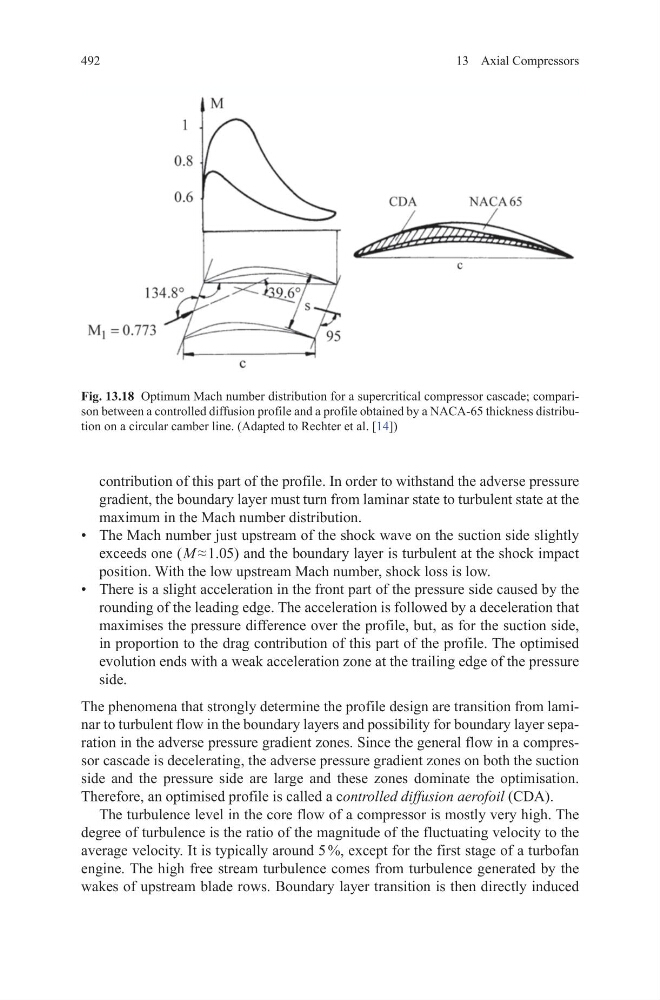
• The Mach number just upstream of the shock wave on the suction side slightly
exceeds one ( M ≈ 1.05) and the boundary layer is turbulent at the shock impact
position. With the low upstream Mach number, shock loss is low.
• There is a slight acceleration in the front part of the pressure side caused by the
rounding of the leading edge. The acceleration is followed by a deceleration that
maximises the pressure difference over the profile, but, as for the suction side,
in proportion to the drag contribution of this part of the profile. The optimised
evolution ends with a weak acceleration zone at the trailing edge of the pressure
side.
The phenomena that strongly determine the profile design are transition from laminar to turbulent flow in the boundary layers and possibility for boundary layer separation in the adverse pressure gradient zones. Since the general flow in a compressor cascade is decelerating, the adverse pressure gradient zones on both the suction
side and the pressure side are large and these zones dominate the optimisation.
Therefore, an optimised profile is called a controlled diffusion aerofoil (CDA).
The turbulence level in the core flow of a compressor is mostly very high. The
degree of turbulence is the ratio of the magnitude of the fluctuating velocity to the
average velocity. It is typically around 5 %, except for the first stage of a turbofan
engine. The high free stream turbulence comes from turbulence generated by the
wakes of upstream blade rows. Boundary layer transition is then directly induced
Fig. 13.18 Optimum Mach number distribution for a supercritical compressor cascade; comparison between a controlled diffusion profile and a profile obtained by a NACA-65 thickness distribution on a circular camber line. (Adapted to Rechter et al. [14])
13 Axial Compressors
contribution of this part of the profile. In order to withstand the adverse pressure
gradient, the boundary layer must turn from laminar state to turbulent state at the
maximum in the Mach number distribution.
• The Mach number just upstream of the shock wave on the suction side slightly
exceeds one ( M ≈ 1.05) and the boundary layer is turbulent at the shock impact
position. With the low upstream Mach number, shock loss is low.
• There is a slight acceleration in the front part of the pressure side caused by the
rounding of the leading edge. The acceleration is followed by a deceleration that
maximises the pressure difference over the profile, but, as for the suction side,
in proportion to the drag contribution of this part of the profile. The optimised
evolution ends with a weak acceleration zone at the trailing edge of the pressure
side.
The phenomena that strongly determine the profile design are transition from laminar to turbulent flow in the boundary layers and possibility for boundary layer separation in the adverse pressure gradient zones. Since the general flow in a compressor cascade is decelerating, the adverse pressure gradient zones on both the suction
side and the pressure side are large and these zones dominate the optimisation.
Therefore, an optimised profile is called a controlled diffusion aerofoil (CDA).
The turbulence level in the core flow of a compressor is mostly very high. The
degree of turbulence is the ratio of the magnitude of the fluctuating velocity to the
average velocity. It is typically around 5 %, except for the first stage of a turbofan
engine. The high free stream turbulence comes from turbulence generated by the
wakes of upstream blade rows. Boundary layer transition is then directly induced
Fig. 13.18 Optimum Mach number distribution for a supercritical compressor cascade; comparison between a controlled diffusion profile and a profile obtained by a NACA-65 thickness distribution on a circular camber line. (Adapted to Rechter et al. [14])