

449
12.5 Performance of Double-Flow Engines
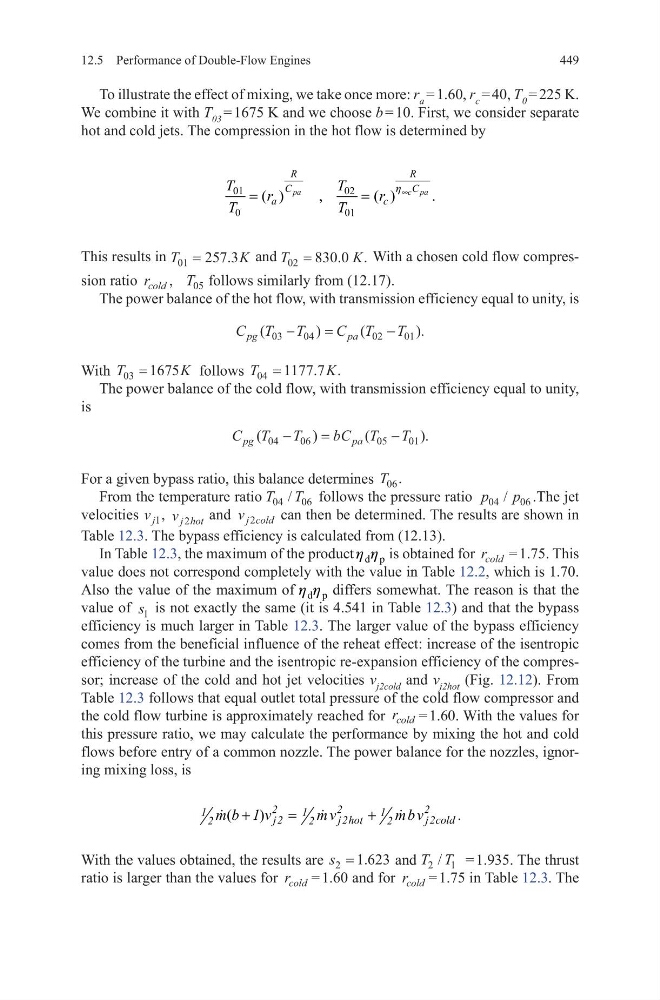
To illustrate the effect of mixing, we take once more: r a = 1.60, r c = 40, T 0 = 225 K.
We combine it with T 03 = 1675 K and we choose b = 10. First, we consider separate
hot and cold jets. The compression in the hot flow is determined by
This results in T
K
01
257 3
=
.
and T
K
02
830 0
=
.
. With a chosen cold flow compression ratio r
T
cold , 05 follows similarly from (12.17).
The power balance of the hot flow, with transmission efficiency equal to unity, is
With T
K
03 1675
=
follows T
K
04
1177 7
=
. .
The power balance of the cold flow, with transmission efficiency equal to unity,
is
For a given bypass ratio, this balance determines T 06 .
From the temperature ratio T T
04
06
/
follows the pressure ratio p
p
04
06
/
.The jet
velocities v j1 , v j hot
2
and v j cold
2
can then be determined. The results are shown in
Table 12.3. The bypass efficiency is calculated from (12.13).
In Table 12.3, the maximum of the product d p
h h is obtained for r cold = 1.75. This
value does not correspond completely with the value in Table 12.2, which is 1.70.
Also the value of the maximum of d p
h h differs somewhat. The reason is that the
value of s 1 is not exactly the same (it is 4.541 in Table 12.3) and that the bypass
efficiency is much larger in Table 12.3. The larger value of the bypass efficiency
comes from the beneficial influence of the reheat effect: increase of the isentropic
efficiency of the turbine and the isentropic re-expansion efficiency of the compressor; increase of the cold and hot jet velocities v j2cold and v j2hot (Fig. 12.12). From
Table 12.3 follows that equal outlet total pressure of the cold flow compressor and
the cold flow turbine is approximately reached for r cold = 1.60. With the values for
this pressure ratio, we may calculate the performance by mixing the hot and cold
flows before entry of a common nozzle. The power balance for the nozzles, ignoring mixing loss, is
With the values obtained, the results are s 2 1 623
= .
and T T
2
1
/
= 1.935. The thrust
ratio is larger than the values for r cold = 1.60 and for r cold = 1.75 in Table 12.3. The
01
02
0
01
( )
,
( )
.
pa
c pa
R
R
C
C
a
c
T
T
r
r
T
T
h ∞
=
=
C T
T
C T
T
pg
pa
(
)
(
) .
03
04
02
01
−
=
−
C T
T
bC T
T
pg
pa
(
)
(
) .
04
06
05
01
−
=
−
(
)
+
=
+
2
2
2
1
1
1
j2
j2hot
j2cold
2
2
2
m b 1 v
m v
mb v
.
12.5 Performance of Double-Flow Engines
To illustrate the effect of mixing, we take once more: r a = 1.60, r c = 40, T 0 = 225 K.
We combine it with T 03 = 1675 K and we choose b = 10. First, we consider separate
hot and cold jets. The compression in the hot flow is determined by
This results in T
K
01
257 3
=
.
and T
K
02
830 0
=
.
. With a chosen cold flow compression ratio r
T
cold , 05 follows similarly from (12.17).
The power balance of the hot flow, with transmission efficiency equal to unity, is
With T
K
03 1675
=
follows T
K
04
1177 7
=
. .
The power balance of the cold flow, with transmission efficiency equal to unity,
is
For a given bypass ratio, this balance determines T 06 .
From the temperature ratio T T
04
06
/
follows the pressure ratio p
p
04
06
/
.The jet
velocities v j1 , v j hot
2
and v j cold
2
can then be determined. The results are shown in
Table 12.3. The bypass efficiency is calculated from (12.13).
In Table 12.3, the maximum of the product d p
h h is obtained for r cold = 1.75. This
value does not correspond completely with the value in Table 12.2, which is 1.70.
Also the value of the maximum of d p
h h differs somewhat. The reason is that the
value of s 1 is not exactly the same (it is 4.541 in Table 12.3) and that the bypass
efficiency is much larger in Table 12.3. The larger value of the bypass efficiency
comes from the beneficial influence of the reheat effect: increase of the isentropic
efficiency of the turbine and the isentropic re-expansion efficiency of the compressor; increase of the cold and hot jet velocities v j2cold and v j2hot (Fig. 12.12). From
Table 12.3 follows that equal outlet total pressure of the cold flow compressor and
the cold flow turbine is approximately reached for r cold = 1.60. With the values for
this pressure ratio, we may calculate the performance by mixing the hot and cold
flows before entry of a common nozzle. The power balance for the nozzles, ignoring mixing loss, is
With the values obtained, the results are s 2 1 623
= .
and T T
2
1
/
= 1.935. The thrust
ratio is larger than the values for r cold = 1.60 and for r cold = 1.75 in Table 12.3. The
01
02
0
01
( )
,
( )
.
pa
c pa
R
R
C
C
a
c
T
T
r
r
T
T
h ∞
=
=
C T
T
C T
T
pg
pa
(
)
(
) .
03
04
02
01
−
=
−
C T
T
bC T
T
pg
pa
(
)
(
) .
04
06
05
01
−
=
−
(
)
+
=
+
2
2
2
1
1
1
j2
j2hot
j2cold
2
2
2
m b 1 v
m v
mb v
.