

437
12.3 Performance Parameters of Aircraft Propulsion Systems
lower the flight speed, the higher the bypass ratio shall be in order to enhance the
propulsive efficiency. This inevitably decreases the dynamic efficiency, so that the
product of both goes through a maximum. This description is a simplification, as it
overlooks that an increase of the bypass ratio causes increased engine dimensions,
resulting in additional drag on the aircraft and added weight. An overall evaluation
must take engine drag and engine weight into account.
The efficiency terminology with propulsion systems is inevitably more complicated than with power gas turbines. With power generation, thermal efficiency
is defined as the ratio of the shaft power to the thermal power. Thermodynamic
efficiency may also be introduced, but is not strictly necessary. With power gas
turbines, a gas generator may be distinguished from a power turbine. The thermodynamic efficiency is then the gas generator efficiency in the sense discussed. The
thermal efficiency is the product of the thermodynamic efficiency and the isentropic
efficiency of the power turbine.
12.3.9 Specific Fuel Consumption
Thrust specific fuel consumption (TSFC) denominates the fuel consumption per
thrust unit. In technical literature, it is mostly expressed in pound mass per hour per
pound force (1 lbm = 0.4536 kg, 1 lbf = 4.448 N). Thrust specific fuel consumption
by modern airliner turbofans in imperial units is of the 0.55–0.60 order at cruise.
The value at take-off is about 0.30. In international units, thrust specific consumption may be expressed in g/s/kN. Departing from imperial units, multiplication by
10
6
/(9.8065 × 3600) = 28.325 is required, leading to the order 16–17 g/s/kN at cruise
conditions.
For an engine driving a propeller, specific fuel consumption is commonly expressed as fuel mass flow rate per unit of power. Technical literature uses pound
mass per hour per horsepower (1 HP = 745.7 W). In these imperial units, the specific
fuel consumption of a turbo-shaft engine is about 0.60 at cruise conditions, so similar to the value of the TSFC of a turbofan. Conversion into kg/kWh requires multiplication by 0.608. So, the order of magnitude is 0.3 kg/kWh in cruise conditions.
For a turboprop, the residual thrust, which is the thrust of the nozzle, is converted
into mechanical power according to the convention that 1 HP of power is equivalent to 2.5 lbf of thrust (1 kW is about 15 N). The precise value of the conversion
factor is not very important as residual thrust is at maximum about 5 % of the total
thrust. The entire mechanical power achieved is called equivalent or effective shaft
horsepower = ESHP.
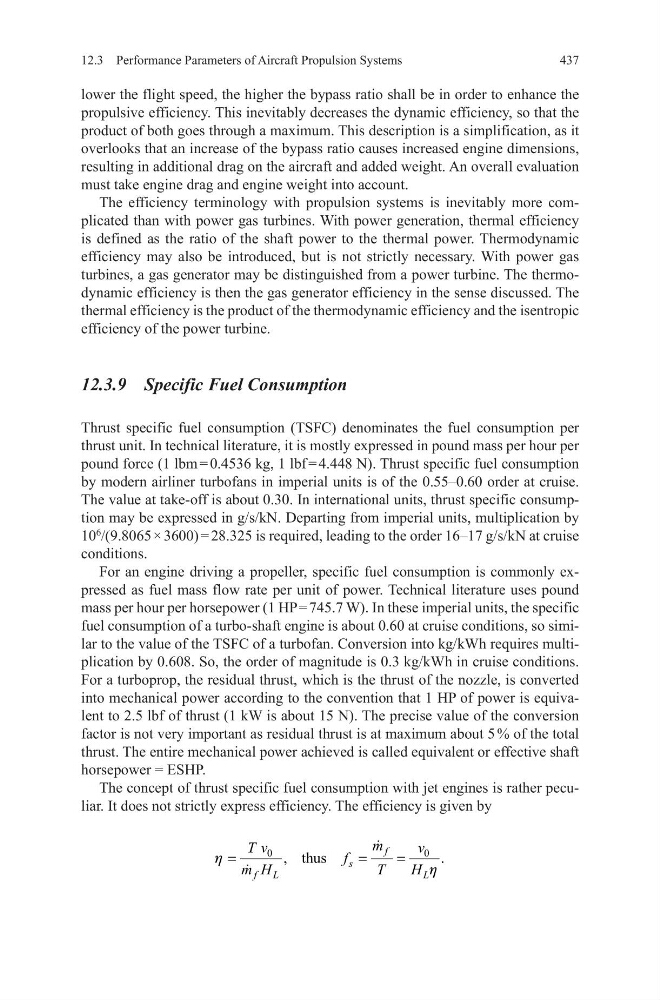
The concept of thrust specific fuel consumption with jet engines is rather peculiar. It does not strictly express efficiency. The efficiency is given by
0
0
, thus
.
f
s
f
L
L
m
T v
v
f
m H
T
H
h
h
=
=
=
12.3 Performance Parameters of Aircraft Propulsion Systems
lower the flight speed, the higher the bypass ratio shall be in order to enhance the
propulsive efficiency. This inevitably decreases the dynamic efficiency, so that the
product of both goes through a maximum. This description is a simplification, as it
overlooks that an increase of the bypass ratio causes increased engine dimensions,
resulting in additional drag on the aircraft and added weight. An overall evaluation
must take engine drag and engine weight into account.
The efficiency terminology with propulsion systems is inevitably more complicated than with power gas turbines. With power generation, thermal efficiency
is defined as the ratio of the shaft power to the thermal power. Thermodynamic
efficiency may also be introduced, but is not strictly necessary. With power gas
turbines, a gas generator may be distinguished from a power turbine. The thermodynamic efficiency is then the gas generator efficiency in the sense discussed. The
thermal efficiency is the product of the thermodynamic efficiency and the isentropic
efficiency of the power turbine.
12.3.9 Specific Fuel Consumption
Thrust specific fuel consumption (TSFC) denominates the fuel consumption per
thrust unit. In technical literature, it is mostly expressed in pound mass per hour per
pound force (1 lbm = 0.4536 kg, 1 lbf = 4.448 N). Thrust specific fuel consumption
by modern airliner turbofans in imperial units is of the 0.55–0.60 order at cruise.
The value at take-off is about 0.30. In international units, thrust specific consumption may be expressed in g/s/kN. Departing from imperial units, multiplication by
10
6
/(9.8065 × 3600) = 28.325 is required, leading to the order 16–17 g/s/kN at cruise
conditions.
For an engine driving a propeller, specific fuel consumption is commonly expressed as fuel mass flow rate per unit of power. Technical literature uses pound
mass per hour per horsepower (1 HP = 745.7 W). In these imperial units, the specific
fuel consumption of a turbo-shaft engine is about 0.60 at cruise conditions, so similar to the value of the TSFC of a turbofan. Conversion into kg/kWh requires multiplication by 0.608. So, the order of magnitude is 0.3 kg/kWh in cruise conditions.
For a turboprop, the residual thrust, which is the thrust of the nozzle, is converted
into mechanical power according to the convention that 1 HP of power is equivalent to 2.5 lbf of thrust (1 kW is about 15 N). The precise value of the conversion
factor is not very important as residual thrust is at maximum about 5 % of the total
thrust. The entire mechanical power achieved is called equivalent or effective shaft
horsepower = ESHP.
The concept of thrust specific fuel consumption with jet engines is rather peculiar. It does not strictly express efficiency. The efficiency is given by
0
0
, thus
.
f
s
f
L
L
m
T v
v
f
m H
T
H
h
h
=
=
=