

403
11.3 Performance of Simple-Cycle Power Gas Turbines
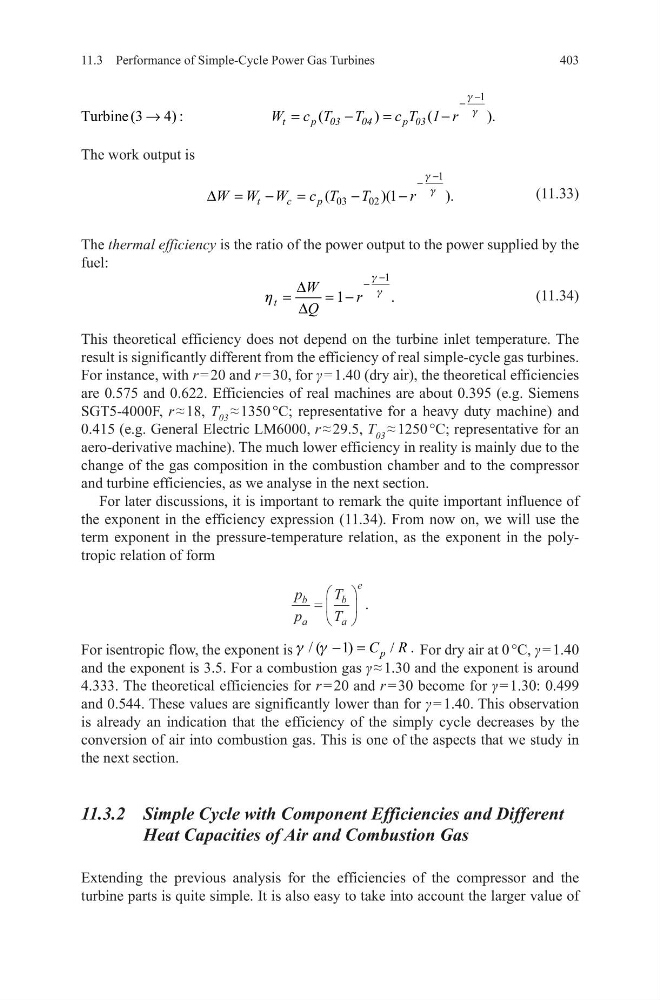
The work output is
(11.33)
The thermal efficiency is the ratio of the power output to the power supplied by the
fuel:
(11.34)
This theoretical efficiency does not depend on the turbine inlet temperature. The
result is significantly different from the efficiency of real simple-cycle gas turbines.
For instance, with r = 20 and r = 30, for γ = 1.40 (dry air), the theoretical efficiencies
are 0.575 and 0.622. Efficiencies of real machines are about 0.395 (e.g. Siemens
SGT5-4000F, r ≈ 18, T 03 ≈ 1350 °C; representative for a heavy duty machine) and
0.415 (e.g. General Electric LM6000, r ≈ 29.5, T 03 ≈ 1250 °C; representative for an
aero-derivative machine). The much lower efficiency in reality is mainly due to the
change of the gas composition in the combustion chamber and to the compressor
and turbine efficiencies, as we analyse in the next section.
For later discussions, it is important to remark the quite important influence of
the exponent in the efficiency expression (11.34). From now on, we will use the
term exponent in the pressure-temperature relation, as the exponent in the polytropic relation of form
For isentropic flow, the exponent is / ( 1)
/ .
p
C R
g g − =
For dry air at 0 °C, γ = 1.40
and the exponent is 3.5. For a combustion gas γ ≈ 1.30 and the exponent is around
4.333. The theoretical efficiencies for r = 20 and r = 30 become for γ = 1.30: 0.499
and 0.544. These values are significantly lower than for γ = 1.40. This observation
is already an indication that the efficiency of the simply cycle decreases by the
conversion of air into combustion gas. This is one of the aspects that we study in
the next section.
11.3.2 Simple Cycle with Component Efficiencies and Different
Heat Capacities of Air and Combustion Gas
Extending the previous analysis for the efficiencies of the compressor and the
turbine parts is quite simple. It is also easy to take into account the larger value of
1
Turbine (3 4) :
(
)
(
).
t
p 03
04
p 03
W c T
T
c T 1 r
g
g
−
−
→
=
−
=
−
1
03
02
(
)(1
).
t
c
p
W W W c T
T
r
g
g
−
−
∆ =
−
=
−
−
1
1
.
t
W
r
Q
g
g
h
−
−
∆
=
= −
∆
p
p
T
T
b
a
b
a
e
=
.
11.3 Performance of Simple-Cycle Power Gas Turbines
The work output is
(11.33)
The thermal efficiency is the ratio of the power output to the power supplied by the
fuel:
(11.34)
This theoretical efficiency does not depend on the turbine inlet temperature. The
result is significantly different from the efficiency of real simple-cycle gas turbines.
For instance, with r = 20 and r = 30, for γ = 1.40 (dry air), the theoretical efficiencies
are 0.575 and 0.622. Efficiencies of real machines are about 0.395 (e.g. Siemens
SGT5-4000F, r ≈ 18, T 03 ≈ 1350 °C; representative for a heavy duty machine) and
0.415 (e.g. General Electric LM6000, r ≈ 29.5, T 03 ≈ 1250 °C; representative for an
aero-derivative machine). The much lower efficiency in reality is mainly due to the
change of the gas composition in the combustion chamber and to the compressor
and turbine efficiencies, as we analyse in the next section.
For later discussions, it is important to remark the quite important influence of
the exponent in the efficiency expression (11.34). From now on, we will use the
term exponent in the pressure-temperature relation, as the exponent in the polytropic relation of form
For isentropic flow, the exponent is / ( 1)
/ .
p
C R
g g − =
For dry air at 0 °C, γ = 1.40
and the exponent is 3.5. For a combustion gas γ ≈ 1.30 and the exponent is around
4.333. The theoretical efficiencies for r = 20 and r = 30 become for γ = 1.30: 0.499
and 0.544. These values are significantly lower than for γ = 1.40. This observation
is already an indication that the efficiency of the simply cycle decreases by the
conversion of air into combustion gas. This is one of the aspects that we study in
the next section.
11.3.2 Simple Cycle with Component Efficiencies and Different
Heat Capacities of Air and Combustion Gas
Extending the previous analysis for the efficiencies of the compressor and the
turbine parts is quite simple. It is also easy to take into account the larger value of
1
Turbine (3 4) :
(
)
(
).
t
p 03
04
p 03
W c T
T
c T 1 r
g
g
−
−
→
=
−
=
−
1
03
02
(
)(1
).
t
c
p
W W W c T
T
r
g
g
−
−
∆ =
−
=
−
−
1
1
.
t
W
r
Q
g
g
h
−
−
∆
=
= −
∆
p
p
T
T
b
a
b
a
e
=
.