

392
11 Power Gas Turbines
Reversible part of the work ( polytropic head ):
Total work:
n 1
1
2
n
p 1
2
1
1
p
p
h c ( T T )
[ 1 (
)
].
1
p
g
D
g
r
−
=
−
=
−
−
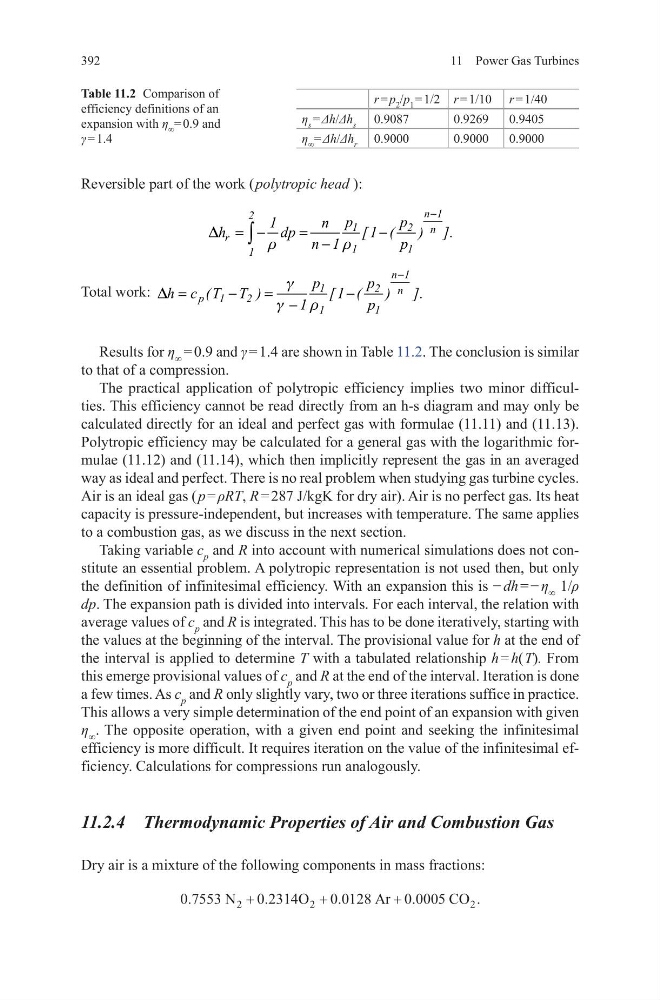
Results for η ∞ = 0.9 and γ = 1.4 are shown in Table 11.2. The conclusion is similar
to that of a compression.
The practical application of polytropic efficiency implies two minor difficulties. This efficiency cannot be read directly from an h-s diagram and may only be
calculated directly for an ideal and perfect gas with formulae (11.11) and (11.13).
Polytropic efficiency may be calculated for a general gas with the logarithmic formulae (11.12) and (11.14), which then implicitly represent the gas in an averaged
way as ideal and perfect. There is no real problem when studying gas turbine cycles.
Air is an ideal gas ( p = ρRT, R = 287 J/kgK for dry air). Air is no perfect gas. Its heat
capacity is pressure-independent, but increases with temperature. The same applies
to a combustion gas, as we discuss in the next section.
Taking variable c p and R into account with numerical simulations does not constitute an essential problem. A polytropic representation is not used then, but only
the definition of infinitesimal efficiency. With an expansion this is − dh = − η ∞ 1/ρ
dp. The expansion path is divided into intervals. For each interval, the relation with
average values of c p and R is integrated. This has to be done iteratively, starting with
the values at the beginning of the interval. The provisional value for h at the end of
the interval is applied to determine T with a tabulated relationship h = h( T). From
this emerge provisional values of c p and R at the end of the interval. Iteration is done
a few times. As c p and R only slightly vary, two or three iterations suffice in practice.
This allows a very simple determination of the end point of an expansion with given
η ∞ . The opposite operation, with a given end point and seeking the infinitesimal
efficiency is more difficult. It requires iteration on the value of the infinitesimal efficiency. Calculations for compressions run analogously.
11.2.4 Thermodynamic Properties of Air and Combustion Gas
Dry air is a mixture of the following components in mass fractions:
n 1
2
1
2
n
r
1
1
1
p
p
1
n
h
dp
[ 1 (
) ].
n 1
p
D
r
r
−
= −
=
−
−
∫
0.7553 N 0.2314O 0.0128 Ar 0.0005 CO
2
2
2
+
+
+
.
r = p 2 /p 1 = 1/2 r = 1/10 r = 1/40
η s = Δh/Δh s 0.9087
0.9269
0.9405
η ∞ = Δh/Δh r 0.9000
0.9000
0.9000
Table 11.2 Comparison of
efficiency definitions of an
expansion with η ∞ = 0.9 and
γ = 1.4
11 Power Gas Turbines
Reversible part of the work ( polytropic head ):
Total work:
n 1
1
2
n
p 1
2
1
1
p
p
h c ( T T )
[ 1 (
)
].
1
p
g
D
g
r
−
=
−
=
−
−
Results for η ∞ = 0.9 and γ = 1.4 are shown in Table 11.2. The conclusion is similar
to that of a compression.
The practical application of polytropic efficiency implies two minor difficulties. This efficiency cannot be read directly from an h-s diagram and may only be
calculated directly for an ideal and perfect gas with formulae (11.11) and (11.13).
Polytropic efficiency may be calculated for a general gas with the logarithmic formulae (11.12) and (11.14), which then implicitly represent the gas in an averaged
way as ideal and perfect. There is no real problem when studying gas turbine cycles.
Air is an ideal gas ( p = ρRT, R = 287 J/kgK for dry air). Air is no perfect gas. Its heat
capacity is pressure-independent, but increases with temperature. The same applies
to a combustion gas, as we discuss in the next section.
Taking variable c p and R into account with numerical simulations does not constitute an essential problem. A polytropic representation is not used then, but only
the definition of infinitesimal efficiency. With an expansion this is − dh = − η ∞ 1/ρ
dp. The expansion path is divided into intervals. For each interval, the relation with
average values of c p and R is integrated. This has to be done iteratively, starting with
the values at the beginning of the interval. The provisional value for h at the end of
the interval is applied to determine T with a tabulated relationship h = h( T). From
this emerge provisional values of c p and R at the end of the interval. Iteration is done
a few times. As c p and R only slightly vary, two or three iterations suffice in practice.
This allows a very simple determination of the end point of an expansion with given
η ∞ . The opposite operation, with a given end point and seeking the infinitesimal
efficiency is more difficult. It requires iteration on the value of the infinitesimal efficiency. Calculations for compressions run analogously.
11.2.4 Thermodynamic Properties of Air and Combustion Gas
Dry air is a mixture of the following components in mass fractions:
n 1
2
1
2
n
r
1
1
1
p
p
1
n
h
dp
[ 1 (
) ].
n 1
p
D
r
r
−
= −
=
−
−
∫
0.7553 N 0.2314O 0.0128 Ar 0.0005 CO
2
2
2
+
+
+
.
r = p 2 /p 1 = 1/2 r = 1/10 r = 1/40
η s = Δh/Δh s 0.9087
0.9269
0.9405
η ∞ = Δh/Δh r 0.9000
0.9000
0.9000
Table 11.2 Comparison of
efficiency definitions of an
expansion with η ∞ = 0.9 and
γ = 1.4