

357
10.2 Types of Wind Energy Conversion Systems
downwind positions, the velocity triangles imply a lift force with a tangential component in the sense of the blade speed. No lift is generated in the other two positions.
The force on a rotor blade changes cyclically with this type. At least three rotor
blades are required to achieve a constant torque. Vertical-axis wind turbines have as
main advantages that they are principally insensitive to wind direction and that the
load may be coupled at ground level. A major disadvantage is that the turbine is not
self-starting when the blade position is fixed. For that reason, sometimes, a verticalaxis wind turbine is combined with a Savonius rotor. Self-start may be achieved
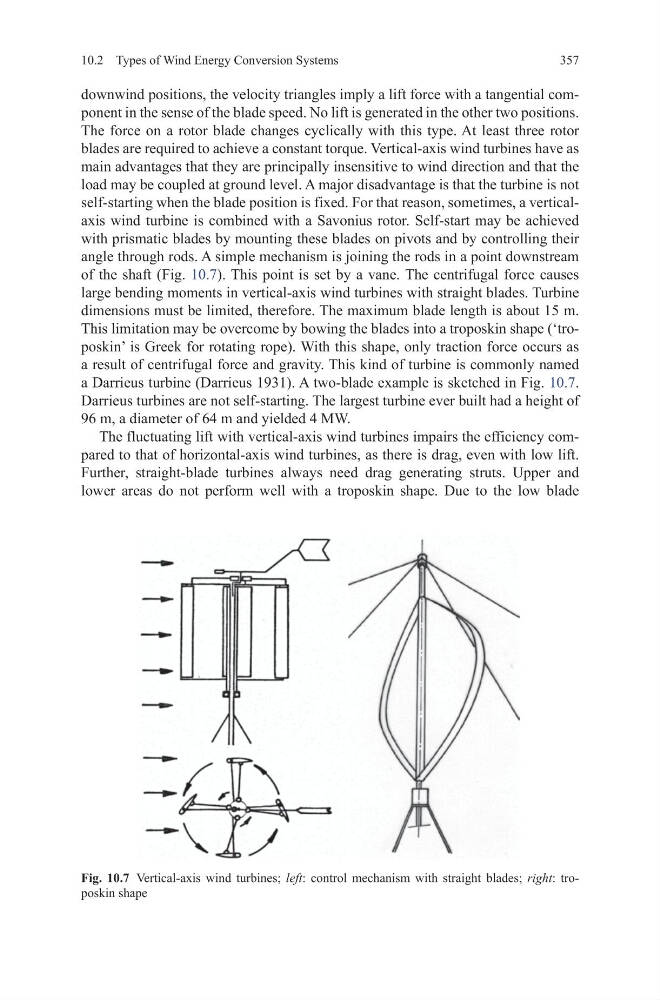
with prismatic blades by mounting these blades on pivots and by controlling their
angle through rods. A simple mechanism is joining the rods in a point downstream
of the shaft (Fig. 10.7). This point is set by a vane. The centrifugal force causes
large bending moments in vertical-axis wind turbines with straight blades. Turbine
dimensions must be limited, therefore. The maximum blade length is about 15 m.
This limitation may be overcome by bowing the blades into a troposkin shape (‘troposkin’ is Greek for rotating rope). With this shape, only traction force occurs as
a result of centrifugal force and gravity. This kind of turbine is commonly named
a Darrieus turbine (Darrieus 1931). A two-blade example is sketched in Fig. 10.7.
Darrieus turbines are not self-starting. The largest turbine ever built had a height of
96 m, a diameter of 64 m and yielded 4 MW.
The fluctuating lift with vertical-axis wind turbines impairs the efficiency compared to that of horizontal-axis wind turbines, as there is drag, even with low lift.
Further, straight-blade turbines always need drag generating struts. Upper and
lower areas do not perform well with a troposkin shape. Due to the low blade
Fig. 10.7 Vertical-axis wind turbines; left: control mechanism with straight blades; right: troposkin shape
10.2 Types of Wind Energy Conversion Systems
downwind positions, the velocity triangles imply a lift force with a tangential component in the sense of the blade speed. No lift is generated in the other two positions.
The force on a rotor blade changes cyclically with this type. At least three rotor
blades are required to achieve a constant torque. Vertical-axis wind turbines have as
main advantages that they are principally insensitive to wind direction and that the
load may be coupled at ground level. A major disadvantage is that the turbine is not
self-starting when the blade position is fixed. For that reason, sometimes, a verticalaxis wind turbine is combined with a Savonius rotor. Self-start may be achieved
with prismatic blades by mounting these blades on pivots and by controlling their
angle through rods. A simple mechanism is joining the rods in a point downstream
of the shaft (Fig. 10.7). This point is set by a vane. The centrifugal force causes
large bending moments in vertical-axis wind turbines with straight blades. Turbine
dimensions must be limited, therefore. The maximum blade length is about 15 m.
This limitation may be overcome by bowing the blades into a troposkin shape (‘troposkin’ is Greek for rotating rope). With this shape, only traction force occurs as
a result of centrifugal force and gravity. This kind of turbine is commonly named
a Darrieus turbine (Darrieus 1931). A two-blade example is sketched in Fig. 10.7.
Darrieus turbines are not self-starting. The largest turbine ever built had a height of
96 m, a diameter of 64 m and yielded 4 MW.
The fluctuating lift with vertical-axis wind turbines impairs the efficiency compared to that of horizontal-axis wind turbines, as there is drag, even with low lift.
Further, straight-blade turbines always need drag generating struts. Upper and
lower areas do not perform well with a troposkin shape. Due to the low blade
Fig. 10.7 Vertical-axis wind turbines; left: control mechanism with straight blades; right: troposkin shape