

351
10.2 Types of Wind Energy Conversion Systems
Most turbines have three rotor blades. At present (2014), machines of the
3 MW order are standard. All manufacturers are developing machines of the
5–6 MW order and larger. There is a strong tendency to even larger power. Larger
machines are principally cheaper per unit of power. Further, at greater hub height,
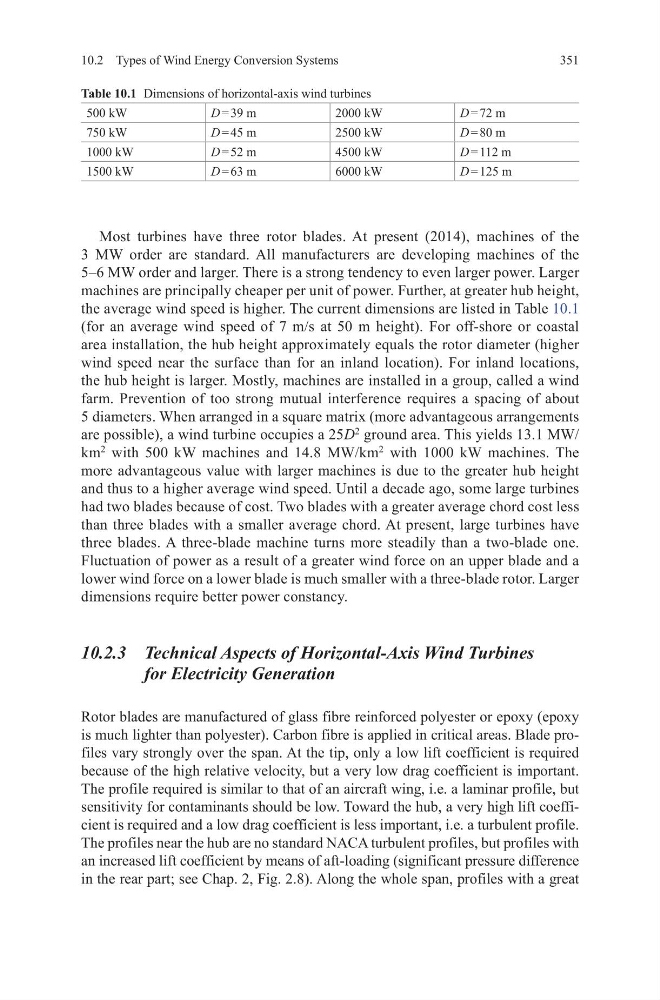
the average wind speed is higher. The current dimensions are listed in Table 10.1
(for an average wind speed of 7 m/s at 50 m height). For off-shore or coastal
area installation, the hub height approximately equals the rotor diameter (higher
wind speed near the surface than for an inland location). For inland locations,
the hub height is larger. Mostly, machines are installed in a group, called a wind
farm. Prevention of too strong mutual interference requires a spacing of about
5 diameters. When arranged in a square matrix (more advantageous arrangements
are possible), a wind turbine occupies a 25D
2
ground area. This yields 13.1 MW/
km
2
with 500 kW machines and 14.8 MW/km
2
with 1000 kW machines. The
more advantageous value with larger machines is due to the greater hub height
and thus to a higher average wind speed. Until a decade ago, some large turbines
had two blades because of cost. Two blades with a greater average chord cost less
than three blades with a smaller average chord. At present, large turbines have
three blades. A three-blade machine turns more steadily than a two-blade one.
Fluctuation of power as a result of a greater wind force on an upper blade and a
lower wind force on a lower blade is much smaller with a three-blade rotor. Larger
dimensions require better power constancy.
10.2.3 Technical Aspects of Horizontal-Axis Wind Turbines
for Electricity Generation
Rotor blades are manufactured of glass fibre reinforced polyester or epoxy (epoxy
is much lighter than polyester). Carbon fibre is applied in critical areas. Blade profiles vary strongly over the span. At the tip, only a low lift coefficient is required
because of the high relative velocity, but a very low drag coefficient is important.
The profile required is similar to that of an aircraft wing, i.e. a laminar profile, but
sensitivity for contaminants should be low. Toward the hub, a very high lift coefficient is required and a low drag coefficient is less important, i.e. a turbulent profile.
The profiles near the hub are no standard NACA turbulent profiles, but profiles with
an increased lift coefficient by means of aft-loading (significant pressure difference
in the rear part; see Chap. 2, Fig. 2.8). Along the whole span, profiles with a great
Table 10.1 Dimensions of horizontal-axis wind turbines
500 kW
D = 39 m
2000 kW
D = 72 m
750 kW
D = 45 m
2500 kW
D = 80 m
1000 kW
D = 52 m
4500 kW
D = 112 m
1500 kW
D = 63 m
6000 kW
D = 125 m
10.2 Types of Wind Energy Conversion Systems
Most turbines have three rotor blades. At present (2014), machines of the
3 MW order are standard. All manufacturers are developing machines of the
5–6 MW order and larger. There is a strong tendency to even larger power. Larger
machines are principally cheaper per unit of power. Further, at greater hub height,
the average wind speed is higher. The current dimensions are listed in Table 10.1
(for an average wind speed of 7 m/s at 50 m height). For off-shore or coastal
area installation, the hub height approximately equals the rotor diameter (higher
wind speed near the surface than for an inland location). For inland locations,
the hub height is larger. Mostly, machines are installed in a group, called a wind
farm. Prevention of too strong mutual interference requires a spacing of about
5 diameters. When arranged in a square matrix (more advantageous arrangements
are possible), a wind turbine occupies a 25D
2
ground area. This yields 13.1 MW/
km
2
with 500 kW machines and 14.8 MW/km
2
with 1000 kW machines. The
more advantageous value with larger machines is due to the greater hub height
and thus to a higher average wind speed. Until a decade ago, some large turbines
had two blades because of cost. Two blades with a greater average chord cost less
than three blades with a smaller average chord. At present, large turbines have
three blades. A three-blade machine turns more steadily than a two-blade one.
Fluctuation of power as a result of a greater wind force on an upper blade and a
lower wind force on a lower blade is much smaller with a three-blade rotor. Larger
dimensions require better power constancy.
10.2.3 Technical Aspects of Horizontal-Axis Wind Turbines
for Electricity Generation
Rotor blades are manufactured of glass fibre reinforced polyester or epoxy (epoxy
is much lighter than polyester). Carbon fibre is applied in critical areas. Blade profiles vary strongly over the span. At the tip, only a low lift coefficient is required
because of the high relative velocity, but a very low drag coefficient is important.
The profile required is similar to that of an aircraft wing, i.e. a laminar profile, but
sensitivity for contaminants should be low. Toward the hub, a very high lift coefficient is required and a low drag coefficient is less important, i.e. a turbulent profile.
The profiles near the hub are no standard NACA turbulent profiles, but profiles with
an increased lift coefficient by means of aft-loading (significant pressure difference
in the rear part; see Chap. 2, Fig. 2.8). Along the whole span, profiles with a great
Table 10.1 Dimensions of horizontal-axis wind turbines
500 kW
D = 39 m
2000 kW
D = 72 m
750 kW
D = 45 m
2500 kW
D = 80 m
1000 kW
D = 52 m
4500 kW
D = 112 m
1500 kW
D = 63 m
6000 kW
D = 125 m