

8 Pumps
306
speed becomes too high or too low, parallel or series connection has to be applied.
Internal forms of parallel or series connection are discussed below.
8.5.2 Internal Parallel Connection of Rotors
Internal parallel connection is normally done with 2 rotors forming a double-suction
rotor (Fig. 8.19), with volute-shaped suction chambers and a common spiral case
outlet. Double-suction rotors have the additional advantage that no axial force is exerted on the shaft (see Sect. 8.6.5). Double-suction pump casings are made with an
axial split (plane containing the shaft). In practise, this is mostly a horizontal split,
since typically these pumps are mounted with a horizontal shaft (Fig. 8.19). Suction
and discharge pipes are connected to the lower part of the casing in order to allow
easy opening of the pump for maintenance.
8.5.3 Internal Series Connection of Rotors: Multistage Pumps
Internal series connection results in a multistage pump (Fig. 8.20). Each stage encompasses a rotor, a diffuser and internal return channels. Rotors should be mounted as close as possible to each other in view of shaft rigidity. Return channels thus
feature short bends. This impairs the efficiency. In the traditional design, called a
ring-section pump (Fig. 8.20), the pump is composed of a series of discs, axially
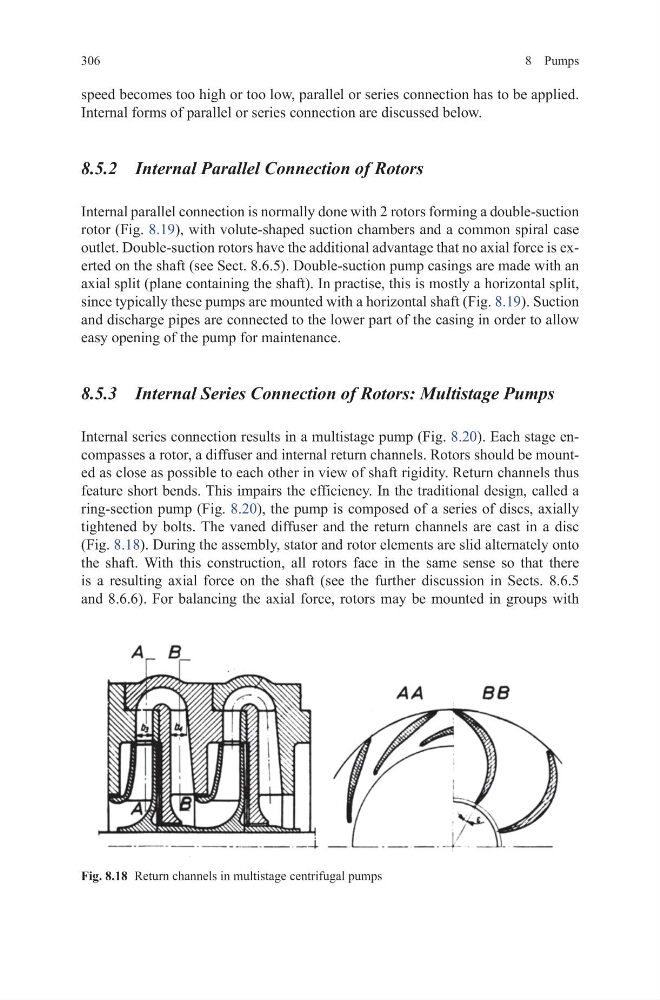
tightened by bolts. The vaned diffuser and the return channels are cast in a disc
(Fig. 8.18). During the assembly, stator and rotor elements are slid alternately onto
the shaft. With this construction, all rotors face in the same sense so that there
is a resulting axial force on the shaft (see the further discussion in Sects. 8.6.5
and 8.6.6). For balancing the axial force, rotors may be mounted in groups with
Fig. 8.18 Return channels in multistage centrifugal pumps
306
speed becomes too high or too low, parallel or series connection has to be applied.
Internal forms of parallel or series connection are discussed below.
8.5.2 Internal Parallel Connection of Rotors
Internal parallel connection is normally done with 2 rotors forming a double-suction
rotor (Fig. 8.19), with volute-shaped suction chambers and a common spiral case
outlet. Double-suction rotors have the additional advantage that no axial force is exerted on the shaft (see Sect. 8.6.5). Double-suction pump casings are made with an
axial split (plane containing the shaft). In practise, this is mostly a horizontal split,
since typically these pumps are mounted with a horizontal shaft (Fig. 8.19). Suction
and discharge pipes are connected to the lower part of the casing in order to allow
easy opening of the pump for maintenance.
8.5.3 Internal Series Connection of Rotors: Multistage Pumps
Internal series connection results in a multistage pump (Fig. 8.20). Each stage encompasses a rotor, a diffuser and internal return channels. Rotors should be mounted as close as possible to each other in view of shaft rigidity. Return channels thus
feature short bends. This impairs the efficiency. In the traditional design, called a
ring-section pump (Fig. 8.20), the pump is composed of a series of discs, axially
tightened by bolts. The vaned diffuser and the return channels are cast in a disc
(Fig. 8.18). During the assembly, stator and rotor elements are slid alternately onto
the shaft. With this construction, all rotors face in the same sense so that there
is a resulting axial force on the shaft (see the further discussion in Sects. 8.6.5
and 8.6.6). For balancing the axial force, rotors may be mounted in groups with
Fig. 8.18 Return channels in multistage centrifugal pumps