

8 Pumps
290
with
2
2
2 2
1
x d ,
a (
)16(
) Q ,
b
.
k
4
z
s W
l s
p
=
= +
=
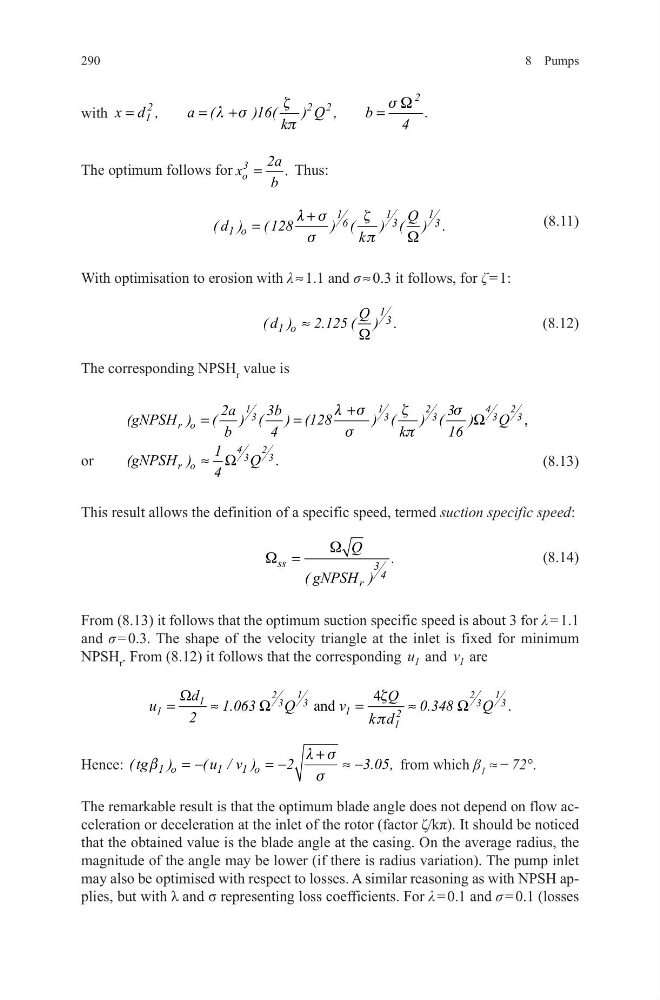
The optimum follows for
.
3
o
2a
x
b
=
Thus:
(8.11)
With optimisation to erosion with λ ≈ 1.1 and σ ≈ 0.3 it follows, for ζ = 1:
(8.12)
The corresponding NPSH r value is
or
(8.13)
This result allows the definition of a specific speed, termed suction specific speed:
(8.14)
From (8.13) it follows that the optimum suction specific speed is about 3 for λ = 1.1
and σ = 0.3. The shape of the velocity triangle at the inlet is fixed for minimum
NPSH r . From (8.12) it follows that the corresponding u 1 and v 1 are
Hence:
l s
b
s
+
= −
= −
≈ −
1 o
1
1 o
( tg )
( u / v )
2
3.05, from which β 1 ≈ − 72°.
The remarkable result is that the optimum blade angle does not depend on flow acceleration or deceleration at the inlet of the rotor (factor ζ/kπ). It should be noticed
that the obtained value is the blade angle at the casing. On the average radius, the
magnitude of the angle may be lower (if there is radius variation). The pump inlet
may also be optimised with respect to losses. A similar reasoning as with NPSH applies, but with λ and σ representing loss coefficients. For λ = 0.1 and σ = 0.1 (losses
l s
z
s
p
W
+
=
1
1
1
6
3
3
1 o
Q
( d ) ( 128
) (
) ( ) .
k
W
≈
1 3
1 o
Q
( d ) 2.125 ( ) .
,
.
4
1
1
2
2
3
3
3
3
3
r o
4
2
3
3
r o
2a
3b
3
(gNPSH ) (
) ( ) (128
) (
) (
)
Q
b
4
k
16
1
(gNPSH )
Q
4
l s
z
s
s
p
+
=
=
Ω
≈ Ω
W
W =
ss
3 4
r
Q
.
( gNPSH )
and
4
.
z
p
Ω
=
≈
Ω
=
≈
Ω
2
1
2
1
1
3
3
3
3
1
1
2
1
d
Q
u
1.063
Q
v
0.348
Q
2
k d
290
with
2
2
2 2
1
x d ,
a (
)16(
) Q ,
b
.
k
4
z
s W
l s
p
=
= +
=
The optimum follows for
.
3
o
2a
x
b
=
Thus:
(8.11)
With optimisation to erosion with λ ≈ 1.1 and σ ≈ 0.3 it follows, for ζ = 1:
(8.12)
The corresponding NPSH r value is
or
(8.13)
This result allows the definition of a specific speed, termed suction specific speed:
(8.14)
From (8.13) it follows that the optimum suction specific speed is about 3 for λ = 1.1
and σ = 0.3. The shape of the velocity triangle at the inlet is fixed for minimum
NPSH r . From (8.12) it follows that the corresponding u 1 and v 1 are
Hence:
l s
b
s
+
= −
= −
≈ −
1 o
1
1 o
( tg )
( u / v )
2
3.05, from which β 1 ≈ − 72°.
The remarkable result is that the optimum blade angle does not depend on flow acceleration or deceleration at the inlet of the rotor (factor ζ/kπ). It should be noticed
that the obtained value is the blade angle at the casing. On the average radius, the
magnitude of the angle may be lower (if there is radius variation). The pump inlet
may also be optimised with respect to losses. A similar reasoning as with NPSH applies, but with λ and σ representing loss coefficients. For λ = 0.1 and σ = 0.1 (losses
l s
z
s
p
W
+
=
1
1
1
6
3
3
1 o
Q
( d ) ( 128
) (
) ( ) .
k
W
≈
1 3
1 o
Q
( d ) 2.125 ( ) .
,
.
4
1
1
2
2
3
3
3
3
3
r o
4
2
3
3
r o
2a
3b
3
(gNPSH ) (
) ( ) (128
) (
) (
)
Q
b
4
k
16
1
(gNPSH )
Q
4
l s
z
s
s
p
+
=
=
Ω
≈ Ω
W
W =
ss
3 4
r
Q
.
( gNPSH )
and
4
.
z
p
Ω
=
≈
Ω
=
≈
Ω
2
1
2
1
1
3
3
3
3
1
1
2
1
d
Q
u
1.063
Q
v
0.348
Q
2
k d