

7.2 Characteristic Numbers of Turbomachines
261
it should be mentioned that turbomachines are not always designed for optimum
efficiency.
7.2.5 Shape of Characteristic Curves
Turbomachine characteristics have a shape depending on the value of the specific
speed. We illustrate this for pumps. In Chap. 1 we learned that rotor work may be
written as the sum of three kinetic energy difference terms:
The lower the specific speed, the more radial-type the meridional shape and the
more dominant the centrifugal term (first term) is in the rotor work. This term does
not vary with the flow rate. The consequence is that the lower the specific speed,
the flatter the head is as a function of the flow rate and the flatter the efficiency is
as a function of the flow rate. This is illustrated in Fig. 7.8, based on pump characteristics published in the books of Pfleiderer [9] and Dietzel [4]. At a high specific
speed, the energy rise as a function of the flow rate typically has a maximum and a
minimum. This is due to circulating flows with operation at very low net flow rate,
as sketched in Fig. 7.9. With mixed flow and axial machines, the consequence is an
increase of the centrifugal term in the rotor work at very low flow rate. Circulating
flows at inlet and outlet occur with purely radial rotors as well, but do not influ2
2
2
2
2
2
2
1
2
1
1
2
u u
v v
w w
W
.
2
2
2
D
−
−
−
=
+
+
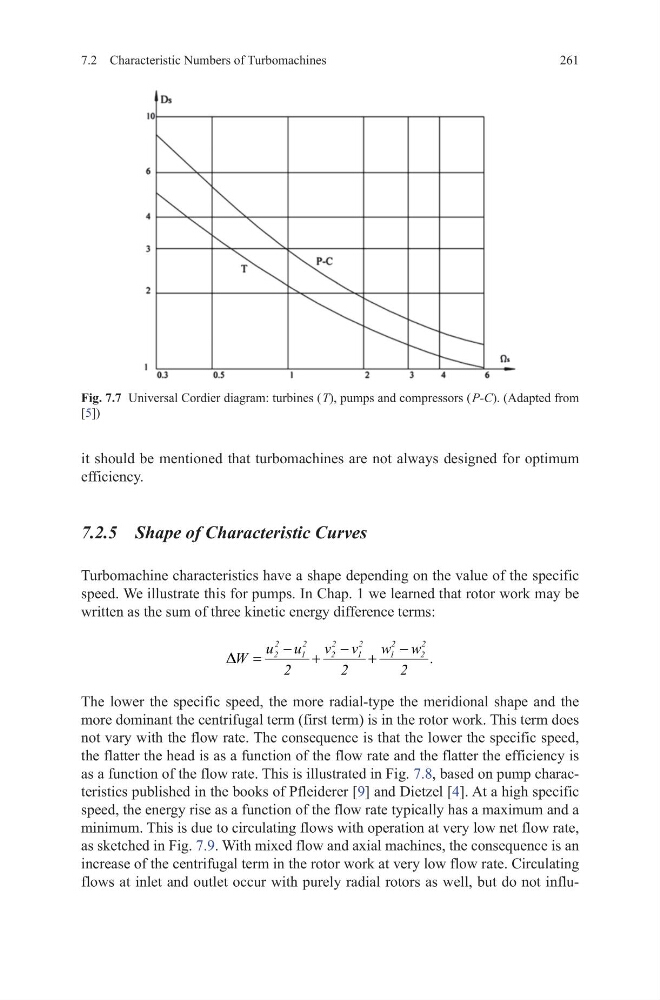
Fig. 7.7 Universal Cordier diagram: turbines ( T), pumps and compressors ( P-C). (Adapted from
[5])
261
it should be mentioned that turbomachines are not always designed for optimum
efficiency.
7.2.5 Shape of Characteristic Curves
Turbomachine characteristics have a shape depending on the value of the specific
speed. We illustrate this for pumps. In Chap. 1 we learned that rotor work may be
written as the sum of three kinetic energy difference terms:
The lower the specific speed, the more radial-type the meridional shape and the
more dominant the centrifugal term (first term) is in the rotor work. This term does
not vary with the flow rate. The consequence is that the lower the specific speed,
the flatter the head is as a function of the flow rate and the flatter the efficiency is
as a function of the flow rate. This is illustrated in Fig. 7.8, based on pump characteristics published in the books of Pfleiderer [9] and Dietzel [4]. At a high specific
speed, the energy rise as a function of the flow rate typically has a maximum and a
minimum. This is due to circulating flows with operation at very low net flow rate,
as sketched in Fig. 7.9. With mixed flow and axial machines, the consequence is an
increase of the centrifugal term in the rotor work at very low flow rate. Circulating
flows at inlet and outlet occur with purely radial rotors as well, but do not influ2
2
2
2
2
2
2
1
2
1
1
2
u u
v v
w w
W
.
2
2
2
D
−
−
−
=
+
+
Fig. 7.7 Universal Cordier diagram: turbines ( T), pumps and compressors ( P-C). (Adapted from
[5])