

7 Dynamic Similitude
258
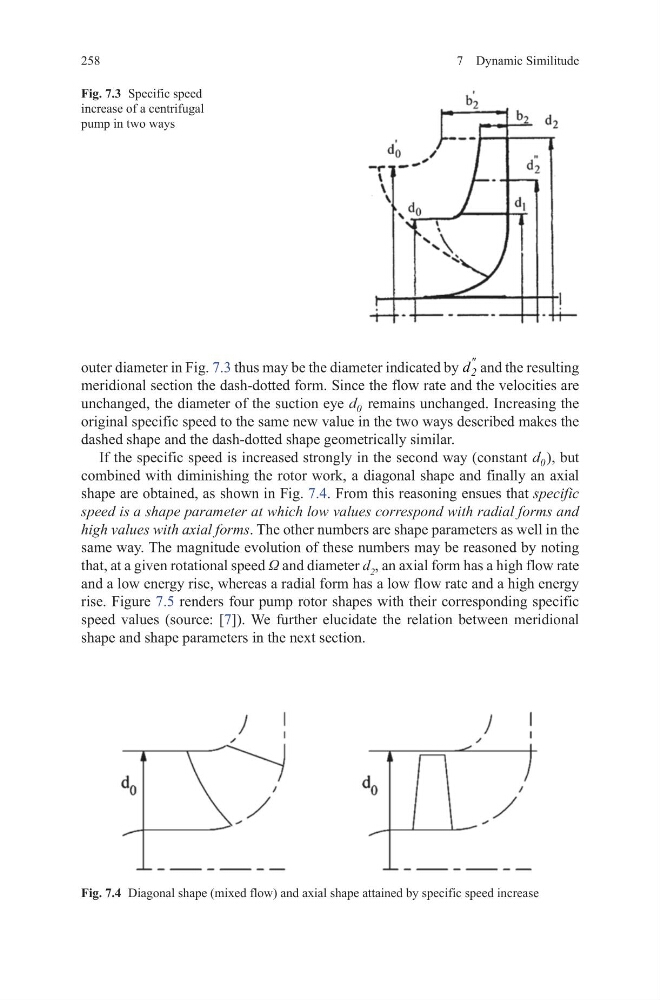
outer diameter in Fig. 7.3 thus may be the diameter indicated by
"
2
d and the resulting
meridional section the dash-dotted form. Since the flow rate and the velocities are
unchanged, the diameter of the suction eye d 0 remains unchanged. Increasing the
original specific speed to the same new value in the two ways described makes the
dashed shape and the dash-dotted shape geometrically similar.
If the specific speed is increased strongly in the second way (constant d 0 ), but
combined with diminishing the rotor work, a diagonal shape and finally an axial
shape are obtained, as shown in Fig. 7.4. From this reasoning ensues that specific
speed is a shape parameter at which low values correspond with radial forms and
high values with axial forms. The other numbers are shape parameters as well in the
same way. The magnitude evolution of these numbers may be reasoned by noting
that, at a given rotational speed Ω and diameter d 2 , an axial form has a high flow rate
and a low energy rise, whereas a radial form has a low flow rate and a high energy
rise. Figure 7.5 renders four pump rotor shapes with their corresponding specific
speed values (source: [7]). We further elucidate the relation between meridional
shape and shape parameters in the next section.
Fig. 7.3 Specific speed
increase of a centrifugal
pump in two ways
Fig. 7.4 Diagonal shape (mixed flow) and axial shape attained by specific speed increase
258
outer diameter in Fig. 7.3 thus may be the diameter indicated by
"
2
d and the resulting
meridional section the dash-dotted form. Since the flow rate and the velocities are
unchanged, the diameter of the suction eye d 0 remains unchanged. Increasing the
original specific speed to the same new value in the two ways described makes the
dashed shape and the dash-dotted shape geometrically similar.
If the specific speed is increased strongly in the second way (constant d 0 ), but
combined with diminishing the rotor work, a diagonal shape and finally an axial
shape are obtained, as shown in Fig. 7.4. From this reasoning ensues that specific
speed is a shape parameter at which low values correspond with radial forms and
high values with axial forms. The other numbers are shape parameters as well in the
same way. The magnitude evolution of these numbers may be reasoned by noting
that, at a given rotational speed Ω and diameter d 2 , an axial form has a high flow rate
and a low energy rise, whereas a radial form has a low flow rate and a high energy
rise. Figure 7.5 renders four pump rotor shapes with their corresponding specific
speed values (source: [7]). We further elucidate the relation between meridional
shape and shape parameters in the next section.
Fig. 7.3 Specific speed
increase of a centrifugal
pump in two ways
Fig. 7.4 Diagonal shape (mixed flow) and axial shape attained by specific speed increase