

7.2 Characteristic Numbers of Turbomachines
255
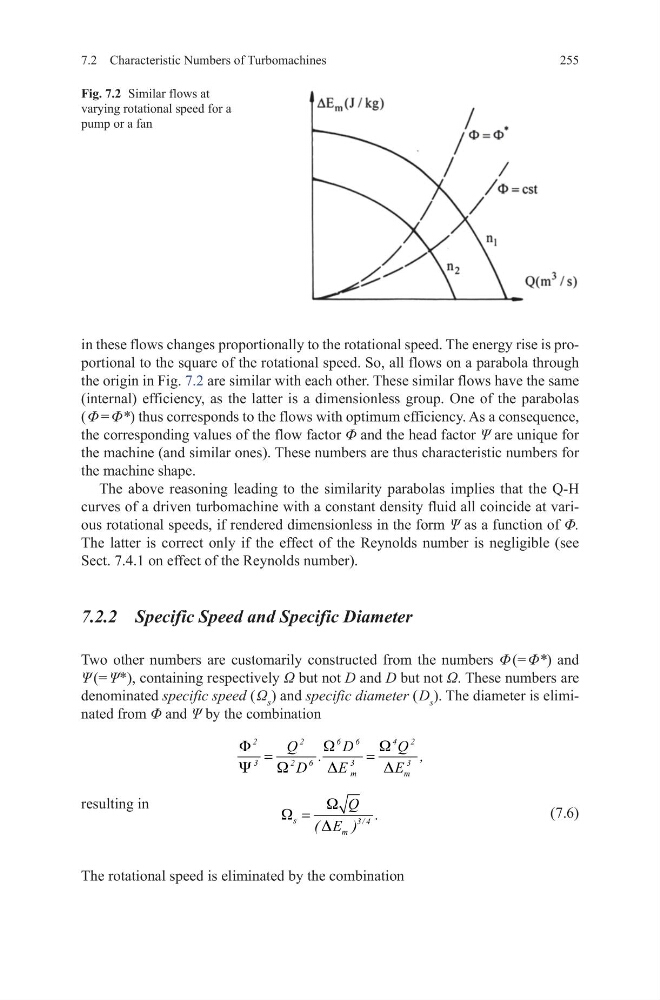
in these flows changes proportionally to the rotational speed. The energy rise is proportional to the square of the rotational speed. So, all flows on a parabola through
the origin in Fig. 7.2 are similar with each other. These similar flows have the same
(internal) efficiency, as the latter is a dimensionless group. One of the parabolas
( Φ = Φ*) thus corresponds to the flows with optimum efficiency. As a consequence,
the corresponding values of the flow factor Φ and the head factor Ψ are unique for
the machine (and similar ones). These numbers are thus characteristic numbers for
the machine shape.
The above reasoning leading to the similarity parabolas implies that the Q-H
curves of a driven turbomachine with a constant density fluid all coincide at various rotational speeds, if rendered dimensionless in the form Ψ as a function of Φ.
The latter is correct only if the effect of the Reynolds number is negligible (see
Sect. 7.4.1 on effect of the Reynolds number).
7.2.2 Specific Speed and Specific Diameter
Two other numbers are customarily constructed from the numbers Φ (= Φ*) and
Ψ (= Ψ*), containing respectively Ω but not D and D but not Ω. These numbers are
denominated specific speed ( Ω s ) and specific diameter ( D s ). The diameter is eliminated from Φ and Ψ by the combination
resulting in
(7.6)
The rotational speed is eliminated by the combination
2
2
6
6
4
2
3
2
6
3
3
m
m
Q
D
Q
.
,
D
E
E
F
W
W
Y
W
D
D
=
=
s
3/ 4
m
Q .
( E )
W
W
D
=
Fig. 7.2 Similar flows at
varying rotational speed for a
pump or a fan
255
in these flows changes proportionally to the rotational speed. The energy rise is proportional to the square of the rotational speed. So, all flows on a parabola through
the origin in Fig. 7.2 are similar with each other. These similar flows have the same
(internal) efficiency, as the latter is a dimensionless group. One of the parabolas
( Φ = Φ*) thus corresponds to the flows with optimum efficiency. As a consequence,
the corresponding values of the flow factor Φ and the head factor Ψ are unique for
the machine (and similar ones). These numbers are thus characteristic numbers for
the machine shape.
The above reasoning leading to the similarity parabolas implies that the Q-H
curves of a driven turbomachine with a constant density fluid all coincide at various rotational speeds, if rendered dimensionless in the form Ψ as a function of Φ.
The latter is correct only if the effect of the Reynolds number is negligible (see
Sect. 7.4.1 on effect of the Reynolds number).
7.2.2 Specific Speed and Specific Diameter
Two other numbers are customarily constructed from the numbers Φ (= Φ*) and
Ψ (= Ψ*), containing respectively Ω but not D and D but not Ω. These numbers are
denominated specific speed ( Ω s ) and specific diameter ( D s ). The diameter is eliminated from Φ and Ψ by the combination
resulting in
(7.6)
The rotational speed is eliminated by the combination
2
2
6
6
4
2
3
2
6
3
3
m
m
Q
D
Q
.
,
D
E
E
F
W
W
Y
W
D
D
=
=
s
3/ 4
m
Q .
( E )
W
W
D
=
Fig. 7.2 Similar flows at
varying rotational speed for a
pump or a fan