

169
4.7 Isentropic and Polytropic Efficiencies
The generated kinetic energy (4.24) is
(4.30)
The generated kinetic energy following the isentropic path is similarly
(4.31)
The integral (4.28) on a polytropic path with exponent n results in
(4.32)
For n < γ, it is verified that
So the isentropic efficiency (ratio of
2
1 1
2 v to 1 2 1
2
v s ) exceeds the polytropic or
infinitesimal efficiency (ratio of 1 2 1
2
v to
r
h
D
−
). The reason why both efficiency
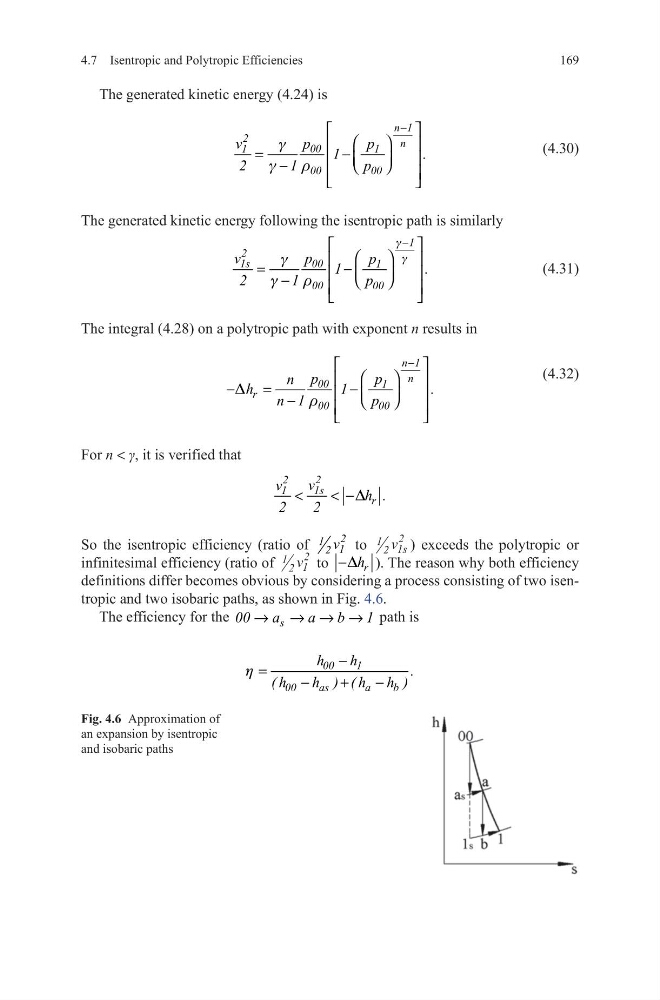
definitions differ becomes obvious by considering a process consisting of two isentropic and two isobaric paths, as shown in Fig. 4.6.
The efficiency for the
s
00 a
a b 1
→ → → → path is
n 1
2
n
00
1
1
00
00
p
v
p
1
.
2
1
p
g
g
r
−
=
−
−
1
2
1s
00
1
00
00
v
p
p
1
.
2
1
p
g
g
g
g
r
−
=
−
−
n 1
n
00
1
r
00
00
p
p
n
h
1
.
n 1
p
D
r
−
−
=
−
−
2
2
1s
1
r
v
v
h .
2
2
D
<
< −
00
1
00
as
a
b
h
h
.
( h
h ) ( h h )
h
−
=
−
+
−
Fig. 4.6 Approximation of
an expansion by isentropic
and isobaric paths
4.7 Isentropic and Polytropic Efficiencies
The generated kinetic energy (4.24) is
(4.30)
The generated kinetic energy following the isentropic path is similarly
(4.31)
The integral (4.28) on a polytropic path with exponent n results in
(4.32)
For n < γ, it is verified that
So the isentropic efficiency (ratio of
2
1 1
2 v to 1 2 1
2
v s ) exceeds the polytropic or
infinitesimal efficiency (ratio of 1 2 1
2
v to
r
h
D
−
). The reason why both efficiency
definitions differ becomes obvious by considering a process consisting of two isentropic and two isobaric paths, as shown in Fig. 4.6.
The efficiency for the
s
00 a
a b 1
→ → → → path is
n 1
2
n
00
1
1
00
00
p
v
p
1
.
2
1
p
g
g
r
−
=
−
−
1
2
1s
00
1
00
00
v
p
p
1
.
2
1
p
g
g
g
g
r
−
=
−
−
n 1
n
00
1
r
00
00
p
p
n
h
1
.
n 1
p
D
r
−
−
=
−
−
2
2
1s
1
r
v
v
h .
2
2
D
<
< −
00
1
00
as
a
b
h
h
.
( h
h ) ( h h )
h
−
=
−
+
−
Fig. 4.6 Approximation of
an expansion by isentropic
and isobaric paths